Stocks
What Is a Stock Bull Market?
Quick answer
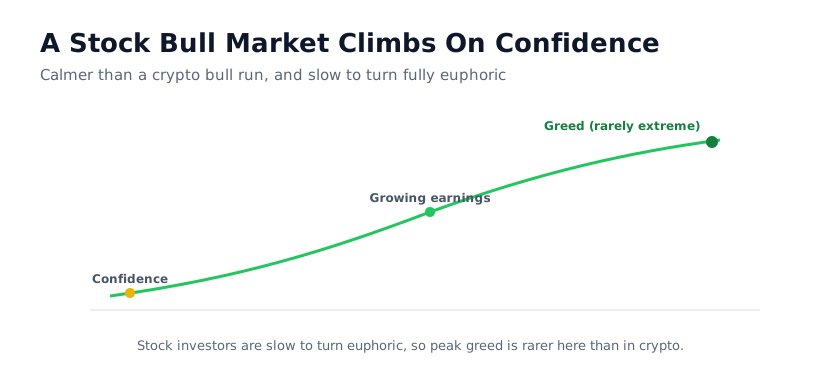
A stock bull market is a sustained rise in share prices, usually over months or years, powered by confidence and growing earnings. It is often defined as a rise of 20% or more from a low, and it tends to last far longer than a bear market. It is calmer than a crypto bull run, because equities have closing bells and a more institutional crowd, and notably, stock investors are slow to turn fully euphoric, so peak greed is rarer here than in crypto. This is education, not financial advice.
CFGI data
The equity crowd is slow to celebrate, even in a bull market. CFGI tracked a 21% S&P 500 year from June 2025 to June 2026 that produced not one extreme-greed close, the score peaking at 78 on 3 July 2025. The Stock Fear and Greed Index runs 0 to 100, updated daily since 2021.
Source: CFGI dataset, 2021 to June 2026.
Key takeaways
- A stock bull market is a sustained rise in share prices.
- It is often defined as a 20%+ rise from a low.
- It is powered by confidence and growing earnings.
- It is calmer than a crypto bull run and lasts longer than bears.
- Stock investors are slow to turn fully euphoric.
What Is a Stock Bull Market?
A bull market is an extended climb in prices, the opposite of a bear market. In stocks it usually unfolds over months or years, supported by a growing economy and rising company earnings. The name is often said to come from the way a bull thrusts its horns upward. Like any market, it runs on mood as well as fundamentals: confidence draws buyers in, which lifts prices, which builds more confidence, a virtuous circle that can sustain a rising market for years.
What Defines a Bull Market
There is no official rulebook, but the common convention is that a bull market begins once prices have risen 20% from a recent low, mirroring the 20% fall that defines a bear market. More than the exact number, what defines a bull market is the sustained character of the advance: a prevailing uptrend of higher highs and higher lows, punctuated by the occasional correction, that keeps reasserting itself over time. A defining feature is also their longevity: historically, stock bull markets have lasted much longer than bear markets, often years rather than months, which reflects the simple fact that, over the long run, economies grow and company earnings rise. The market’s default direction, given enough time, is up.
The Psychology of a Bull Market
A bull market moves through a recognisable emotional arc. It typically begins in disbelief, while the scars of the previous decline are still fresh and few trust the recovery. As prices keep rising, disbelief gives way to hope, then optimism, then belief, and finally, near the top, euphoria. This is the origin of the saying that bull markets "climb a wall of worry": the most durable advances begin amid fear and skepticism, with plenty of doubters who must gradually be won over, and their delayed buying provides fuel. The danger arrives only at the end, when the last doubters have converted and euphoria leaves no one left to convince. A bull market dies of optimism, not of fear.
Bull Markets Climb a Wall of Worry
The healthiest advances start in disbelief and fear, with doubters still to convert. The danger comes at the euphoric end, when everyone already believes and there is no one left to win over.
How It Differs From a Crypto Bull Run
Equity bull markets tend to be steadier than crypto bull markets. Stocks have closing bells that impose an overnight pause, a larger institutional base that tempers the swings, and real earnings underneath that anchor prices to something tangible. Crypto, young and trading 24/7 with little fundamental anchor, tends to run hotter and crash harder, with parabolic surges and brutal 70 to 80% drawdowns. So while both are bull markets driven by greed, a stock bull market is more of a steady, years-long climb, where a crypto bull run is a faster, wilder ride. The difference shows up directly in sentiment: crypto reaches euphoric extremes far more readily than equities do.
Why Is Peak Greed Rarer In Stocks?
Because the equity crowd is cautious by nature: quick to panic, slow to celebrate. CFGI data captured this asymmetry strikingly in a 21% S&P 500 year that produced not a single euphoric close, the score peaked at 78 in July 2025 but never tipped into Extreme Greed. Greed built, but it rarely reached the extreme. This fits the broader pattern that fear, driven by loss aversion, runs to deeper extremes than greed: the equity score has plunged to 3 but topped out at 83. The practical upshot is that a true Extreme Greed reading in stocks is a genuinely notable, relatively rare event, and worth heeding when it does appear. Track the equity mood on the Stock Fear and Greed Index.
Frequently asked questions
What is a stock bull market?
A sustained rise in share prices, usually over months or years, powered by a growing economy and rising earnings. It is often defined as a rise of 20% or more from a recent low, and tends to last far longer than a bear market.
How long do stock bull markets last?
There is no fixed length; some have run for years, far longer than bear markets, reflecting that economies and earnings grow over time. They tend to last as long as confidence and earnings growth hold up. The past is not a forecast.
Why are stock bull markets calmer than crypto?
Stocks have closing bells, a larger institutional base and real earnings underneath, so swings tend to be less violent than in young, 24/7 crypto markets, which run hotter and crash harder.
Do stocks reach extreme greed?
Rarely. CFGI data shows the equity crowd is slow to turn euphoric: a 21% S&P 500 year produced no euphoric close, peaking at 78. A true extreme-greed reading is a notable event in stocks. This is education, not financial advice.
CFGI.io, Market sentiment research
The CFGI research team builds and maintains the CFGI Fear and Greed Index: a 0 to 100 sentiment score from 10 sub-indicators across hundreds of crypto assets and the equity market, refreshed every 15 minutes. We have tracked market emotion through multiple full crypto and equity cycles.
Think we missed something?
Spotted a gap, disagree with a take, or think we should cover a new topic? Message us and we'll act on your input.
Message us on TelegramKeep reading
This article is educational and is not financial advice. Crypto and equities are volatile and you can lose money. See our disclaimer.