Stocks
What Is the FTSE 100?
Quick answer
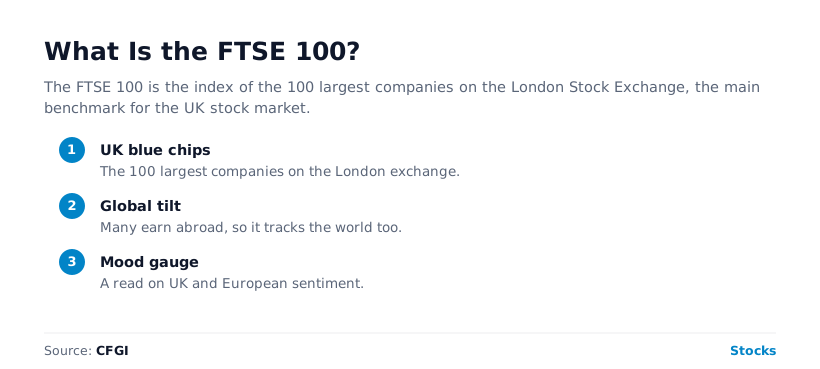
The FTSE 100 is a stock index of the 100 largest companies listed on the London Stock Exchange by market value. Pronounced "footsie", it is the headline benchmark for the UK stock market, much as the S&P 500 is for the US. But it has a twist: because most of its companies earn the bulk of their revenue abroad, the FTSE 100 often reflects the world economy, commodity prices and the value of the pound as much as Britain itself, which makes it a global gauge wearing a national label.
CFGI data
The FTSE 100 is a global mood gauge, and CFGI scores that mood live. Because so many of its members earn abroad, its sentiment tracks world risk appetite, the same risk-on, risk-off swing CFGI puts on a 0 to 100 scale, daily for equities, rather than the health of the UK economy alone.
Source: CFGI methodology, 10-input 0 to 100 model.
Key takeaways
- The FTSE 100 tracks the 100 largest London-listed companies by market value.
- It is the main UK benchmark, nicknamed "the Footsie".
- Most of its firms earn abroad, so it is a global, not just UK, gauge.
- A weaker pound can lift it, by boosting overseas earnings in sterling.
- It leans toward value and dividends, with little technology exposure.
The UK’s Headline Index
Like the S&P 500 in the US, the FTSE 100 is a market index that bundles the biggest listed companies, here the 100 largest on the London Stock Exchange, into a single number, weighted by market value so the largest firms count most. Launched in 1984, it is the index quoted when people ask how the UK market did today, and "the Footsie" has become shorthand for British shares as a whole.
A Global Gauge In Disguise
Here is the quirk that surprises newcomers: the FTSE 100 is a poor barometer of the British economy. Many of its members, global miners, energy giants, international banks and consumer-goods multinationals, earn most of their revenue abroad, often in US dollars. So the index tends to move with global growth, commodity prices and currencies far more than with how shoppers on a UK high street are faring. Its sentiment is, in effect, a read on the wider world dressed up as a national benchmark.
The Weak-Pound Paradox
This global character produces one genuinely counterintuitive effect. A falling pound, usually seen as bad news for Britain, often lifts the FTSE 100. The reason is simple arithmetic: most of its companies earn in dollars and other foreign currencies but report their results in pounds, so when sterling weakens, those overseas earnings translate into more pounds and the index rises. It is one of the few places in finance where bad domestic news, a sliding currency, can show up as a higher headline number. Understanding it explains why the FTSE 100 sometimes climbs on days the UK economy looks shaky.
The Mental Flip
For most national indices, a weaker currency is a headwind. For the FTSE 100, with its dollar-earning multinationals, it is often a tailwind. The index and the economy can move in opposite directions.
What Is Inside: Old Economy and Income
The FTSE 100 has a very different make-up from the US benchmarks. It is heavy in financials, energy, mining, healthcare, utilities and consumer staples, the "old economy", and notably light on the big technology names that dominate the S&P 500. That gives it a value tilt and, crucially, a reputation as an income index: it has long offered a higher dividend yield than the US market, around 3% or more, with its companies forecast to pay out tens of billions of pounds in dividends in a single year. For investors who prize steady income over rapid growth, that profile is the FTSE 100’s main appeal.
FTSE 100 Versus S&P 500
| FTSE 100 | S&P 500 | |
|---|---|---|
| Market | UK (but global earnings) | US (largely global too) |
| Tilt | Value, income | Growth, technology |
| Dividend yield | Higher (around 3%+) | Lower |
| Tech exposure | Low | High |
Two very different benchmarks.
The trade-off is clear in the record: the FTSE 100’s lack of big technology names meant it badly lagged the S&P 500 through the tech-driven bull market of the 2010s. In return, it offers more income and a different, more defensive flavour of exposure, which can shine when value and commodities are in favour.
How to Read Or Invest In It
Most people get FTSE 100 exposure through a low-cost index fund or ETF that tracks it, rather than buying all 100 shares. Its membership is reviewed every quarter, with companies that have grown promoted in and shrinking ones dropped, so the list reflects the current giants of the London market. When reading the FTSE 100, the key habit is to remember what it really is: less a thermometer for Britain than a globally exposed, income-rich, value-tilted slice of the world’s biggest old-economy companies that happen to be listed in London.
The FTSE 100 and Sentiment
Because its fortunes are tied to global growth, commodities and currencies, the FTSE 100 is a useful read on worldwide risk appetite, not just British confidence. When global sentiment turns risk-on, its miners and banks tend to rally; when fear spreads, they fall with everything else. That swing is the same mood a Stock Fear and Greed Index measures on a 0 to 100 scale. Reading the FTSE alongside the gauge, and bearing in mind the pound’s paradoxical effect, gives a fuller picture of what is really driving the index on any given day.
Frequently asked questions
What is the FTSE 100?
A stock index of the 100 largest companies on the London Stock Exchange by market value, the headline benchmark for the UK stock market, nicknamed "the Footsie".
Why does a weak pound lift the FTSE 100?
Because most of its companies earn in foreign currencies but report in pounds. When sterling weakens, those overseas earnings translate into more pounds, raising the index, even though a weak pound is usually bad news for the UK economy.
How is the FTSE 100 different from the S&P 500?
The FTSE 100 leans toward value, income and old-economy sectors with little technology, and offers a higher dividend yield. The S&P 500 is more growth- and tech-heavy, which is why the FTSE lagged it through the 2010s tech boom.
Does the FTSE 100 reflect the UK economy?
Not closely. Because so many of its companies earn most of their revenue abroad, it tracks global growth, commodities and the pound more than the domestic UK economy. This is education, not financial advice.
CFGI.io, Market sentiment research
The CFGI research team builds and maintains the CFGI Fear and Greed Index: a 0 to 100 sentiment score from 10 sub-indicators across hundreds of crypto assets and the equity market, refreshed every 15 minutes. We have tracked market emotion through multiple full crypto and equity cycles.
Think we missed something?
Spotted a gap, disagree with a take, or think we should cover a new topic? Message us and we'll act on your input.
Message us on TelegramKeep reading
This article is educational and is not financial advice. Crypto and equities are volatile and you can lose money. See our disclaimer.