Markets
What Is Market Sentiment?
Quick answer
Market sentiment is the overall attitude of investors toward a market at a given time, from extreme fear to extreme greed. It is the emotional layer on top of the fundamentals, and over short horizons it moves price more than the fundamentals do. Measuring it from behaviour turns a vague feeling into a number you can compare across time and across markets, which is exactly what a Fear and Greed Index does. This is education, not financial advice.
CFGI data
Different markets carry different moods, and CFGI measures both the same way. On 5 February 2026 the crypto market hit an all-time low of 12, Extreme Fear, while the stock market sat at 35, ordinary Fear. One company scoring both crowds on the same 0 to 100 scale, since March 2022, is what makes the comparison possible.
Source: CFGI dataset, March 2022 to June 2026.
Key takeaways
- Sentiment is the market mood, from extreme fear to extreme greed.
- It sits on top of fundamentals and drives the short run.
- In the long run, fundamentals reassert themselves.
- It is measured from behaviour, not opinion polls.
- Different markets can hold very different moods at the same moment.
What Is Market Sentiment?
Market sentiment is how investors collectively feel about a market right now. It ranges from extreme fear, when everyone wants out, to extreme greed, when everyone wants in. It often diverges from what the fundamentals alone would justify, which is exactly why a strong company’s stock can fall and a shaky one can rally. Sentiment is, in short, the crowd’s mood, and because markets are made of people, that mood is one of the most powerful forces acting on price from moment to moment.
Sentiment Versus Fundamentals
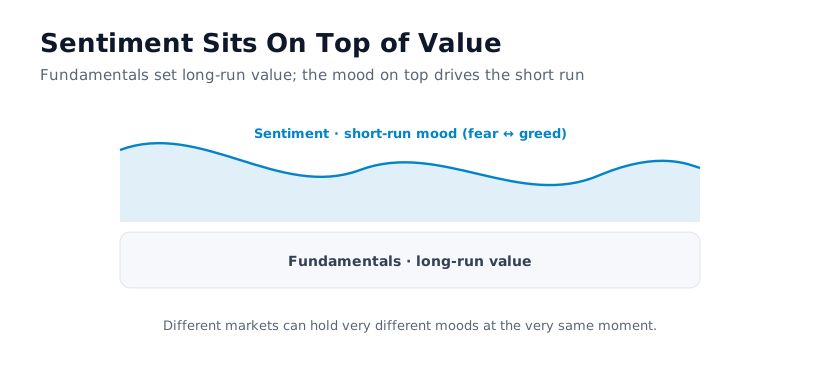
It helps to picture a market as two layers. Underneath sit the fundamentals, the real, measurable value of an asset: a company’s earnings, a coin’s adoption and utility. On top sits sentiment, the shifting mood that decides how much the crowd is willing to pay for those fundamentals today. The legendary investor Benjamin Graham captured the relationship perfectly: in the short run, the market is a "voting machine", driven by popularity and emotion, but in the long run it is a "weighing machine", which eventually settles on real value. This is the key to understanding sentiment: over days, weeks and months it can push prices far from fair value in either direction, but over years, fundamentals reassert themselves. Sentiment dominates the short run; value wins the long one.
Voting Machine, Then Weighing Machine
Short-term, the market votes on mood and prices can detach from value; long-term, it weighs real fundamentals. Sentiment rules the near term, value the long term.
How Is Sentiment Measured?
By reading behaviour, not asking opinions. Volatility, momentum, volume, breadth, safe-haven demand and, in crypto, on-chain flows all reveal how the crowd is acting, and actions are far more honest than words: what people do with their money tells you more than what they say in a survey. CFGI combines 10 such signals into a single score from 0 to 100, the Fear and Greed Index. The value of doing this is that it converts a vague, unmeasurable feeling, "the mood seems nervous", into a concrete, comparable number, so you can say precisely how fearful the crowd is today versus a month ago, or how one market compares with another, rather than relying on guesswork and gut feel.
Why Sentiment Matters
Sentiment matters because it is what actually moves prices in the timeframes most people experience. It is the engine of the short-term swings, the rallies and sell-offs that fundamentals alone cannot explain, and because crowds overshoot, it is what drives prices to the extremes of bubble and panic. Those extremes are precisely where the savvy find their edge: a market gripped by Extreme Fear is often oversold, and one lost in Extreme Greed is often overbought, the raw material of contrarian thinking. Sentiment also explains the divergences a price chart alone hides, like a market that keeps rising even as conviction quietly drains away. And perhaps most usefully, understanding sentiment is a mirror: it reminds you that you are part of the crowd, feeling the same fear and greed, which is the first step to not being ruled by them.
Why Does Sentiment Differ Across Markets?
Crowds are not the same. The crypto crowd swings to both extremes fast and trades 24/7; the equity crowd panics quickly but is slow to turn euphoric. Because CFGI scores both on one scale, the contrast is visible: on 5 February 2026 crypto sat at an all-time low of 12 while stocks held at 35, two very different moods at the same instant. That is the value of measuring why emotions move markets consistently: you can compare moods rather than guess, seeing whether a wave of fear is contained to one market or sweeping across all of them. Different assets, with different participants, leverage and maturity, simply feel differently at the same moment, and a single common scale is what lets you read those differences instead of guessing at them.
Frequently asked questions
What is market sentiment?
The overall attitude of investors toward a market at a given time, from extreme fear to extreme greed. It is the emotional layer on top of the fundamentals, and over short horizons it moves price more than the fundamentals do.
What is the difference between sentiment and fundamentals?
Fundamentals are the real, measurable value of an asset (earnings, adoption); sentiment is the mood that decides what the crowd will pay for them today. As Benjamin Graham put it, the market is a "voting machine" in the short run and a "weighing machine" in the long run.
How is market sentiment measured?
Through measurable behaviour: volatility, momentum, volume, breadth, safe-haven demand and on-chain flows. CFGI combines 10 such signals into a single 0 to 100 score per market and per asset, turning a vague feeling into a comparable number.
Can two markets have different sentiment at once?
Yes. On 5 February 2026, CFGI scored crypto at an all-time low of 12 while the stock market sat at 35. Different crowds, different moods, measured the same way. This is education, not financial advice.
CFGI.io, Market sentiment research
The CFGI research team builds and maintains the CFGI Fear and Greed Index: a 0 to 100 sentiment score from 10 sub-indicators across hundreds of crypto assets and the equity market, refreshed every 15 minutes. We have tracked market emotion through multiple full crypto and equity cycles.
Think we missed something?
Spotted a gap, disagree with a take, or think we should cover a new topic? Message us and we'll act on your input.
Message us on TelegramKeep reading
This article is educational and is not financial advice. Crypto and equities are volatile and you can lose money. See our disclaimer.