Markets
What Is Liquidity?
Quick answer
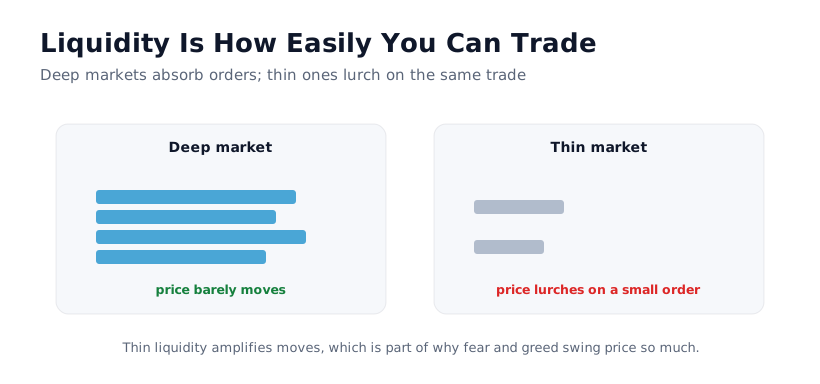
Liquidity is how easily an asset can be bought or sold without moving its price. A liquid market has plenty of buyers and sellers, so trades fill quickly at a fair price, shown by a tight bid-ask spread and high volume. A thin, illiquid market moves sharply on small orders. Liquidity matters for sentiment because thin markets let fear and greed swing prices much harder, and it tends to vanish exactly when it is needed most. This is education, not financial advice.
CFGI data
Thin liquidity amplifies emotion, and CFGI captures the result. Volume and order-book pressure are 2 of the 10 indicators behind its 0 to 100 Fear and Greed score, tracked across hundreds of assets every 15 minutes since March 2022, so a low-liquidity lurch shows up in the reading rather than passing unseen.
Source: CFGI methodology and dataset, March 2022 to June 2026.
Key takeaways
- Liquidity is how easily you can trade without moving the price.
- It shows up as a tight bid-ask spread and high volume.
- Liquid markets have many buyers and sellers; thin ones do not.
- Thin liquidity makes prices swing harder and dries up in a panic.
- That amplification is part of why fear and greed move price so much.
What Is Liquidity?
Liquidity measures how easily you can turn an asset into cash, or cash into the asset, without shifting the price. Cash itself is the most liquid thing there is. A major stock or Bitcoin is highly liquid, you can buy or sell a meaningful amount instantly at close to the quoted price. A tiny altcoin or a rare collectible is not: selling it quickly may mean accepting a much lower price, or waiting a long time to find a buyer at all. Liquidity, in short, is the ease of getting in and out, and it is one of the most underrated forces in markets.
How Liquidity Shows Up
You can read an asset’s liquidity from a few tell-tale signs. The clearest is the "bid-ask spread", the gap between the highest price buyers offer and the lowest price sellers accept: a liquid asset has a razor-thin spread, while an illiquid one has a wide one, so you lose more just by crossing it to trade. High trading volume is another marker, lots of activity means lots of willing counterparties, as is a "deep" order book with plenty of orders stacked at every price level to absorb trades. The flip side is "slippage": in a thin market, a large order eats through the available orders and fills at progressively worse prices, so you end up paying more (or receiving less) than the quoted price. Tight spreads, heavy volume, a deep book and low slippage all describe a liquid market; their opposites describe a thin one.
Why Does Liquidity Matter?
In a deep, liquid market there is always someone to trade with, so prices move smoothly and predictably. In a thin market, a single large order can swing the price sharply because there are few orders to absorb it. Crucially, liquidity also tends to dry up exactly when it is needed most, in a panic. When fear takes hold, buyers step back and pull their orders, so the book thins out just as a wave of selling arrives, and with little to absorb it, prices fall faster and further. This is a major reason crashes are so violent: it is not only that more people want to sell, but that there are far fewer people willing to buy, so each sale moves the price more. Liquidity is the cushion under prices, and it is thinnest precisely when you most need it.
Liquidity Vanishes In a Panic
Thin liquidity is an amplifier, and it dries up exactly when it is needed most. In a crash, buyers pull back, so the same selling moves price far more, which is why crashes are so sharp.
Liquidity and Volatility
Liquidity and volatility are two sides of the same coin: the thinner the liquidity, the more violently a given amount of buying or selling moves the price. This is the key to understanding why small-cap stocks and minor altcoins are so much more volatile than blue-chips or Bitcoin, the same wave of fear or greed that barely nudges a deeply liquid asset can send a thin one soaring or crashing, because there is so little depth to absorb the flow. It is also why "flash crashes", sudden, violent price drops that reverse within minutes, happen: a burst of selling hits a momentarily thin order book and the price air-pockets lower before liquidity returns. For anyone trading less liquid assets, this is a vital risk to respect: in a thin market, your own order can move the price against you, and an exit you assumed was easy can prove costly in a hurry.
How Does CFGI Account for It?
Because liquidity shapes how violently sentiment moves price, CFGI reads volume and order-book pressure as 2 of the 10 indicators behind the Fear and Greed Index. A move on thin volume is treated differently from the same move on heavy volume, so the score reflects conviction, not just price. This matters because a price spike on almost no volume is a fragile, low-conviction move that can reverse easily, while the same move on heavy volume reflects real, broad participation. By weighing liquidity alongside price, the index avoids being fooled by thin, unrepresentative lurches, and gives a truer read of how much genuine fear or greed is actually behind a move, rather than mistaking a low-liquidity twitch for a meaningful shift in the crowd’s mood.
Frequently asked questions
What is liquidity?
How easily an asset can be bought or sold without moving its price. Cash is the most liquid thing there is; a major stock or Bitcoin is highly liquid; a tiny altcoin or rare collectible is not, selling it quickly may mean accepting a much lower price.
How can you tell if a market is liquid?
By a tight bid-ask spread, high trading volume, a deep order book with many orders at each price, and low slippage. Their opposites, a wide spread, low volume, a thin book and high slippage, describe an illiquid market.
Why does liquidity dry up in a crash?
Because buyers step back and pull their orders when they are fearful. With fewer orders to absorb selling, prices fall faster and further, which is why crashes can be so sharp and why liquidity is thinnest exactly when it is needed most.
How does liquidity affect sentiment readings?
CFGI weighs volume and order-book pressure among its 10 indicators, so a price move on thin liquidity is read differently from one backed by heavy trading. The score reflects conviction, not just price. This is education, not financial advice.
CFGI.io, Market sentiment research
The CFGI research team builds and maintains the CFGI Fear and Greed Index: a 0 to 100 sentiment score from 10 sub-indicators across hundreds of crypto assets and the equity market, refreshed every 15 minutes. We have tracked market emotion through multiple full crypto and equity cycles.
Think we missed something?
Spotted a gap, disagree with a take, or think we should cover a new topic? Message us and we'll act on your input.
Message us on TelegramKeep reading
This article is educational and is not financial advice. Crypto and equities are volatile and you can lose money. See our disclaimer.