Markets
What Is Euphoria In Markets?
Quick answer
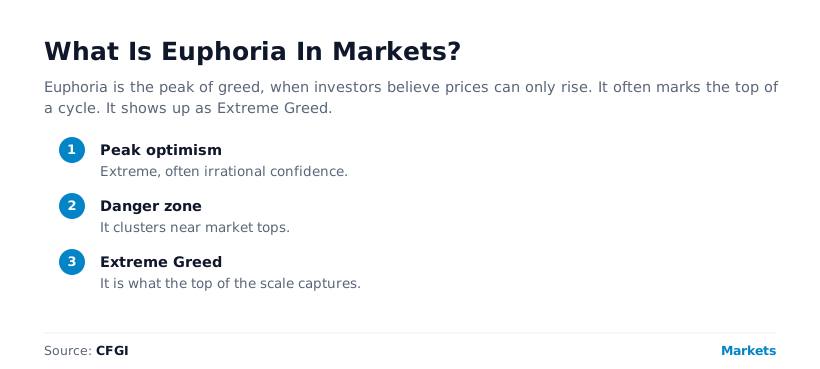
Euphoria is the emotional peak of a bull market: the point where investors are so confident that they believe prices can only keep rising, caution disappears, and almost everyone is buying. It is the third stage of the classic bubble cycle, driven by greed and FOMO rather than fundamentals, and because it represents maximum greed with no one left to buy, it often marks the top. On a Fear and Greed Index, it reads as deep Extreme Greed. This is education, not financial advice.
CFGI data
Euphoria is the greed extreme of the scale. Although CFGI data since 2021 shows the equity score reaches greed peaks near 83 less often than it reaches fear lows, a reading pinned at the top of the 0 to 100 range with universal confidence is the data signature of euphoria, historically a late-cycle condition.
Source: CFGI dataset, 2021 to June 2026.
Key takeaways
- Euphoria is the peak of greed in a bull market.
- It is the third stage of the classic bubble cycle.
- Investors believe prices can only rise; caution vanishes.
- Its hallmark phrase is "this time is different".
- With no one left to buy, it often precedes a crash.
The Peak of Confidence
Euphoria is the final, most dangerous stage of greed. After a long rise, scepticism gives way to certainty: the asset is special, the rules no longer apply, and missing out is the only real risk. New buyers pile in, often using leverage, convinced the trend is permanent. The problem is mathematical as much as emotional. When almost everyone is already in, there is little buying power left to push prices higher, which is why euphoria so often precedes a market crash or sharp correction.
Euphoria In the Bubble Cycle
The economist Hyman Minsky mapped how bubbles inflate and burst in five emotional stages, and euphoria sits right at the dangerous middle.
- Displacement: a new idea or technology excites investors and a trend begins.
- Boom: prices rise steadily and more people take notice.
- Euphoria: caution is abandoned, valuations are ignored, and frenzied buying takes over.
- Profit-taking: the smart money quietly starts selling near the top.
- Panic: the trend reverses and the crowd rushes for the exits.
Euphoria is the hinge of the whole cycle: the moment of greatest optimism and, in hindsight, greatest risk.
The Signs of Euphoria
Euphoria has a recognisable fingerprint. Buying becomes frenzied and driven by FOMO rather than analysis. Traditional valuation metrics are dismissed as outdated. Leverage and debt climb as people borrow to buy more. Inexperienced investors flood in, often hearing about the asset at dinner parties or on social media. Prices go parabolic, rising almost vertically. And the mood turns unanimously bullish, with sceptics mocked or ignored. No single sign is conclusive, but when several appear together, especially the dismissal of valuations and a wave of new money chasing a vertical chart, the market is displaying the classic symptoms of a euphoric top.
"This Time Is Different"
Every euphoric peak is rationalised by the same idea: that this time, the old rules do not apply. The legendary investor John Templeton called "this time is different" the four most expensive words in the English language, because they recur at the top of every bubble. The story changes, a revolutionary technology, a new economic era, a fresh paradigm, but the function is always the same: to justify paying any price by arguing that traditional limits no longer hold. Recognising that phrase, in the market’s mouth or your own, is one of the most reliable euphoria warnings there is. Genuinely new things do appear, but "different" rarely means "exempt from gravity".
The Four Most Expensive Words
"This time is different" is the anthem of every euphoric top. When valuations are waved away because the old rules supposedly no longer apply, treat it as a warning, not reassurance.
Irrational Exuberance
The most famous name for euphoria came from Federal Reserve chairman Alan Greenspan, who in 1996 wondered aloud how to tell when "irrational exuberance" had unduly inflated asset prices. The economist Robert Shiller later made it the title of a celebrated book warning, presciently, about the dotcom and housing bubbles. The phrase captures the heart of euphoria: collective sentiment driven far from rationality by psychological biases working together, herd behaviour, overconfidence, and the assumption that a recent trend will simply continue. Euphoria is exuberance that has lost its anchor in value.
The Minsky Moment: When Euphoria Breaks
Euphoria does not last, and its ending has a name: the "Minsky Moment", the abrupt collapse that follows a long, debt-fuelled climb. In the final stretch before the break, confidence curdles into recklessness, with high leverage, sky-high valuations and ever-riskier bets all resting on the belief that prices can only rise. Then something small punctures the story, profit-takers start selling, latecomers cannot find buyers, and the leverage that powered the ascent now accelerates the fall. The crash is rarely caused by the trigger itself; it is caused by how much fragility euphoria quietly built up beforehand. The bigger the euphoria, the harder the Minsky Moment.
Euphoria and Extreme Greed
Euphoria is what deep Extreme Greed looks like in emotional terms. A Fear and Greed Index pinned near the top of its scale, while everyone insists the rise will continue, is the signal contrarians treat as a moment for caution, not confidence. The gauge cannot tell you the exact day euphoria will break, no tool can, but it can show you, in a single number, when the crowd has reached the kind of one-sided conviction that has marked tops before. In a euphoric market, that quiet, numerical reminder to check your risk is exactly what emotion is least willing to hear.
Frequently asked questions
What is euphoria in markets?
The emotional peak of a bull market, where investors are so confident they believe prices can only rise, caution disappears, and almost everyone is buying. It is the third stage of the classic bubble cycle and often marks a top.
What are the stages of a bubble?
Economist Hyman Minsky described five: displacement, boom, euphoria, profit-taking and panic. Euphoria is the dangerous middle, where valuations are ignored and frenzied buying takes over.
Why is "this time is different" a warning?
Because it recurs at the top of every bubble to justify ignoring valuations. John Templeton called it the four most expensive words in investing. Genuinely new things appear, but "different" rarely means exempt from gravity.
How is euphoria shown on the Fear and Greed Index?
As deep Extreme Greed, a reading near the top of the scale, paired with universal confidence. Contrarians treat it as a moment for caution, though it cannot time the exact top. This is education, not financial advice.
CFGI.io, Market sentiment research
The CFGI research team builds and maintains the CFGI Fear and Greed Index: a 0 to 100 sentiment score from 10 sub-indicators across hundreds of crypto assets and the equity market, refreshed every 15 minutes. We have tracked market emotion through multiple full crypto and equity cycles.
Think we missed something?
Spotted a gap, disagree with a take, or think we should cover a new topic? Message us and we'll act on your input.
Message us on TelegramKeep reading
This article is educational and is not financial advice. Crypto and equities are volatile and you can lose money. See our disclaimer.