Markets
What Is Herd Behaviour In Markets?
Quick answer
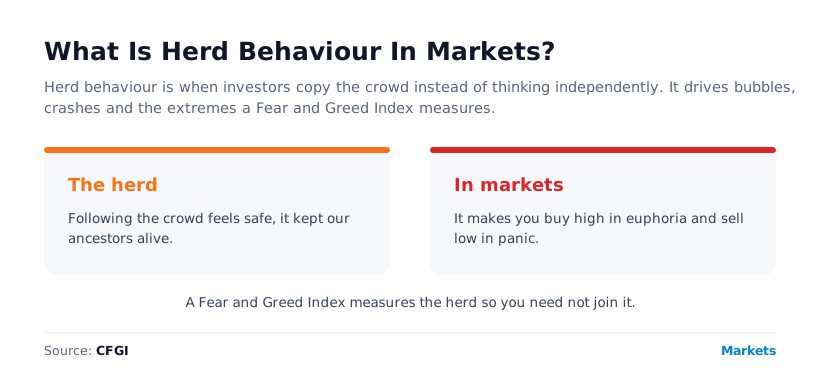
Herd behaviour is when investors follow the crowd rather than their own analysis, buying because others are buying and selling because others are selling. It is rooted in the instinct that following the group feels safer in uncertainty, and it feeds on itself: rising prices attract more buyers, falling prices trigger more sellers. Herding is what pushes markets to the extremes of fear and greed, and a Fear and Greed Index is essentially a measure of how strong the herd has become. This is education, not financial advice.
CFGI data
Herding is what makes sentiment reach extremes, and CFGI measures how far it has gone, from an extreme-fear 3 in equities on 8 April 2025 to greed highs near 83. The more one-sided the herd, the closer the reading sits to 0 or 100 on the scale.
Source: CFGI dataset, 2021 to June 2026.
Key takeaways
- Herd behaviour is following the crowd instead of independent analysis.
- It is rooted in social proof and the safety of numbers.
- It is self-reinforcing: buying begets buying, selling begets selling.
- It drives the emotional cycle from euphoria to capitulation.
- A Fear and Greed Index measures how strong the herd has become.
Why Investors Herd
Herding is a deep instinct: in uncertain situations, copying others feels safer than going it alone. In markets, that means buying what is rising because everyone else is, and selling what is falling for the same reason. The problem is that the crowd is often most confident exactly when it is most wrong. Herding is self-reinforcing: rising prices draw in more buyers, which raises prices further, until the move overshoots into a bubble, and falling prices trigger more selling, which deepens the fall, until it overshoots into a crash. The Fear and Greed Index reads how far the herd has pushed.
The Psychology of Following
Herding is powered by "social proof", the instinct to treat the crowd’s behaviour as information, on the reasonable-sounding assumption that so many people cannot all be wrong. The pull is astonishingly strong: one University of Leeds study found that when just 5% of a crowd moved with purpose, the other 95% followed without even realising they were copying. In markets, this is reinforced by FOMO, the fear of missing out, by loss aversion, and, for professionals, by career risk, since few are ever blamed for losing money the same way everyone else did. Going along with the crowd is comfortable, defensible and easy; thinking independently is none of those things.
How Herding Moves Markets
The market damage comes from how herding distorts the balance of buyers and sellers. As more investors pile onto the same side, the market becomes dangerously one-sided, almost all buyers in a euphoric uptrend, almost all sellers in a panicked downtrend. This is what lets trends run far beyond what fundamentals can justify: a rising price keeps attracting buyers simply because it is rising, not because the underlying value has changed. The same engine works in reverse on the way down. Herding, in other words, is the mechanism that turns a reasonable move into an overshoot, inflating bubbles at the top and accelerating crashes at the bottom, the very extremes a sentiment gauge is built to flag.
The Emotional Cycle of the Herd
The herd moves through a recognisable emotional cycle, the same one in every boom and bust.
- Disbelief and hope: a recovery begins but few trust it.
- Optimism and belief: the trend is accepted and the crowd piles in.
- Euphoria: the peak, where greed is universal and caution vanishes.
- Anxiety and denial: the trend cracks but the herd hopes it is a dip.
- Fear, panic and capitulation: the crowd rushes out, selling at the bottom.
- Despair, then disbelief: the low forms while no one believes it.
Recognising which emotion the herd is feeling is one of the most useful things an investor can do, because the cycle’s emotional peaks and troughs tend to line up with its price extremes.
Going Against the Herd
The contrarian insight is that the herd is usually right in the middle of a trend and wrong at its extremes. Following the crowd works fine most of the time, but at the turning points, peak euphoria and peak panic, the crowd is precisely the wrong thing to follow, which is the basis of contrarian investing and of "be greedy when others are fearful, and fearful when others are greedy". The catch is that going against the herd is genuinely hard: it means buying when everything feels terrible and selling when everything feels wonderful, standing apart from people who all seem confident. That discomfort is exactly why the contrarian edge exists, and why so few capture it.
Right In the Middle, Wrong At the Ends
The herd is a fine guide during a trend and a dangerous one at its extremes. The skill is not always opposing the crowd, but knowing when it has become too one-sided to trust.
Herding and Fear and Greed
The two emotions that drive the herd are fear and greed. Greed makes the herd chase; fear makes it flee. Extreme readings on a sentiment index are simply moments when almost everyone is doing the same thing, which is why contrarians watch them. A Fear and Greed Index is, in a real sense, a herd-o-meter: the closer it sits to 0 or 100, the more one-sided the crowd has become, and the more the conditions for a reversal have quietly built up. It cannot tell you the exact moment the herd will turn, but it can tell you, in a single number, just how crowded onto one side everyone has become.
Frequently asked questions
What is herd behaviour in investing?
Following the crowd instead of your own analysis: buying because others buy, selling because others sell. It is rooted in social proof and the safety of numbers, is self-reinforcing, and pushes markets to extremes of fear and greed.
Why do investors follow the crowd?
Because of social proof, the instinct that so many people cannot all be wrong, plus FOMO, loss aversion and, for professionals, the career safety of failing the same way as everyone else. One study found 95% of a crowd will follow just 5% who move with purpose.
Why is herd behaviour risky?
Because the crowd is often most confident when it is most stretched. Herding makes markets one-sided, sustaining trends past what fundamentals justify, which inflates bubbles and accelerates crashes by overshooting in both directions.
How does it relate to the Fear and Greed Index?
A Fear and Greed Index measures how one-sided the herd has become. Extreme readings mean almost everyone is fearful or greedy together, which is exactly when contrarians grow cautious. This is education, not financial advice.
CFGI.io, Market sentiment research
The CFGI research team builds and maintains the CFGI Fear and Greed Index: a 0 to 100 sentiment score from 10 sub-indicators across hundreds of crypto assets and the equity market, refreshed every 15 minutes. We have tracked market emotion through multiple full crypto and equity cycles.
Think we missed something?
Spotted a gap, disagree with a take, or think we should cover a new topic? Message us and we'll act on your input.
Message us on TelegramKeep reading
This article is educational and is not financial advice. Crypto and equities are volatile and you can lose money. See our disclaimer.