Stocks
What Is Leverage?
Quick answer
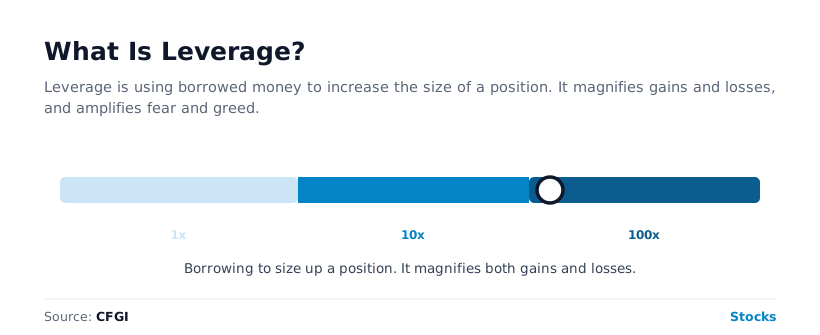
Leverage is the use of borrowed money or financial tools to control a larger position than your own capital would allow. It magnifies returns in both directions: a small price move produces a large gain or loss relative to what you put in, and a big enough adverse move can wipe you out entirely. Leverage is a powerful amplifier of fear and greed, because it forces decisions, especially forced selling, when positions move against the borrower. This is education, not financial advice.
CFGI data
Leverage turns sentiment swings into bigger price swings. A greedy, heavily leveraged market is fragile, and when fear hits, forced unwinding deepens the fall. CFGI plunging during a sharp decline, like the equity 3 on 8 April 2025 on its 0 to 100 scale, often reflects leverage being flushed out.
Source: CFGI dataset, 2021 to June 2026.
Key takeaways
- Leverage uses borrowed money to control a larger position.
- It magnifies both gains and losses by the leverage ratio.
- A big enough adverse move can wipe out your capital entirely.
- Leveraged ETFs suffer "volatility decay" if held over time.
- It amplifies fear and greed across the whole market.
Amplifying the Outcome
Leverage comes in many forms, margin loans, futures, options, leveraged products, but the principle is constant: control more than your capital alone allows. Used on a winning position, it multiplies the gain on your committed cash. Used on a loser, it multiplies the loss just as fast, and can wipe out the position entirely. This is why leverage is described as a double-edged sword. It does not change the direction of a move, only the size of its consequences for the borrower.
A Worked Example
Suppose you have 10,000 dollars. Unleveraged, you buy 10,000 dollars of stock. With 5:1 leverage, you control 50,000 dollars of the same stock. Watch what a 10% move does to your own money.
| Outcome | No leverage | 5:1 leverage |
|---|---|---|
| Position size | $10,000 | $50,000 |
| Stock rises 10% | +$1,000 (+10%) | +$5,000 (+50%) |
| Stock falls 10% | -$1,000 (-10%) | -$5,000 (-50%) |
| Stock falls 20% | -$2,000 (-20%) | -$10,000 (wiped out) |
The same 10% move, with and without 5:1 leverage.
The upside is seductive and the downside is brutal: at 5:1, a 20% drop erases your entire stake, and a larger fall can leave you owing the lender money. Leverage magnifies the percentage, not just the dollars.
The Leverage Ratio
The "leverage ratio" measures how much you are amplifying: it is your total position size divided by your own equity. Control 100,000 dollars of an asset with 10,000 dollars of your own money and you are at 10:1. The ratio tells you exactly how fragile you are, because it is the inverse of how big an adverse move wipes you out. At 2:1, a 50% drop ruins you; at 10:1, just 10%; at 100:1, a mere 1% move against you erases everything. Standard stock margin is a relatively tame 2:1, but some futures and crypto venues offer 50:1 or 100:1, levels at which the smallest wobble is fatal to the position.
The Ratio Is Your Fragility
A leverage ratio of N:1 means an adverse move of about 100/N percent wipes you out. At 10:1 that is a 10% move; at 100:1, just 1%. The higher the leverage, the smaller the move that ends you.
Margin Calls and Liquidation
Borrowed positions come with a tripwire. Your broker requires a "maintenance margin", a minimum equity level in the account. If losses push you below it, you get a margin call: a demand to deposit more funds fast. If you cannot, the broker will force-sell your positions, often without much notice, to recover its loan, a liquidation. This is the mechanism that turns leverage from a personal risk into a market one: when many leveraged players are forced to sell at once, the selling drives prices lower, triggering yet more margin calls in a self-reinforcing cascade. It is how leverage converts an ordinary dip into a violent crash.
The lesson is that leverage removes your ability to simply wait out a bad patch. An unleveraged investor can hold through a 30% drawdown and recover; a heavily leveraged one is forced out at the bottom, crystallising the loss at the worst possible moment. Survival, not just return, is what leverage quietly puts at risk.
Leveraged ETFs and Volatility Decay
Leveraged ETFs offer a packaged way to get 2x or 3x exposure with no margin call and no forced liquidation, which makes them look safer. But they hide a subtler trap: "volatility decay". Because these funds reset their leverage daily, their long-term return is not a clean multiple of the index, and in choppy markets they bleed value. The classic example: a 3x fund that gains 30% one day and loses 30% the next turns one dollar into 1.30 and then into 0.91, a 9% loss, even though the simple average daily move was zero. Over weeks of volatility this drag compounds, which is why leveraged ETFs are tools for single-day trading, not for buying and holding.
Leverage and the Emotional Cycle
Leverage amplifies fear and greed at the market level. A greedy market piling on leverage becomes fragile, primed for a sharp unwind, because so many positions are one bad move from a forced sale. When fear arrives, forced selling by over-leveraged players deepens the drop, which a Fear and Greed Index registers as a plunge toward Extreme Fear. Deep, fast fear readings like CFGI’s equity 3 in April 2025 often mark exactly these moments, the violent flush as leverage is wrung out of the system. High leverage makes both the highs and the lows more violent, which is why measures of it sit alongside sentiment as warning signs.
Frequently asked questions
What is leverage?
Using borrowed money or financial tools to control a larger position than your own capital allows. It magnifies returns in both directions, by an amount set by the leverage ratio.
Why is leverage risky?
Because it multiplies losses as fast as gains and can force selling when a position moves against you. At 5:1, a 20% drop wipes out your stake; at higher ratios, an even smaller move can, and you may end up owing the lender.
Why do leveraged ETFs lose value over time?
Because they reset their leverage daily, so in choppy markets "volatility decay" erodes them. A 3x fund up 30% then down 30% ends below where it started, even though the average daily move was zero. They are built for single-day trades, not holding.
How does leverage amplify fear and greed?
A heavily leveraged, greedy market is fragile; when fear hits, forced unwinding deepens the fall, which a Fear and Greed Index registers as a sharper plunge toward Extreme Fear. This is education, not financial advice.
CFGI.io, Market sentiment research
The CFGI research team builds and maintains the CFGI Fear and Greed Index: a 0 to 100 sentiment score from 10 sub-indicators across hundreds of crypto assets and the equity market, refreshed every 15 minutes. We have tracked market emotion through multiple full crypto and equity cycles.
Think we missed something?
Spotted a gap, disagree with a take, or think we should cover a new topic? Message us and we'll act on your input.
Message us on TelegramKeep reading
This article is educational and is not financial advice. Crypto and equities are volatile and you can lose money. See our disclaimer.