Markets
What Is a Market Bubble?
Quick answer
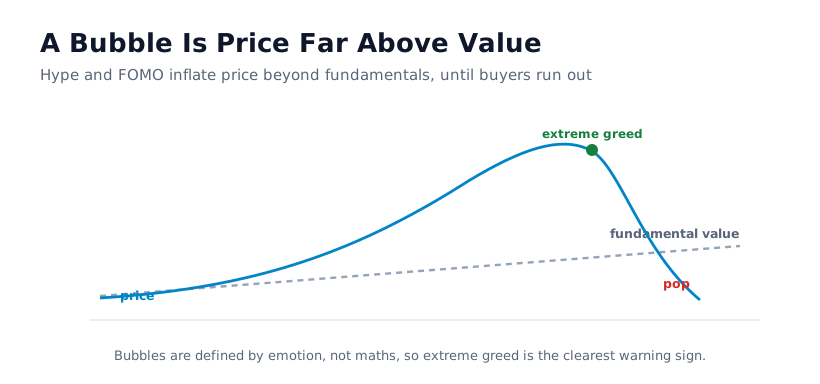
A market bubble is when prices rise far above what the fundamentals can justify, driven by hype and the fear of missing out. It inflates on greed and pops when buyers run out. Bubbles tend to move through recognisable stages, recur throughout history from tulips to dot-com to crypto, and are notoriously hard to spot until they burst, which is why extreme greed is their clearest warning sign and why measuring the mood matters. This is education, not financial advice.
CFGI data
A bubble is greed pushed past reason, and memecoins are its purest form. CFGI scored Shiba Inu at an extreme-greed 95 on 2 March 2024, a token with almost nothing underneath running hotter than any major coin. That 0 to 100 fear and greed score has tracked the crowd since March 2022.
Source: CFGI dataset, March 2022 to June 2026.
Key takeaways
- A bubble is prices rising far beyond what fundamentals justify.
- It tends to move through five stages, from a real story to panic.
- Bubbles recur throughout history, from tulips to crypto.
- They are hard to spot until they pop.
- Extreme greed is the clearest warning sign.
What Is a Market Bubble?
A bubble forms when a price detaches from reality. Buyers stop asking what something is worth and start buying because it is going up and they do not want to miss out. The classic examples, from tulips to dot-com stocks to crypto manias, all share the same shape: a self-reinforcing climb powered by belief rather than value. At its core a bubble is a feedback loop of greed, rising prices attract buyers, whose buying lifts prices further, which attracts still more buyers, until the price bears almost no relationship to the underlying asset.
The Five Stages of a Bubble
The economist Hyman Minsky described how bubbles tend to move through five recognisable stages, a model worth knowing because it repeats:
- Displacement: a genuine innovation or trend, a new technology, low rates, a real story, attracts early money.
- Boom: prices rise, the story spreads, media attention grows and more buyers pile in.
- Euphoria: caution evaporates, FOMO takes over, price detaches from value and "this time is different" becomes the mantra.
- Profit-taking: the early, informed money quietly recognises the excess and begins to sell.
- Panic: belief cracks, buyers vanish, and the price collapses far faster than it climbed.
Not every bubble fits this neatly, but the arc, a real seed, a euphoric overshoot, a brutal collapse, is remarkably consistent.
Famous Bubbles In History
Bubbles are not a modern quirk; they recur across centuries because human nature does. The Dutch Tulip Mania of the 1630s saw single tulip bulbs trade for the price of a house before collapsing. The South Sea Bubble of 1720 ruined fortunes across Britain, even, famously, Isaac Newton’s. The Roaring Twenties ended in the 1929 crash and the Great Depression. The dot-com bubble of the late 1990s sent internet stocks to absurd valuations before wiping out trillions in 2000. The 2008 financial crisis grew from a housing and credit bubble. And crypto has had several of its own, from the 2017 ICO mania to memecoin frenzies. Different assets, different eras, the same story: a real or imagined opportunity, inflated by greed into a mania, ending in a crash. Studying them is the best inoculation against being caught in the next.
Why Bubbles Are So Hard to Spot
If the pattern is so consistent, why does almost everyone get caught? Because from the inside, a bubble does not feel like a bubble, it feels like a once-in-a-lifetime opportunity you would be foolish to miss. During the boom and euphoria stages, prices really are rising and early buyers really are getting rich, which seems to validate the mania and silences the doubters. The phrase "this time is different" is the most expensive in finance precisely because, in the moment, there is always a compelling story for why the old rules no longer apply. Even seasoned professionals are routinely swept up, partly through genuine belief and partly through the greater-fool logic of expecting to sell to someone else before the music stops. Certainty about a bubble usually only arrives after it has burst, which is exactly why a measure of crowd emotion is so valuable: it can flag the dangerous euphoria that price alone disguises as success.
"This Time Is Different"
Bubbles are hard to spot because, from the inside, the mania looks like real opportunity and rising prices seem to prove it. The four most expensive words in finance are "this time is different".
Why Is Extreme Greed the Warning Sign?
Because a bubble is greed with no brakes. When emotion drives markets to the point where almost everyone is euphoric and already invested, there is little buying power left to sustain the climb. That is why extreme greed readings cluster near bubble peaks, and why the purest bubbles, like memecoins with almost nothing underneath, run the hottest of all: CFGI scored Shiba Inu at an extreme-greed 95, and its market record high sits at 87. No reading calls the top, but watching the mood reach an extreme is more useful than watching the price alone, because it puts a number on the euphoria a bubble disguises as healthy growth. See it on the live index, and read the flip side in what a market crash is.
Frequently asked questions
What is a market bubble?
When prices rise far above what fundamentals justify, driven by hype and FOMO, in a self-reinforcing feedback loop of greed. It inflates on belief rather than value and pops when buyers run out, often far faster than it climbed.
What are the stages of a bubble?
Hyman Minsky’s model has five: displacement (a real trend attracts early money), boom (prices and attention rise), euphoria (FOMO takes over and price detaches from value), profit-taking (smart money sells), and panic (belief cracks and price collapses).
Why are bubbles so hard to spot?
Because from the inside a mania feels like genuine opportunity, and rising prices seem to validate it. "This time is different" is always the story, and even professionals get caught. Certainty usually only comes after the bubble pops.
What sentiment reading signals a bubble?
Extreme greed, a reading of 80 or above. It means the crowd is euphoric and stretched, with little buying power left, which clusters near bubble peaks. CFGI’s high of 87, and a Shiba Inu reading of 95, marked such moments. This is education, not financial advice.
CFGI.io, Market sentiment research
The CFGI research team builds and maintains the CFGI Fear and Greed Index: a 0 to 100 sentiment score from 10 sub-indicators across hundreds of crypto assets and the equity market, refreshed every 15 minutes. We have tracked market emotion through multiple full crypto and equity cycles.
Think we missed something?
Spotted a gap, disagree with a take, or think we should cover a new topic? Message us and we'll act on your input.
Message us on TelegramKeep reading
This article is educational and is not financial advice. Crypto and equities are volatile and you can lose money. See our disclaimer.