Crypto
What Are FOMO and FUD?
Quick answer
FOMO is the "fear of missing out": the urge to buy because everyone else seems to be making money. FUD is "fear, uncertainty and doubt": the spread of negative feeling that pushes people to sell. They are the two faces of crowd emotion, FOMO is greed, FUD is fear, they are often deliberately weaponised to manipulate a crowd, and they move crypto faster than almost anything else. This is education, not financial advice.
CFGI data
FOMO is greed with a deadline; FUD is fear looking for a reason. CFGI turns both into one number from 0 to 100, and the extremes are rare: across its record the crypto market sat in extreme greed on just 2% of days and extreme fear on 1%, spending most of its life in between. It reads 10 indicators across hundreds of assets, every 15 minutes since March 2022.
Source: CFGI dataset, March 2022 to June 2026.
Key takeaways
- FOMO is fear of missing out: the urge to buy into a rally.
- FUD is fear, uncertainty and doubt: the pull to sell.
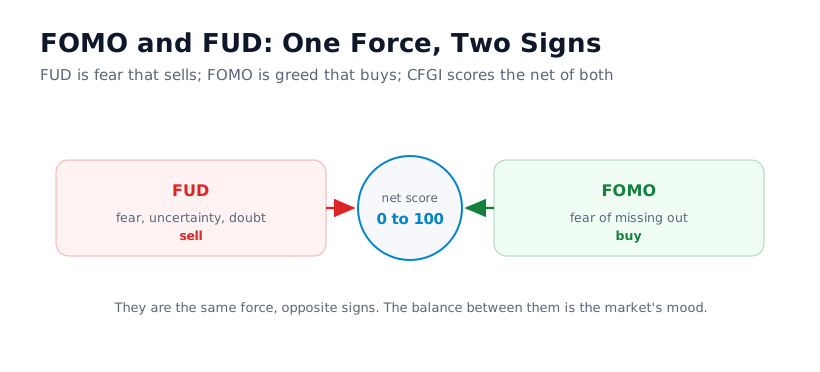
- FOMO is greed; FUD is fear. They are the same force, opposite signs.
- Both are often weaponised to manipulate the crowd.
- CFGI scores the net of both as a 0 to 100 reading.
What Is FOMO?
FOMO, the fear of missing out, is what greed feels like from the inside. Prices are rising, friends and feeds are full of gains, and the pull to buy before it is "too late" becomes hard to resist. It is the engine of the late stage of a bull market, and it usually peaks right as the move is running out of road, drawing in the largest crowd of buyers at the very top, just before the reversal. The cruel irony of FOMO is that the stronger it feels, the later in the cycle you usually are, and the worse the moment to act on it.
What Is FUD?
FUD, fear, uncertainty and doubt, is the opposite pull. Bad news, rumours or a falling price spread a negative mood that makes holders want out. Some FUD is justified, a genuine problem with a project deserves real concern, and some is pure noise, baseless rumour that panics people into selling at exactly the wrong time. Either way it drives the selling that defines a bear market, peaking at the point of deepest fear. Learning to separate legitimate, fact-based concern from empty, emotional FUD is one of the most valuable skills in crypto, because the same falling price can be a warning to heed or a panic to ignore, and telling them apart requires looking past the emotion to the facts.
Two Faces of One Force, Often Weaponised
FOMO and FUD are not two separate things but two sides of a single coin, the crowd’s emotion pointing in opposite directions, and the same market can swing violently from one to the other. What makes them especially important in crypto is how often they are deliberately weaponised. Bad actors spread FUD, false rumours, exaggerated fears, to scare a crowd into selling so they can buy cheaply, a tactic sometimes called "shaking the tree". Conversely, they manufacture FOMO, coordinated hype, paid influencers, fake urgency, to lure buyers into a pump and dump before dumping their bags on the excited newcomers. In a young, lightly regulated, social-media-driven market, this manipulation is rife, which is why a healthy skepticism is essential: when you feel a strong urge to buy or sell driven by what "everyone" is saying online, it is worth asking whether someone is deliberately pulling your emotional strings.
Someone May Be Pulling the Strings
FUD is spread to scare you into selling cheap; FOMO is manufactured to lure you into buying the top. In a lightly regulated market, assume both can be deliberate, and check the facts behind the feeling.
FOMO, FUD and Your Own Psychology
Beyond the deliberate manipulation, FOMO and FUD are simply contagious, and crypto’s always-on, social-media-saturated culture spreads them faster than perhaps any market in history. A green candle and a wall of celebratory posts can ignite genuine FOMO in minutes; a scary headline can trigger real FUD just as fast. The crucial realisation is that these are emotions happening inside you, not insights about the asset. The antidote is the same as for any emotional investing: have a plan made in calm times, and when you feel a powerful, urgent pull to buy or sell because of the crowd’s mood, treat that very feeling as a signal to slow down rather than speed up. Recognising "I am feeling FOMO right now" or "this is FUD getting to me" is half the battle, because naming the emotion restores enough distance to think clearly, instead of simply reacting with the herd.
How Does CFGI Measure FOMO and FUD?
FOMO and FUD are just everyday names for greed and fear, and that is exactly what CFGI scores. When FOMO dominates, the Crypto Fear and Greed Index pushes toward Extreme Greed; when FUD wins, it falls toward Extreme Fear. The single 0 to 100 number is the net result of the tug of war between the two. Seeing it as a score is the point: it turns a feeling you might be caught up in into something you can read from the outside, an objective check against the emotional pull of the crowd. And the data offers a useful perspective on how rare the true extremes are, the crypto market has sat in extreme greed on only about 2% of days and extreme fear on about 1%, spending the vast majority of its life somewhere in between, a reminder that the most intense FOMO and FUD, however loud, are the exception rather than the rule.
Frequently asked questions
What does FOMO stand for?
Fear of missing out: the anxiety that others are profiting and you are being left behind, which drives impulsive buying. In sentiment terms it is greed, and it tends to peak right at the top of a rally.
What does FUD stand for?
Fear, uncertainty and doubt: negative feeling, justified or not, that pushes people to sell. In sentiment terms it is fear. Separating fact-based concern from baseless, emotional FUD is a key skill.
Are FOMO and FUD deliberately used to manipulate?
Often, yes. FUD is spread to scare people into selling cheaply ("shaking the tree"), and FOMO is manufactured with hype to lure buyers into a pump and dump. In a lightly regulated, social-driven market this manipulation is common, so healthy skepticism matters.
How do FOMO and FUD relate to the Fear and Greed Index?
They are the plain-language versions of greed and fear. CFGI scores the net of both as a single 0 to 100 reading, high when FOMO dominates, low when FUD does, turning a feeling you might be caught up in into something you can read objectively. This is education, not financial advice.
CFGI.io, Market sentiment research
The CFGI research team builds and maintains the CFGI Fear and Greed Index: a 0 to 100 sentiment score from 10 sub-indicators across hundreds of crypto assets and the equity market, refreshed every 15 minutes. We have tracked market emotion through multiple full crypto and equity cycles.
Think we missed something?
Spotted a gap, disagree with a take, or think we should cover a new topic? Message us and we'll act on your input.
Message us on TelegramKeep reading
This article is educational and is not financial advice. Crypto and equities are volatile and you can lose money. See our disclaimer.