Markets
What Is Overconfidence Bias?
Quick answer
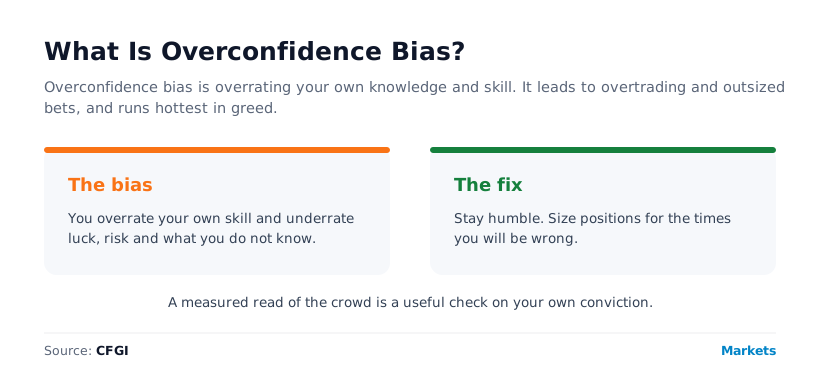
Overconfidence bias is the tendency to overrate your own knowledge, skill and judgement, to believe you know more, and can predict better, than you actually can. In investing it leads to overtrading, under-estimating risk and making outsized bets, and the research is damning: the most active, confident traders tend to earn the lowest net returns. It runs hottest during greedy, rising markets, when a few wins convince people they have a special edge, just before conditions punish the overconfident. This is education, not financial advice.
CFGI data
Overconfidence peaks with greed. A rising market convinces people their skill, not the tide, is lifting them, which is why a Fear and Greed Index in Extreme Greed, 80 or above on its 0 to 100 scale, is also a warning about your own certainty. The index is a check against mistaking a bull market for genius.
Source: CFGI dataset and behavioural-finance research, June 2026.
Key takeaways
- Overconfidence bias is overrating your own knowledge and skill.
- It comes in three forms: overestimation, overplacement and miscalibration.
- Its main cost is overtrading, which research links to lower net returns.
- It runs hottest in greedy, rising markets, where luck looks like skill.
- Trading less, and treating your certainty as a warning, are the best defences.
Mistaking Luck for Skill
Most people rate themselves above average at things they cannot all be above average at, and investing is no exception. Overconfidence bias makes investors over-estimate how much they know and how well they can predict, leading to excessive trading, concentrated bets and a habit of ignoring risk. The trap is sharpest after a winning streak: in a rising market almost everything goes up, and it is easy to mistake the tide for one’s own brilliance, just before the tide turns.
The Three Forms of Overconfidence
Researchers split overconfidence into three distinct flavours, and investors fall for all of them.
- Overestimation: thinking your ability or knowledge is better than it really is, "I understand this company inside out".
- Overplacement: the "better than average" effect, believing you are more skilled than most other investors, which most people cannot be.
- Miscalibration: being too sure of your forecasts, setting confidence ranges far too narrow, so you are surprised far more often than you expect.
A close cousin, the "illusion of control", convinces people their actions sway outcomes that are largely down to chance, the more you trade, the more in control you feel, even as the results say otherwise.
The Real Cost: Overtrading
Overconfidence does its damage mainly through overtrading. Convinced they can beat the market and time it well, overconfident investors trade far more than is wise, and every trade carries costs and the risk of poor timing. The evidence is blunt: studies have found the average active individual investor underperforms a simple passive index by as much as 3.8 percentage points a year, much of it eaten by the costs of frequent trading. The famous summary from the research is that "trading is hazardous to your wealth". The more certain you feel, the more you tend to trade, and the more you trade, the worse you tend to do.
The Counterintuitive Lesson
For most investors, doing less is doing better. Overconfidence whispers "trade more"; the data whispers back that the patient, low-activity investor usually wins.
Boys Will Be Boys: The Famous Study
The most cited evidence comes from Brad Barber and Terrance Odean’s 2001 study, memorably titled "Boys Will Be Boys". Drawing on tens of thousands of brokerage accounts, and on the psychological finding that men tend to be more overconfident than women, it showed overconfidence translating directly into worse results.
| Group | Traded more by | Annual return penalty |
|---|---|---|
| Men vs women | 45% | 1.4% lower |
| Single men vs single women | 67% | 2.3% lower |
Barber and Odean (2001): more trading, lower returns.
The mechanism was clear: the more overconfident group traded more, ran up more costs, and earned lower net returns. It is one of behavioural finance’s cleanest demonstrations that overconfidence is not harmless self-belief, it has a measurable price.
Why a Rising Market Breeds It
Bull markets are overconfidence factories. When nearly everything is rising, almost any decision looks smart, and people quietly credit their own skill rather than the rising tide. This is reinforced by "self-attribution bias", the habit of chalking wins up to skill and losses up to bad luck, which lets a run of good fortune harden into a belief in personal genius. The effect peaks near the top, exactly when caution would serve best, and it evaporates in the crash that follows, when the same investors decide they were never any good. Recognising that your confidence tends to rise with the market, not with your actual skill, is half the battle.
How to Guard Against It
The defences are humble but effective. Trade less, the single most powerful fix, since lower activity directly cuts the costs that overconfidence inflates. Keep a decision journal recording why you made each move, so you can later check your forecasts honestly against reality and expose your true hit rate. Size positions sensibly so no single confident bet can ruin you. Seek out the view opposite to yours before acting. And if you cannot consistently beat a passive index, consider simply owning one. Above all, treat strong certainty, especially after a winning streak, as a yellow flag rather than a green light.
Overconfidence and Greed
Overconfidence and greed feed each other. A Fear and Greed Index in Extreme Greed is, in part, a market full of overconfident investors all feeling certain at once. That makes it a useful check on yourself: when the crowd, and you, feel most sure, that shared certainty is often the warning sign. The gauge cannot cure your overconfidence, but it can hold up a mirror, showing you, in a single number, that the very moment you feel most brilliant may be the moment to slow down.
Frequently asked questions
What is overconfidence bias?
The tendency to overrate your own knowledge, skill and judgement, believing you know more and can predict better than you can. In investing it leads to overtrading, under-estimating risk and making outsized bets.
How does overconfidence hurt returns?
Mainly through overtrading. Studies have found the average active individual investor underperforms a passive index by as much as 3.8 percentage points a year, much of it lost to the costs and poor timing of frequent trading.
What did the Barber and Odean study find?
Their 2001 "Boys Will Be Boys" study found men, who tend to be more overconfident, traded 45% more than women and earned 1.4% lower annual returns. Among singles, men traded 67% more and earned 2.3% less. More trading, lower returns.
How do you guard against it?
Trade less, keep a decision journal, size positions sensibly, seek out opposing views, consider passive index investing, and treat your own certainty, especially in Extreme Greed, as a possible warning sign. This is education, not financial advice.
CFGI.io, Market sentiment research
The CFGI research team builds and maintains the CFGI Fear and Greed Index: a 0 to 100 sentiment score from 10 sub-indicators across hundreds of crypto assets and the equity market, refreshed every 15 minutes. We have tracked market emotion through multiple full crypto and equity cycles.
Think we missed something?
Spotted a gap, disagree with a take, or think we should cover a new topic? Message us and we'll act on your input.
Message us on TelegramKeep reading
This article is educational and is not financial advice. Crypto and equities are volatile and you can lose money. See our disclaimer.