Markets
What Is the Bandwagon Effect?
Quick answer
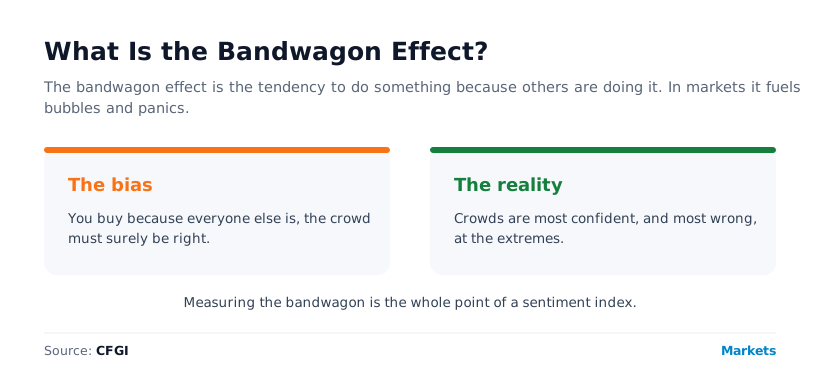
The bandwagon effect is the tendency to do something mainly because lots of other people are doing it, turning off your own critical thinking and following the crowd instead. In markets it shows up as piling into an asset because it is going up and everyone is talking about it, or selling because everyone else is. It is closely tied to herd behaviour, and it is one of the forces that pushes prices to extremes and inflates bubbles, the very swings a Fear and Greed Index measures. This is education, not financial advice.
CFGI data
The bandwagon effect is what a Fear and Greed Index quantifies at scale. When the crowd piles in together, CFGI reads Extreme Greed, 80 or above on its 0 to 100 scale; when it stampedes out, Extreme Fear, under 20. CFGI has tracked that crowd since March 2022, turning the bandwagon into a single number.
Source: CFGI dataset, behavioural-finance framing.
Key takeaways
- The bandwagon effect is doing something because others are.
- It is driven by FOMO, social proof and the ease of following.
- In markets it means chasing rallies and joining sell-offs.
- Its feedback loop inflates bubbles and accelerates panics.
- It pushes prices to the extremes a Fear and Greed Index measures.
Following Because Others Follow
The bandwagon effect is a shortcut the brain takes: if everyone is doing something, it must be right. In markets that becomes buying an asset because it is rising and everyone is talking about it, or selling because the crowd is heading for the exit. The defining feature is that the decision is driven by the crowd’s behaviour rather than by your own analysis, you climb aboard because the wagon is already rolling and full. It is a close cousin of herd behaviour and a cornerstone of behavioural finance.
Why We Jump On: FOMO and Social Proof
Three forces make the bandwagon almost irresistible. The first is FOMO, the fear of missing out, the painful feeling of being left behind while others appear to get rich. The second is "social proof", the deep human instinct to look to others for the right answer in uncertain situations, on the reasonable-sounding but often wrong assumption that the crowd must know something. The third is simple mental economy: following the crowd is far less effort than doing your own rigorous analysis, so the brain takes the cheap route. Together they switch off independent judgement at exactly the moments it matters most.
Why It Moves Prices: The Feedback Loop
When enough people jump on, the bandwagon becomes self-reinforcing. Rising prices attract more buyers, whose buying pushes prices higher still, which attracts yet more buyers, and so on. The same loop runs in reverse on the way down: falling prices trigger selling that drives prices lower and frightens more people out. This feedback is how bubbles inflate far beyond what fundamentals justify, and how panics cascade into crashes. Crucially, it detaches price from value, the asset is going up because it is going up, not because it is worth more, which is the hallmark of a bandwagon-driven move and the seed of its eventual reversal.
Bandwagons Through History
The bandwagon effect is as old as markets and endlessly repeated. The 1600s Dutch Tulip Mania, the South Sea Bubble, the 1929 crash, the dotcom boom and bust, and the more recent meme-stock surges around GameStop are all, at heart, the same story: a crowd pouring into something because everyone else was, until the wagon ran out of road. The modern twist is speed. Social media platforms spread the buying frenzy in hours rather than months, and online communities can coordinate a stampede on a single stock, which is why bandwagon-driven moves now form, and burst, faster than ever.
Bandwagon, Herd and FOMO
These overlapping ideas are easy to muddle, so it helps to separate them. Herd behaviour is the broad tendency to follow the crowd. The bandwagon effect is the more specific pull to join because a trend is already popular and visibly growing, the crowd’s size is itself the reason to join. FOMO is the emotion that powers both, the dread of being the one left out. They are three angles on the same underlying force, the human discomfort with standing apart from the group, and recognising any of them is a step toward resisting all three.
The Question to Ask
Before joining a trend, ask: "Would I do this if no one else were?" If the only real reason is that everyone else is, you are on the bandwagon, not making a decision.
How to Resist the Bandwagon
Beating the bandwagon is mostly about restoring independent judgement. Judge an asset on its own merits, what it is, what it does, what it is worth, rather than on how popular it has become or how loud the hype is. Be most sceptical, not most excited, when something is universally loved and rising vertically, because that is precisely when the crowd is most one-sided. This is the spirit of Warren Buffett’s habit of leaning against prevailing sentiment. And a neutral, numerical signal helps: a sentiment gauge can show you, dispassionately, just how crowded the wagon has become.
The Bandwagon and Market Sentiment
The bandwagon effect is, in aggregate, exactly what a Fear and Greed Index measures. When the crowd piles into risk together, the gauge climbs toward Extreme Greed, 80 or above on its 0 to 100 scale; when it stampedes for the exits, the gauge plunges toward Extreme Fear. The index, in effect, turns the bandwagon into a number you can read at a glance. That makes it a quiet defence against the very instinct it tracks: when it shows the wagon is dangerously crowded, that is the cue for an independent thinker to slow down and look twice.
Frequently asked questions
What is the bandwagon effect?
The tendency to do something mainly because many others are doing it, following the crowd instead of your own analysis. In markets it means chasing rallies because everyone is buying, or joining sell-offs because everyone is selling.
What drives the bandwagon effect?
Mainly FOMO (the fear of missing out), social proof (looking to others for the right answer in uncertainty), and the mental ease of following the crowd rather than doing rigorous analysis of your own.
How is it different from herd behaviour?
They overlap heavily. Herd behaviour is the broad tendency to follow the crowd; the bandwagon effect is the specific pull to join because a trend is already popular and growing. FOMO is the emotion that powers both.
How can investors resist it?
By judging an asset on its own merits rather than its popularity, being most sceptical when something is universally loved, and using a neutral signal like a Fear and Greed reading to see how crowded the trade has become. This is education, not financial advice.
CFGI.io, Market sentiment research
The CFGI research team builds and maintains the CFGI Fear and Greed Index: a 0 to 100 sentiment score from 10 sub-indicators across hundreds of crypto assets and the equity market, refreshed every 15 minutes. We have tracked market emotion through multiple full crypto and equity cycles.
Think we missed something?
Spotted a gap, disagree with a take, or think we should cover a new topic? Message us and we'll act on your input.
Message us on TelegramKeep reading
This article is educational and is not financial advice. Crypto and equities are volatile and you can lose money. See our disclaimer.