Markets
What Is a Market Melt-Up?
Quick answer
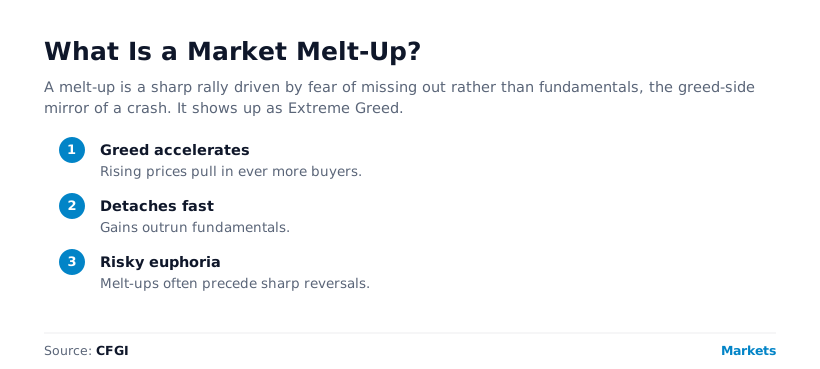
A melt-up is a rapid, accelerating rise in prices driven more by the fear of missing out than by improving fundamentals. It is the greed-side mirror of a crash: investors pile in because everyone else is, pushing prices up faster than the underlying value justifies. Melt-ups can run far longer than seems reasonable, but because they are built on emotion, they tend to reverse sharply when the buying exhausts. They read as Extreme Greed on a Fear and Greed Index, and like all extremes, they do not last. This is education, not financial advice.
CFGI data
Melt-ups drive the score toward the top of the range, though CFGI data since March 2022 shows the greed extreme is reached less often than fear. When sentiment pins near Extreme Greed on accelerating price, it is the data signature of a melt-up, a crowd buying because others are.
Source: CFGI dataset, March 2022 to June 2026.
Key takeaways
- A melt-up is a fast rally driven by fear of missing out.
- It is the greed-side mirror of a crash.
- It is fed by FOMO, short-covering and performance-chasing.
- It runs on emotion, not value, so it reverses sharply.
- It reads as Extreme Greed and rarely lasts.
A Crash In Reverse
If a crash is fear feeding on fear, a melt-up is greed feeding on greed. Prices rise, which draws in buyers afraid of missing out, which pushes prices higher still. The move accelerates, often detaching from fundamentals, because the reason people are buying is mainly that prices are going up. Melt-ups can be exhilarating and dangerous in equal measure. They can run far longer than seems reasonable, but because they are built on emotion rather than value, they tend to reverse sharply when the buying exhausts itself.
What Drives a Melt-Up
A melt-up is powered by several reinforcing forces. FOMO is the engine: as prices surge, the fear of being left behind overwhelms caution and pulls in fresh buyers. Recency bias convinces the crowd the recent gains will simply continue, so they chase performance. Sceptics who had bet against the market, the short-sellers, can be forced to buy back to cap their losses, adding a wave of "short-covering" fuel that pushes prices higher still. And once a melt-up is under way, the very momentum becomes the story, drawing in money that buys simply because everything is going up. Each of these feeds the others, which is what gives a melt-up its self-accelerating, almost vertical character.
Melt-Up Versus Meltdown
A melt-up and a "meltdown", a crash, are mirror images, but they are not perfectly symmetrical. Both detach price from value and both feed on emotion, one on greed, the other on fear. The difference echoes the broader asymmetry between the two emotions: meltdowns tend to be faster and more violent, because fear is sharp and panic is sudden, while melt-ups usually build more gradually, as greed accumulates. Markets are often said to "take the stairs up and the elevator down", and a melt-up is the rarer, more exuberant case of the market sprinting up the stairs. Recognising you are in one is useful precisely because the descent that often follows can be far quicker than the climb.
The Rarer Extreme
Crashes are common and quick; full melt-ups are rarer and build over time. Both end the same way, with a sharp reversal once the emotion driving them runs out.
Melt-Up Or Sustainable Rally?
Not every strong rally is a melt-up, and telling them apart matters. A healthy, sustainable rally is underpinned by genuinely improving fundamentals, rising earnings, a strengthening economy, real adoption, so the higher prices are backed by something solid. A melt-up, by contrast, runs largely on emotion and expanding valuations, with prices climbing far faster than any underlying improvement. The warning signs of the latter are an accelerating, near-parabolic chart, valuations being dismissed as irrelevant, narrowing market breadth where only a few names carry the index, and a flood of inexperienced money. When a rally’s speed and price stop being justified by its fundamentals, it has likely crossed from healthy advance into melt-up territory.
The Danger of Chasing It
The cruel thing about a melt-up is that it punishes both caution and greed. Sit it out and you watch others get rich; chase it near the top and you risk buying right before the reversal. Because melt-ups can "stay irrational longer than you can stay solvent", trying to short or call the top is notoriously dangerous. The more disciplined response is risk management rather than prediction: if you are already riding the move, consider trimming into the strength and taking some profits off the table, rather than adding more at ever-higher prices. The goal is to participate without being the last, most euphoric buyer left holding the position when the music stops.
Melt-Ups and Extreme Greed
A Fear and Greed Index reads a melt-up as Extreme Greed, the top of the 0 to 100 scale. The index will not call the precise top, no tool can, but a reading pinned near the extreme on accelerating price is the signature of a crowd in full FOMO. Used well, that reading is not a reason to pile in but a prompt to manage risk: when the gauge is screaming Extreme Greed and the chart is going vertical, the disciplined question is not "how much more can I make?" but "how exposed am I if this reverses tomorrow?" In a melt-up, that calm, numerical check is exactly what euphoria least wants to hear.
Frequently asked questions
What is a market melt-up?
A rapid, accelerating rally driven by fear of missing out rather than fundamentals. It is the greed-side mirror of a crash, where prices rise faster than value justifies because people are buying mainly because prices are rising.
What drives a melt-up?
FOMO is the engine, reinforced by recency bias and performance-chasing, short-sellers forced to buy back ("short-covering"), and momentum money that buys simply because everything is going up. Each force feeds the others.
How is a melt-up different from a healthy rally?
A sustainable rally is backed by improving fundamentals, so higher prices rest on something real. A melt-up runs on emotion and expanding valuations, with an accelerating chart, dismissed valuations and narrowing breadth as warning signs.
How does the Fear and Greed Index show a melt-up?
As Extreme Greed, a reading of 80 or above. A score pinned near the extreme on accelerating price is the signature of a melt-up, best read as a prompt to manage risk rather than to chase. This is education, not financial advice.
CFGI.io, Market sentiment research
The CFGI research team builds and maintains the CFGI Fear and Greed Index: a 0 to 100 sentiment score from 10 sub-indicators across hundreds of crypto assets and the equity market, refreshed every 15 minutes. We have tracked market emotion through multiple full crypto and equity cycles.
Think we missed something?
Spotted a gap, disagree with a take, or think we should cover a new topic? Message us and we'll act on your input.
Message us on TelegramKeep reading
This article is educational and is not financial advice. Crypto and equities are volatile and you can lose money. See our disclaimer.