Markets
What Is a Market Crash?
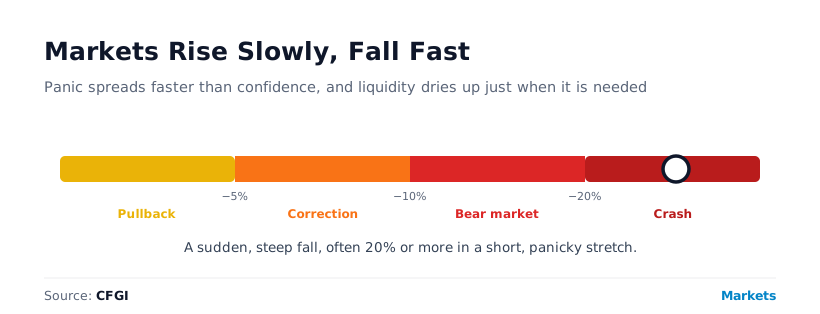
Quick answer
A market crash is a sudden, steep drop in prices over a short time, driven by fear and forced selling. Markets rise slowly but fall fast, because panic spreads quicker than confidence and liquidity dries up just when it is needed. Crashes are triggered by a shock meeting a fragile, over-leveraged market, recur throughout history, and bottom at capitulation, the point of maximum fear, when the last sellers give up. This is education, not financial advice.
CFGI data
A crash is fear at full volume, and CFGI has a benchmark for it. The FTX collapse drove the crypto market to a low of 16 on 9 November 2022 as a major exchange failed overnight. That 0 to 100 fear and greed score has tracked the crowd across hundreds of assets since March 2022.
Source: CFGI dataset, March 2022 to June 2026.
Key takeaways
- A crash is a sudden, steep fall in prices over a short time.
- It is triggered by a shock meeting a fragile, leveraged market.
- Fear spreads faster than confidence, so markets fall fast.
- Crashes recur throughout history, from 1929 to crypto.
- They bottom at capitulation, the point of maximum fear.
What Is a Market Crash?
A crash is a violent, compressed version of a fall: a large drop in days or even hours rather than months. It is the opposite of a bubble, and often its sequel, the air rushing out all at once. Crypto crashes can be especially brutal, with major assets shedding much of their value before the mood turns. A crash differs from an ordinary bear market mainly in speed: where a bear market is a slow, grinding decline over months, a crash is the sudden, panic-driven plunge, the difference between deflating and bursting.
What Triggers a Crash
A crash needs two things: a trigger and a fragile market for it to spread through. The trigger is the spark, a sudden economic shock, a bursting bubble, a financial crisis, a collapsing institution, or a liquidity squeeze, and it is usually a surprise. But a spark alone is not enough; it must land on dry tinder. The fragility comes from the conditions that build up beforehand: stretched valuations, heavy leverage, crowded positioning and widespread complacency, often the legacy of a preceding period of greed. This is why crashes so often follow euphoria: a market deep in greed is fully invested and over-leveraged, with few new buyers and many forced sellers, so when the shock arrives there is nothing to cushion it. The same trigger that a calm, cautious market would absorb can set a hot, crowded one ablaze.
Why Do Markets Crash So Fast?
Because fear is faster than greed. Panic is contagious, and selling begets selling: as prices fall, more people rush to get out, which drives prices lower, which frightens still more people, a self-reinforcing spiral. Worse, liquidity dries up exactly when it is needed: buyers step back, so there are fewer orders to absorb the selling, and each sale moves the price further. On top of this, forced liquidations of leveraged positions pour fuel on the fire, when prices fall enough, over-leveraged traders are automatically sold out, adding a wave of mechanical selling that has nothing to do with choice. The combination of contagious panic, vanishing liquidity and forced selling is why a crash can erase in days what took months or years to build, the market taking the elevator down after climbing the stairs up.
Famous Market Crashes
Crashes punctuate financial history, each different in detail but identical in emotion. The Wall Street Crash of 1929 ushered in the Great Depression. "Black Monday" in October 1987 saw the US market fall about 22% in a single day, still the largest one-day percentage drop on record. The dot-com bubble burst in 2000, and the 2008 global financial crisis brought the banking system to the brink. In 2020, the Covid shock caused one of the fastest crashes ever before an equally rapid rebound. Crypto has had its own brutal examples, from the Terra/Luna collapse to the FTX exchange failure in late 2022, which drove the crypto market to a CFGI low of 16. The recurring lesson across every era is the same: crashes are driven by the same human panic, they feel unprecedented each time, and markets have, so far, eventually recovered from all of them, though never on a schedule anyone could predict.
Why Does Capitulation Mark the Bottom?
A crash ends when there is no one left to sell. Once fear is total and the determined sellers have sold, even modest buying can turn the market. That is why extreme fear clusters near bottoms, and why safe-haven assets peak in demand at the worst moment. CFGI’s all-time low of 12, in the same territory as the FTX and Luna panics, is a measured snapshot of that capitulation, the exhausted, total fear from which recoveries tend to begin. No reading calls the bottom, but watching fear reach an extreme is the contrarian’s cue to pay attention rather than join the panic. The crucial caveat is that "near a bottom" is not "the bottom": fear can always deepen further, and a market can keep falling after it already looks maximally afraid. Read the mood on the live index. This is education, not financial advice.
Frequently asked questions
What is a market crash?
A sudden, steep drop in prices over a short time, days or even hours, driven by fear and forced selling. It is the violent, compressed opposite of a bubble, and differs from a slow bear market mainly in its speed.
What causes a market crash?
A trigger, a shock, a popped bubble, a financial crisis or a liquidity squeeze, meeting a fragile, often over-leveraged market built up during a period of greed. The spark needs dry tinder: stretched valuations, heavy leverage and complacency.
Why do markets crash so fast?
Because fear is faster than greed. Panic is contagious and selling begets selling; liquidity dries up as buyers step back; and forced liquidations of leveraged positions add mechanical selling. The market takes the elevator down after climbing the stairs up.
Does extreme fear mean a crash is over?
Not reliably. Extreme fear clusters near bottoms because selling exhausts itself, but fear can deepen further and a market can keep falling. It is context and a cue to pay attention, not a signal to act. This is education, not financial advice.
CFGI.io, Market sentiment research
The CFGI research team builds and maintains the CFGI Fear and Greed Index: a 0 to 100 sentiment score from 10 sub-indicators across hundreds of crypto assets and the equity market, refreshed every 15 minutes. We have tracked market emotion through multiple full crypto and equity cycles.
Think we missed something?
Spotted a gap, disagree with a take, or think we should cover a new topic? Message us and we'll act on your input.
Message us on TelegramKeep reading
This article is educational and is not financial advice. Crypto and equities are volatile and you can lose money. See our disclaimer.