Markets
Fear and Greed Index for Beginners
Quick answer
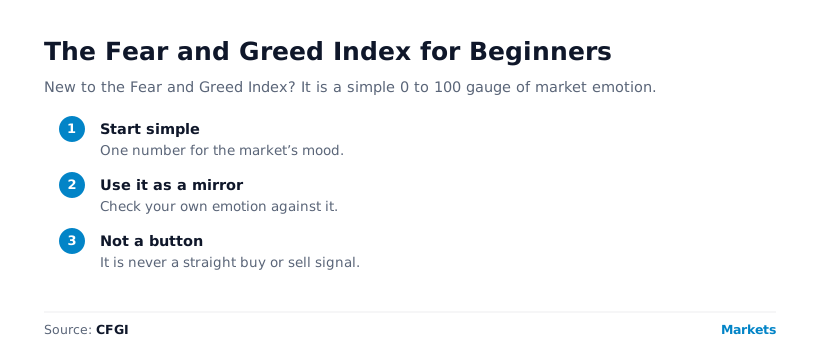
For beginners, the Fear and Greed Index is the easiest way to see the mood of the market at a glance. It turns complex sentiment into a single number from 0 to 100: low means investors are fearful, high means they are greedy. You do not need any experience to read it. The key is to use it as a calm reference point and a mirror for your own emotion, not as a button that tells you when to buy or sell. This is education, not financial advice.
CFGI data
CFGI makes the mood beginner-friendly: one 0 to 100 score per asset, updated every 15 minutes across four timeframes since March 2022. No charts to interpret, just a clear read of whether the crowd is fearful or greedy.
Source: CFGI dataset, March 2022 to June 2026.
Key takeaways
- The index is a simple 0 to 100 gauge of market emotion.
- Low is fear; high is greed; the extremes matter most.
- No experience is needed to read it.
- Use it as a calm reference and a mirror, not a buy or sell button.
- Avoid the beginner trap of treating it as a prediction.
The Simplest Place to Start
Markets are driven by emotion as much as by numbers, and the two emotions that matter most are fear and greed. The Fear and Greed Index measures the balance between them and shows it as one easy number. A low reading means the crowd is nervous; a high one means it is confident, even euphoric. That is the whole idea. You do not need to understand every input to get value from it: the score itself tells you where sentiment stands today. For a newcomer, this is wonderfully approachable, it distils a dauntingly complex topic, market psychology, into a single figure anyone can read at a glance.
Reading the Score: The Five Zones
The 0 to 100 scale is split into five simple zones, which are all you really need to read it:
| Score | Zone | In plain terms |
|---|---|---|
| 0 to 19 | Extreme Fear | The crowd is panicking |
| 20 to 39 | Fear | Nervous and cautious |
| 40 to 59 | Neutral | Calm, no strong emotion |
| 60 to 79 | Greed | Confident and optimistic |
| 80 to 100 | Extreme Greed | Euphoric, maybe overheated |
The five zones, in plain terms.
The one habit worth learning from the start is to pay most attention to the two ends, Extreme Fear and Extreme Greed, and to treat the neutral middle as "nothing much to see". The extremes are where the reading carries the most meaning, while a score sitting around 50 is simply telling you the market is going about its business with no strong emotion in charge.
How a Beginner Can Use It
- Check the score and its zone, from Extreme Fear to Extreme Greed.
- Use it as a gut check: if you feel like buying and the index reads Extreme Greed, pause.
- Remember that extremes tend not to last, but the index does not say when they will turn.
- Pair it with a plan and a long horizon rather than reacting to every move.
- Never treat it as financial advice or a guaranteed signal.
Start Simple
The most useful beginner habit is to treat the index as a mirror for your own emotion. When your feeling and the extreme agree, that is a reason to slow down, not speed up. This is education, not financial advice.
Beginner Mistakes to Avoid
A few gentle warnings will save a newcomer a lot of grief. The biggest mistake is treating the index as a magic buy or sell signal, reasoning "it says Extreme Fear, so I should buy now". It does not work like that: the index reads the present mood, it does not predict the next move, and an extreme can persist for a long time, so a low reading is not a promise of a bounce. A second trap is acting on the noisy middle of the scale, around 50, where the reading is essentially meaningless; the index only earns attention at the extremes. A third is checking it obsessively and reacting to every small wiggle, which leads only to anxiety and overtrading. And the most important warning of all: the Fear and Greed Index is one piece of context, not a complete strategy, and it is certainly not financial advice. A beginner who avoids these traps, and simply uses the index as a calm, honest read of the crowd’s mood, will get far more from it than one who treats it as a crystal ball. The encouraging news is that the right way to use it is also the simplest: glance at it, note whether the crowd is calm or at an extreme, use it to check your own feelings, and otherwise get on with a sensible long-term plan, no advanced knowledge required.
Frequently asked questions
Is the Fear and Greed Index good for beginners?
Yes. It turns complex market psychology into one simple 0 to 100 number, so anyone can read the market’s mood at a glance without experience. It is one of the most approachable sentiment tools there is.
How do I read the Fear and Greed Index?
By its five zones: under 20 is Extreme Fear (panic), 20 to 39 Fear, 40 to 59 Neutral, 60 to 79 Greed, and 80 to 100 Extreme Greed (euphoria). Pay most attention to the two extremes and treat the neutral middle as "nothing much to see".
How should a beginner use it?
As a calm reference and a gut check, not a buy or sell button. If your own feeling matches an extreme reading, treat it as a prompt to slow down and stick to your plan. It is a mirror for your own emotion.
Can the Fear and Greed Index tell me when to buy?
No. It reads the mood, not the right moment to trade, and an extreme can persist for a long time. It is one input among several and is not financial advice. This is education, not financial advice.
CFGI.io, Market sentiment research
The CFGI research team builds and maintains the CFGI Fear and Greed Index: a 0 to 100 sentiment score from 10 sub-indicators across hundreds of crypto assets and the equity market, refreshed every 15 minutes. We have tracked market emotion through multiple full crypto and equity cycles.
Think we missed something?
Spotted a gap, disagree with a take, or think we should cover a new topic? Message us and we'll act on your input.
Message us on TelegramKeep reading
This article is educational and is not financial advice. Crypto and equities are volatile and you can lose money. See our disclaimer.