Markets
What Is Financial Contagion?
Quick answer
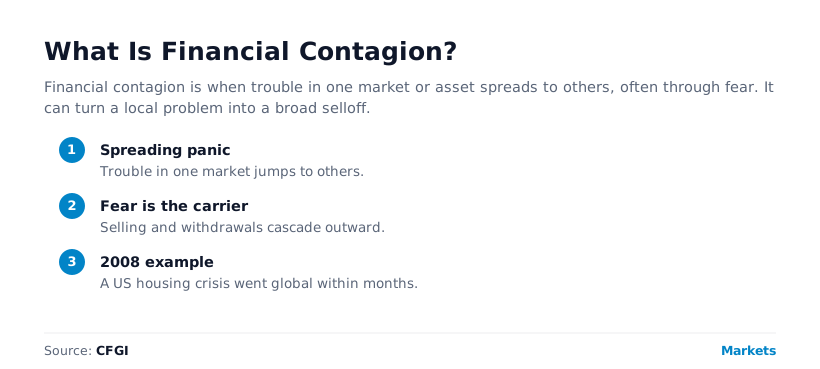
Financial contagion is when distress in one asset, institution or market spreads to others that may not be directly connected. It travels through real links, like shared lenders and forced selling, but also, crucially, through fear: panic in one place makes investors flee risk everywhere. Contagion is how a local problem can become a global sell-off, it is why correlations jump in a crisis, and it shows up as a fast, broad collapse in sentiment. This is education, not financial advice.
CFGI data
Contagion is fear spreading faster than fundamentals. When one shock turns into broad panic, CFGI’s score falls across many assets at once, the equity 3 on 8 April 2025 reflected exactly that kind of wide, fear-driven move on the 0 to 100 scale. Per-asset scoring shows how far the fear has spread.
Source: CFGI dataset, 2021 to June 2026.
Key takeaways
- Contagion is distress in one place spreading to others.
- It travels through mechanical links and through fear.
- In a crisis, correlations jump and diversification weakens.
- It can turn a local problem into a global sell-off.
- It shows up as a fast, wide collapse in sentiment.
How Trouble Spreads
Contagion has two channels. The first is mechanical: institutions share lenders and counterparties, and forced selling in one place, to meet margin calls or redemptions, drives down prices elsewhere. The second is emotional: when investors see panic in one market, fear spreads, and they sell risk across the board even where nothing has fundamentally changed. The emotional channel is why contagion can be so fast and so wide. Fear does not respect the boundaries between assets; a flight to safety in one corner can drain risk appetite everywhere at once.
The Mechanical Channel
The first way trouble spreads is through real, physical connections in the financial plumbing. Banks, funds and traders lend to and borrow from one another, so when one firm fails, the institutions that lent to it take losses too, and may be dragged down in turn. Leverage accelerates this: when a fund faces losses and margin calls, it is forced to sell whatever it can, often its healthiest, most liquid assets, which pushes down the prices of those assets and inflicts losses on everyone else who holds them. That triggers fresh margin calls and more forced selling, a deleveraging cascade. Through these shared counterparties and fire sales, a problem in one corner mechanically transmits into others that seemed unrelated.
The Fear Channel
The second channel is psychological, and often faster and more powerful. When investors see one market in freefall, fear becomes generalised: they stop trusting their assumptions, rush to reduce risk, and sell things that have no real connection to the original problem, simply because everything suddenly feels dangerous. This is why a saying among traders holds that "in a crisis, all correlations go to one", meaning assets that normally move independently start falling together. The fear channel does not need any mechanical link at all; a frightening headline and a herd instinct are enough. It is contagion as pure sentiment, and it can engulf markets in hours.
Correlations Go to One
In calm times, different assets move independently. In a panic, they crash together as fear overrides fundamentals, which is exactly when the diversification you were counting on does least.
Contagion In History
The pattern recurs across eras and markets. The 1997 Asian financial crisis gave the term its modern fame, as trouble in Thailand spread across the region and beyond. The 2008 global financial crisis saw losses on US subprime mortgages cascade through interconnected banks into a worldwide collapse. And crypto has lived its own version: in 2022, the failure of the Terra stablecoin rippled into the hedge fund Three Arrows Capital, then the lender Celsius, and ultimately the exchange FTX, a domino chain of linked failures. In each case, a problem that looked contained, one country, one mortgage type, one token, proved to be the first domino in a much longer line.
Why Diversification Can Fail When You Need It
Contagion exposes a hard truth about diversification: it works wonderfully in normal times and weakest in a crisis. Spreading money across many assets protects you against isolated, asset-specific problems, but contagion is precisely the event in which everything falls together, so the protection thins out at the worst possible moment. This is one reason genuine safe havens, cash, high-quality government bonds, sometimes gold, matter: they are among the few things that can hold or rise when contagion drags almost everything else down. Understanding contagion is understanding why "I’m diversified" is reassurance for ordinary turbulence, not for a full-blown panic.
Contagion and Sentiment
Because contagion spreads through fear, it registers as a broad, simultaneous drop across a Fear and Greed Index. When many different assets all swing toward Extreme Fear at once, it is a sign that panic, not just fundamentals, is driving the move, the signature of contagion rather than an isolated sell-off. This is where CFGI’s per-asset scoring is especially revealing: by reading hundreds of assets individually, it shows how far the fear has actually reached, whether the panic is contained to one corner or has gone system-wide. A wall of red across unrelated assets is contagion made visible.
Frequently asked questions
What is financial contagion?
When distress in one asset, institution or market spreads to others, through real links like shared lenders and forced selling, and through fear that drives investors to flee risk everywhere, even where nothing has changed.
How does contagion spread?
Two ways: mechanically, through shared counterparties, leverage and forced selling, and emotionally, as panic in one market makes investors sell risk across the board. The fear channel needs no real link at all.
Why does diversification fail in a contagion?
Because contagion is the event in which normally independent assets fall together, "all correlations go to one". Diversification protects against isolated problems, but its protection thins exactly when a broad panic hits.
How does contagion show on the Fear and Greed Index?
As a broad, simultaneous drop across many assets toward Extreme Fear. When everything swings fearful at once, panic, not just fundamentals, is driving it, and per-asset scoring shows how far it has spread. This is education, not financial advice.
CFGI.io, Market sentiment research
The CFGI research team builds and maintains the CFGI Fear and Greed Index: a 0 to 100 sentiment score from 10 sub-indicators across hundreds of crypto assets and the equity market, refreshed every 15 minutes. We have tracked market emotion through multiple full crypto and equity cycles.
Think we missed something?
Spotted a gap, disagree with a take, or think we should cover a new topic? Message us and we'll act on your input.
Message us on TelegramKeep reading
This article is educational and is not financial advice. Crypto and equities are volatile and you can lose money. See our disclaimer.