Markets
What Is a Black Swan Event?
Quick answer
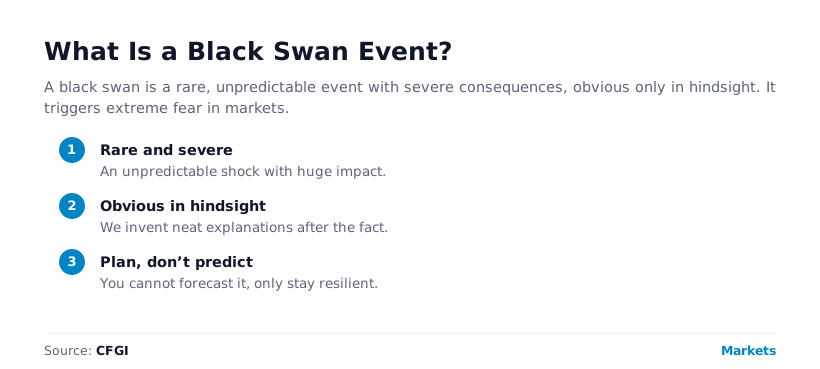
A black swan is a rare, high-impact event that is almost impossible to predict in advance and seems obvious only in hindsight. In markets, black swans, like a sudden crisis or shock, trigger violent sell-offs because no one was positioned for them. They drive sentiment to Extreme Fear within hours, and their real lesson is that risk management matters far more than forecasting: you cannot predict a black swan, but you can build a portfolio that survives one. This is education, not financial advice.
CFGI data
Black swans produce the sharpest moves on the scale. The CFGI equity score collapsing to an extreme-fear 3 on 8 April 2025 shows how fast a shock can pin sentiment at the bottom of its 0 to 100 range, far faster than greed ever builds. Such events are why fear extremes are reached more abruptly, and more often, than greed ones.
Source: CFGI dataset, 2021 to June 2026.
Key takeaways
- A black swan is rare, high-impact and nearly impossible to predict.
- Taleb’s three criteria include being rationalised as obvious in hindsight.
- Standard risk models miss them because real markets have "fat tails".
- The point is not to predict them but to survive them.
- They push sentiment to Extreme Fear faster than anything else.
The Unpredictable Shock
The term, popularised by Nassim Nicholas Taleb in his 2007 book, describes events that sit outside the realm of normal expectations. Because they cannot be forecast, markets are never positioned for them, and that is exactly why the reaction is so violent: prices have to reprice an entire new reality all at once, with no warning and no cushion. The name comes from the old assumption that all swans were white, until black ones were discovered, a single observation that shattered a belief no amount of past data had questioned.
Taleb’s Three Criteria
Taleb defined a black swan by three specific features, and all three matter.
- It is an outlier. It lies outside normal expectations, because nothing in the past convincingly pointed to it.
- It has extreme impact. When it happens, the consequences are severe, not a minor surprise.
- It is explained in hindsight. Afterwards, people construct stories that make it seem predictable, "the signs were all there", even though no one acted on them.
That third criterion is the sneaky one. Hindsight bias convinces us, after the fact, that we could have seen it coming, which breeds dangerous overconfidence about the next one.
Why Standard Models Miss Them: Fat Tails
Part of Taleb’s argument is that conventional finance is structurally blind to black swans. Many risk models, such as Value at Risk, assume that returns follow a tidy bell curve and lean heavily on historical data, which by definition excludes the unprecedented. Real markets, though, have "fat tails": extreme events happen far more often, and are far larger, than a bell curve predicts. By treating rare catastrophes as essentially impossible, these models give a false sense of safety and can leave institutions most exposed precisely where the danger is greatest. Understanding fat tails is understanding why "once in a century" market events seem to arrive every decade or so.
The Famous Black Swans
History offers a grim roll call. The 2008 global financial crisis and the collapse of Lehman Brothers, the September 11 attacks, the bursting of the dotcom bubble, the 1987 "Black Monday" crash, and the 2011 Japanese earthquake and tsunami are all cited as black swans: rare, severe, and unforeseen by the markets they upended. Each one repriced the world violently, wiped out those who had quietly bet against such events ever happening, and was then neatly explained in hindsight as though it had been obvious all along. The list is a reminder that the next one will look just as inevitable afterwards, and just as invisible before.
Black Swan Or White Swan?
The term is widely misused, often slapped on any unpleasant surprise. Taleb himself is strict about it, and tellingly argued that the COVID-19 pandemic was not a black swan at all but a "white swan": a foreseeable event. Virologists and risk experts had warned for years that a global pandemic was not just possible but likely; the failure was one of preparation, not prediction. The distinction matters. A true black swan is genuinely unforeseeable; a white swan is a known risk that was ignored. Calling every crisis a black swan is a convenient way to dodge responsibility for risks that were, in fact, on the table all along.
The Honest Test
Before labelling something a black swan, ask whether it was truly unforeseeable, or simply unwelcome and ignored. Most "black swans" turn out, on inspection, to be white swans nobody wanted to look at.
The Lesson: Survive, Don’t Predict
The paradox at the heart of black swan theory is that you cannot predict a specific one, yet you can be certain that some will occur. That flips the goal of risk management from forecasting to robustness. The practical defences are unglamorous but powerful: genuine diversification, so no single shock can ruin you; sensible position sizing, never betting more than you can afford to lose; keeping some cash and avoiding extreme leverage, so a sudden crash does not force you to sell at the bottom. The aim is not to dodge the unforeseeable, which is impossible, but to build a portfolio that bends rather than breaks when it arrives.
Black Swans and Extreme Fear
A Fear and Greed Index will not warn you of a black swan, nothing can, but it captures the aftermath instantly, plunging to Extreme Fear on its 0 to 100 scale as the crowd reacts to a reality no one priced in. The index reads the shock; it does not predict it. That is worth remembering both ways: do not expect any sentiment gauge to see a true black swan coming, but do expect it to register the panic in real time, which can at least help you keep your head, and your plan, when the unforeseeable finally lands.
Frequently asked questions
What is a black swan event?
A rare, high-impact event that is almost impossible to predict and seems obvious only in hindsight, by Nassim Taleb’s definition. In markets, black swans trigger violent sell-offs because no one was positioned for them.
Why do standard risk models miss black swans?
Because models like Value at Risk assume a bell-curve distribution and rely on historical data, which excludes the unprecedented. Real markets have "fat tails", where extreme events happen far more often and larger than those models predict.
Was COVID-19 a black swan?
Taleb himself argued it was not, calling it a "white swan": a foreseeable risk that experts had long warned about. The failure was preparation, not prediction. The term is often misused for any unwelcome surprise.
Can you predict a black swan?
No, by definition. The point is not to forecast specific events but to survive them, through diversification, position sizing, limited leverage and prudent risk management. This is education, not financial advice.
CFGI.io, Market sentiment research
The CFGI research team builds and maintains the CFGI Fear and Greed Index: a 0 to 100 sentiment score from 10 sub-indicators across hundreds of crypto assets and the equity market, refreshed every 15 minutes. We have tracked market emotion through multiple full crypto and equity cycles.
Think we missed something?
Spotted a gap, disagree with a take, or think we should cover a new topic? Message us and we'll act on your input.
Message us on TelegramKeep reading
This article is educational and is not financial advice. Crypto and equities are volatile and you can lose money. See our disclaimer.