Crypto
What Is HODLing?
Quick answer
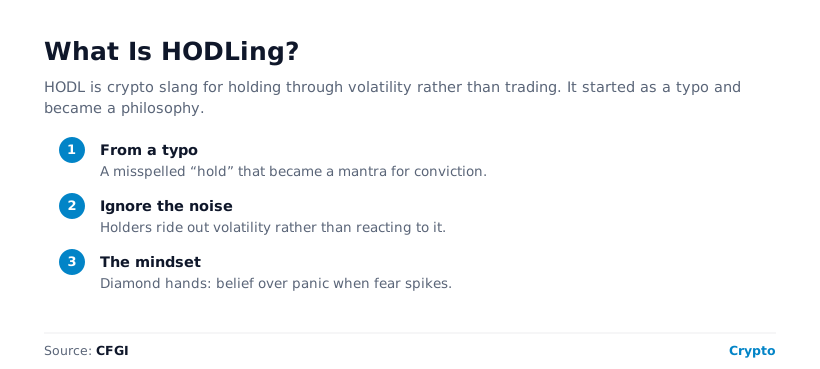
HODL is crypto slang for holding a coin through ups and downs rather than trying to trade in and out. It began as a misspelling of "hold" in a 2013 forum post and is now often read as "hold on for dear life." HODLing is a deliberate way to sidestep emotional trading: by committing to hold, you avoid panic selling in fear and chasing in greed. The trade-off is that you ride the full drawdowns and carry full market risk, so it takes conviction and a long horizon. This is education, not financial advice.
CFGI data
HODLing is essentially a strategy for ignoring the sentiment swings CFGI measures. Where the index has moved between Extreme Fear and Greed across hundreds of assets since March 2022, a HODLer chooses not to act on those swings, accepting volatility as the price of a long horizon.
Source: CFGI dataset, March 2022 to June 2026.
Key takeaways
- HODL means holding through volatility rather than trading.
- It started as a typo for "hold" and became a philosophy.
- It is a way to avoid emotional, in-and-out trading.
- It carries full market risk and full drawdowns.
- Conviction in the asset is what makes it work, or fail.
From Typo to Philosophy
The word comes from a 2013 Bitcoin forum post titled "I AM HODLING", a drunken misspelling of holding that the community adopted. It now stands for the idea of holding through volatility, sometimes glossed as "hold on for dear life", rather than trading the swings. As an approach, HODLing is a way to remove emotion: by deciding in advance to hold, a HODLer sidesteps the panic selling and FOMO buying that hurt returns. The trade-off is that you ride the full drawdowns, which takes conviction and a long horizon.
Why HODLers Hold
The case for HODLing rests on two sturdy ideas. The first is that timing the market is extraordinarily hard, and most who try it underperform; by committing to hold, you sidestep the temptation to sell low in fear and buy high in greed that wrecks so many returns. The second is the brutal maths of missing the best days: a handful of the strongest sessions account for a huge share of long-run gains, and because those days often cluster right after the scariest drops, the trader who flees in fear tends to miss exactly the rebound that matters most. A HODLer accepts gut-wrenching volatility as the price of admission for the long-term upside they believe in, choosing patience over precision.
HODLing Versus Trading and DCA
HODLing sits at the patient end of a spectrum of approaches. Active trading tries to profit from the swings by getting in and out, which is high-effort, high-risk, and where most people underperform a simple hold. HODLing does the opposite: buy and then hold through everything, accepting the full ride. A close cousin is dollar-cost averaging, buying a fixed amount at regular intervals regardless of price, which adds discipline by spreading your entry over time and is often paired with HODLing, accumulate steadily, then hold. All three are really answers to the same question of how much to let short-term price action drive your decisions, and HODLing’s answer is: as little as humanly possible.
The Risks of HODLing
HODLing is not a magic shield, and an honest account has to name its dangers. It carries the full market risk of the asset, including crypto’s brutal 70 to 80% drawdowns in a crypto winter, which can take years to recover, if they recover at all. The deeper trap is "HODLing" the wrong thing: blind, stubborn holding of a coin whose thesis has collapsed, or that was a scam to begin with, is not conviction but denial, the same trap as mistaking diamond hands for wisdom. Real HODLing rests on an ongoing belief that the asset is genuinely worth owning; it is not a licence to stop thinking. And concentrating everything in one or two coins, as many HODLers do, magnifies the risk if that conviction proves wrong.
HODL Is Not "Never Re-Examine"
Holding through volatility is discipline; holding a broken project to zero is denial. The line is whether the asset is still genuinely worth owning, a question worth revisiting, not ignoring.
HODLing and Sentiment
A HODLer largely ignores the Crypto Fear and Greed Index day to day, which is the point: the whole strategy is about not reacting to the swings it measures. But it still has value as a mirror. Noticing that you desperately want to break your HODL during Extreme Fear is exactly the moment the strategy is designed to protect you from, because that is when panic selling does the most damage. Equally, feeling the urge to pile in more during Extreme Greed is the FOMO the approach guards against. HODLing does not remove risk; it removes the temptation to act on emotion, and a sentiment gauge can quietly confirm, at the extremes, that the emotion you are feeling is precisely the one to resist.
Frequently asked questions
What does HODL mean?
It is crypto slang for holding a coin through volatility rather than trading it. It started as a misspelling of "hold" in a 2013 forum post and is now read as "hold on for dear life."
Why do HODLers hold instead of trade?
Because timing the market is very hard and most who try it underperform, and because the best days, which drive much of the long-run return, often cluster right after the scariest drops. A HODLer accepts volatility as the price of the long-term upside.
Is HODLing a good strategy?
It removes emotional trading by committing to hold, which suits a long horizon and high conviction. But it carries full market risk and full drawdowns of 70 to 80% in crypto winters, and it is not a licence to hold a broken project blindly. It is not right for everyone.
Does HODLing ignore the Fear and Greed Index?
Largely, by design. The index still works as a mirror: wanting to break a HODL during Extreme Fear, or pile in during Extreme Greed, is the exact emotion the approach exists to resist. This is education, not financial advice.
CFGI.io, Market sentiment research
The CFGI research team builds and maintains the CFGI Fear and Greed Index: a 0 to 100 sentiment score from 10 sub-indicators across hundreds of crypto assets and the equity market, refreshed every 15 minutes. We have tracked market emotion through multiple full crypto and equity cycles.
Think we missed something?
Spotted a gap, disagree with a take, or think we should cover a new topic? Message us and we'll act on your input.
Message us on TelegramKeep reading
This article is educational and is not financial advice. Crypto and equities are volatile and you can lose money. See our disclaimer.