Crypto
What Is Bitcoin?
Quick answer
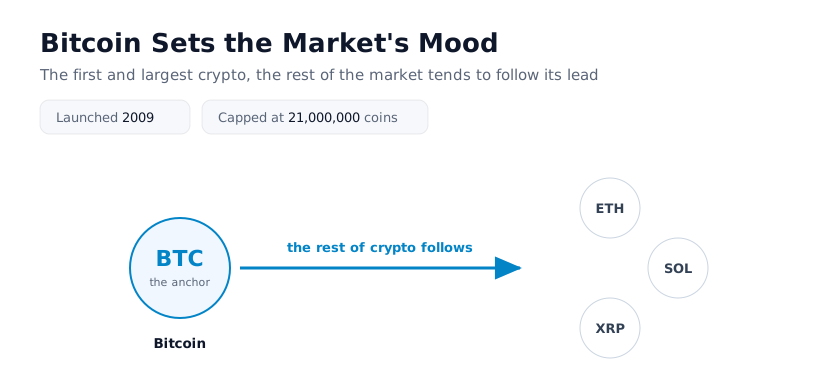
Bitcoin is the first and largest cryptocurrency, launched in 2009. It is digital money on a public blockchain, with a fixed supply capped at 21 million coins and no central authority. Its scarcity and decentralisation underpin the "digital gold" case for it as a store of value. Because it is the biggest and oldest crypto asset, Bitcoin sets the emotional tone for the whole market, and the rest of crypto tends to follow its mood. This is education, not financial advice.
CFGI data
Bitcoin is the market anchor, and CFGI scores it on its own 0 to 100 scale. Bitcoin has run from an all-time low of 10 on 5 February 2026 to a high of 89 on 28 February 2024, and that 10 sat below the wider market’s 12 the same day, so Bitcoin led the bottom.
Source: CFGI dataset, March 2022 to June 2026.
Key takeaways
- Bitcoin is the first and largest cryptocurrency, launched in 2009.
- Its supply is capped at 21 million coins, and no company or government controls it.
- Its scarcity underpins the "digital gold" store-of-value case.
- As the biggest asset, Bitcoin sets the mood for the whole crypto market.
- CFGI data shows the major coins track Bitcoin closely.
What Is Bitcoin?
Bitcoin is a cryptocurrency: digital money that lives on a blockchain, a shared ledger maintained by a global network rather than a bank. It was launched in 2009 by the pseudonymous Satoshi Nakamoto, and it was the first asset to let strangers send value online without a middleman, solving a problem, how to prevent digital money from being copied and spent twice, that had stumped computer scientists for decades. It is also the largest crypto asset by far, which is why people treat it as the market benchmark, the asset against which all of crypto is measured.
How Does Bitcoin Work?
- Fixed supply: only 21 million Bitcoin will ever exist, written into the code.
- Mining: computers compete to validate transactions and are rewarded with new Bitcoin, a process called proof of work.
- The halving: roughly every four years the mining reward halves, slowing new supply.
- Self-custody: you hold a private key that controls your coins; there is no bank to reset it.
Together these features make Bitcoin "decentralised": no company, government or individual is in charge, the network is run by thousands of independent computers around the world following the same rules, which is what makes it resistant to censorship and control.
Why Does Bitcoin Have Value?
Bitcoin has value for the same reason any money does: people collectively accept that it does. This can feel unsatisfying, but it is equally true of a paper banknote or a bar of gold, whose worth also rests on shared agreement rather than physical usefulness. What gives Bitcoin its particular case is a combination of properties: it is genuinely scarce (capped at 21 million), it is decentralised and hard to censor or seize, it is divisible and easy to send anywhere in the world, and it is durable in a way a digital record maintained by a global network can be. As with all money, that value is ultimately collective confidence, and confidence moves with sentiment, which is exactly why Bitcoin’s price can swing so dramatically on shifts in the crowd’s mood.
Bitcoin As "Digital Gold"
The most influential thesis for Bitcoin is that it is "digital gold", a modern, digital store of value to rival the ancient one. The parallel is rooted in scarcity: where gold is scarce because it is hard to mine, Bitcoin is scarce by design, with a hard 21-million cap that no government or central bank can inflate away, in deliberate contrast to ordinary "fiat" currencies that can be printed at will. Proponents argue this makes Bitcoin a potential hedge against the debasement of paper money and a censorship-resistant way to hold wealth outside the traditional financial system, which is why it has attracted growing interest from individuals and institutions as a long-term holding. Critics counter that it is too volatile to be a reliable store of value and lacks gold’s long history. Either way, the digital-gold narrative is central to understanding Bitcoin: much of its long-term investment case, and much of the conviction of its holders, rests on the idea of provably scarce, decentralised money in a world of inflating currencies.
Scarce by Design
Bitcoin’s 21-million cap is its defining feature: unlike fiat money that can be printed, it cannot be inflated away. That provable scarcity is the heart of the "digital gold" store-of-value case.
Why Does Bitcoin Set the Market Mood?
Bitcoin is the anchor of crypto sentiment. When Bitcoin is fearful, that fear tends to spread; when it runs hot, the market often follows. CFGI data shows just how tightly the majors track it: Ethereum moves in step with Bitcoin 78% of the time, the tightest of the majors, with the rest in the low 70s. This is why Bitcoin is treated as the bellwether of the entire asset class, a sharp move in Bitcoin sets the emotional tone, and altcoins, being smaller and riskier, tend to amplify whatever Bitcoin does, rising harder in its rallies and falling harder in its declines. Bitcoin’s own all-time fear low of 10 even sat below the wider market’s 12 on the same day, a sign it can lead the market into and out of its extremes. You can watch Bitcoin sentiment on the Bitcoin Fear and Greed Index and compare it with the wider crypto market.
Frequently asked questions
What is Bitcoin?
The first and largest cryptocurrency, launched in 2009 by the pseudonymous Satoshi Nakamoto. It is digital money on a public blockchain, with a fixed supply capped at 21 million coins and no central authority, the first asset to let strangers send value online without a middleman.
How many Bitcoin are there?
Bitcoin is capped at 21 million coins, and that limit is fixed in its code. Most have already been mined; the rest are released slowly, with the rate halving roughly every four years.
Why is Bitcoin called "digital gold"?
Because, like gold, it is genuinely scarce, capped at 21 million and impossible for any government to inflate away, and is seen as a decentralised, censorship-resistant store of value. The thesis is that it is a modern hedge against the debasement of paper money. Critics note it is far more volatile than gold.
Why does the whole crypto market follow Bitcoin?
Bitcoin is the largest and most liquid crypto asset, so it acts as the market benchmark. CFGI data shows the majors track its sentiment closely, with Ethereum at 78% in step, so when Bitcoin moves the rest tend to as well. This is education, not financial advice.
CFGI.io, Market sentiment research
The CFGI research team builds and maintains the CFGI Fear and Greed Index: a 0 to 100 sentiment score from 10 sub-indicators across hundreds of crypto assets and the equity market, refreshed every 15 minutes. We have tracked market emotion through multiple full crypto and equity cycles.
Think we missed something?
Spotted a gap, disagree with a take, or think we should cover a new topic? Message us and we'll act on your input.
Message us on TelegramKeep reading
This article is educational and is not financial advice. Crypto and equities are volatile and you can lose money. See our disclaimer.