Markets
Trading vs Investing: What Is the Difference?
Quick answer
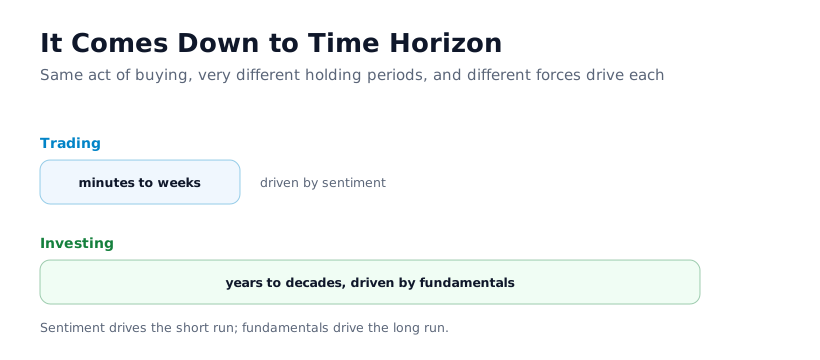
Trading and investing both mean buying assets, but over very different time horizons. A trader seeks short-term profit from price moves and holds for minutes to weeks, leaning on charts, momentum and sentiment. An investor holds for years, aiming to grow with an asset’s long-term value, leaning on fundamentals. That gap matters because sentiment and emotion drive the short run, while fundamentals drive the long run, and the data strongly favours patient investing for most people. This is education, not financial advice.
CFGI data
Sentiment matters most over short horizons, which is why traders watch it more than long-term investors. CFGI scores it from 0 to 100 across more than 100 crypto and equity assets, refreshed every 15 minutes since March 2022, so the short-term mood is readable while the long-term picture is left to fundamentals.
Source: CFGI dataset, March 2022 to June 2026.
Key takeaways
- Trading is short-term; investing is long-term.
- Time horizon is the core difference, and it changes everything else.
- Sentiment drives the short run; fundamentals drive the long run.
- The data shows most traders, and most active funds, underperform.
- You can do both, as long as you keep the horizons separate.
What Is the Difference?
| Trading | Investing | |
|---|---|---|
| Time horizon | Minutes to weeks | Years to decades |
| Goal | Profit from price moves | Grow with the asset |
| Main driver | Sentiment and momentum | Fundamentals and value |
| Tools | Charts, technicals | Earnings, valuation |
| Activity | Frequent | Patient |
Two different games.
The Core Difference: Time Horizon
Everything flows from the holding period. A short horizon forces a trader to care about minute-by-minute moves, to act frequently, to watch costs and short-term taxes that eat into rapid gains, and to manage the stress of constant decisions. A long horizon lets an investor largely ignore the daily noise, act rarely, defer tax, and let compounding do the heavy lifting over years. The two are not just different strategies; they are different relationships with time itself, and confusing them, treating a long-term holding like a trade, or a trade like an investment, is one of the most common ways people get into trouble.
Different Analysis: Technical Versus Fundamental
Because they answer different questions, the two camps lean on different tools. Traders use technical analysis, charts, momentum, volume and sentiment, to read what the price is doing now and might do next. Investors use fundamental analysis, earnings, cash flow, valuation and competitive position, to judge what a business is actually worth over time. Benjamin Graham’s famous line captures why both work in their own domain: in the short run the market is a voting machine, in the long run a weighing machine. Over days, votes, which is to say emotion, win; over years, weight, which is to say value, wins.
The Data: Which One Wins?
The evidence here is unusually one-sided. Study after study finds that the large majority of active traders lose money over time, with success rates that fall further the longer people persist, because frequent trading runs into costs, taxes and the near-randomness of short-term moves. The same pattern holds one level up: most professional active fund managers fail to beat a simple index over long periods, with figures often around 90% underperforming over 15 years. The conclusion most evidence points to is humbling but useful: for the average person, patient, low-cost, long-term investing beats active trading, not because trading cannot work, but because doing it well, consistently, is extraordinarily hard.
The Honest Odds
Trading is not impossible, but the base rates are brutal. Most who try it underperform a boring buy-and-hold approach, which is the single most important fact to weigh before choosing the trader’s path.
Active Versus Passive: A Related Split
Even within investing there is a milder version of the same debate: active versus passive. Active investors try to pick winning stocks or time the market to beat an index, usually at higher cost; passive investors simply buy the whole market cheaply and hold. As with trading, the long-run data favours the lower-effort, lower-cost side: most active strategies trail a passive index over time. The throughline across all of these comparisons, trading versus investing, active versus passive, is the same: costs and effort are reliable, while outperformance is elusive, so the patient, cheap approach tends to win for most people.
Can You Do Both?
Yes, and many people sensibly do. A common structure is a "core and satellite" approach: build a large, long-term, diversified core that you leave alone, and set aside a small, separate amount to trade or speculate with, money you could afford to lose. The one rule that matters is to keep the two horizons cleanly separated. The damage is done when they bleed into each other, when a trade that goes wrong gets quietly "reclassified" as a long-term investment to avoid taking the loss, or when a long-term holding is panic-traded on a bad day. Decide which game you are playing before you act, not after.
Where Does Sentiment Fit?
Sentiment sits at the heart of trading and the edge of investing. For a trader, a Fear and Greed Index shows whether the crowd is stretched right now, valuable in a world where short-term moves are driven by mood. For a long-term investor, the same gauge is more of a sanity check: extreme readings are a reminder not to buy into euphoria or panic-sell into fear, the two moments that do the most damage to a long-run plan. Either way it is context, not instruction, weighted heavily by the trader and lightly by the investor, but useful to both.
Frequently asked questions
What is the difference between trading and investing?
Trading is short-term buying and selling for quick profit, using charts and momentum, over minutes to weeks. Investing is long-term holding to grow with an asset’s value, using fundamentals, over years to decades. Time horizon is the core difference.
Is trading or investing better?
Neither is universally better, but the data strongly favours investing for most people: the majority of active traders, and of active fund managers, underperform a patient, low-cost, long-term approach over time. It comes down to your goals, effort and risk tolerance.
Can you do both?
Yes. A common approach is a large long-term core plus a small, separate amount to trade. The key is to keep the two horizons cleanly separated and never reclassify a failed trade as a "long-term investment".
Does sentiment matter for long-term investors?
Less than for traders, but it still helps as a check: extreme greed or fear can flag a bad moment to act emotionally. Over the long run, fundamentals dominate. This is education, not financial advice.
CFGI.io, Market sentiment research
The CFGI research team builds and maintains the CFGI Fear and Greed Index: a 0 to 100 sentiment score from 10 sub-indicators across hundreds of crypto assets and the equity market, refreshed every 15 minutes. We have tracked market emotion through multiple full crypto and equity cycles.
Think we missed something?
Spotted a gap, disagree with a take, or think we should cover a new topic? Message us and we'll act on your input.
Message us on TelegramKeep reading
This article is educational and is not financial advice. Crypto and equities are volatile and you can lose money. See our disclaimer.