Stocks
What Is Panic Selling?
Quick answer
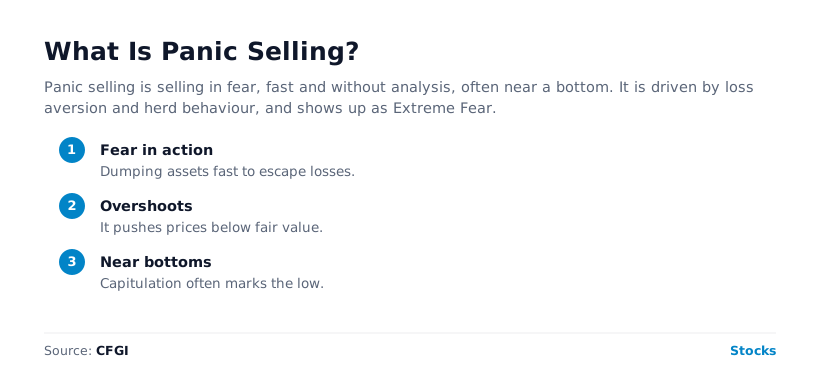
Panic selling is when investors sell quickly out of fear rather than analysis, usually during a sharp decline. Driven by loss aversion and the urge to follow the crowd, it feeds on itself: falling prices trigger more selling, stop-loss and automated orders fire, and prices drop lower still. Because it represents peak fear, panic selling often clusters near market bottoms and reads as Extreme Fear on a sentiment index, the opposite of where most investors should want to sell. This is education, not financial advice.
CFGI data
Panic selling is the behaviour behind the deepest readings. The CFGI equity score hit an extreme-fear 3 on 8 April 2025, near the bottom of its 0 to 100 range, the data signature of a crowd selling in fear, and such lows have historically sat closer to turning points than to the start of a decline.
Source: CFGI dataset, 2021 to June 2026.
Key takeaways
- Panic selling is selling in fear, fast and without analysis.
- It is driven by loss aversion and herd behaviour.
- Cascades are amplified by stop-loss and automated orders.
- It often clusters near market bottoms, reading as Extreme Fear.
- Selling at peak panic usually locks in losses near a low.
Why Investors Panic Sell
Panic selling is emotion overriding plan. When prices fall fast, loss aversion, the pain of losses felt about twice as strongly as gains, pushes investors to sell just to stop the hurt. Herd behaviour amplifies it: seeing others sell makes selling feel urgent. The result is a cascade, where each wave of selling drives prices lower, which triggers the next wave. It tends to exhaust itself only when most sellers are out, which is why panic selling often marks a low rather than the start of one.
The Anatomy of a Cascade
Panic selling turns an ordinary decline into a freefall through a chain reaction. A sharp drop triggers fear, prompting some investors to sell. That selling pushes prices lower, which trips pre-set "stop-loss" orders that automatically sell when a price is hit, adding a wave of mechanical selling on top of the emotional kind. Lower prices then hit leveraged traders with margin calls, forcing yet more sales, and the falling market frightens still more people into joining. Each link tightens the next, and the spiral accelerates. This is how a manageable dip can become a violent crash in minutes: the selling itself manufactures the conditions for more selling, with fear and automation feeding each other.
Panic Selling In History
The pattern recurs across every major crash.
| Event | What happened |
|---|---|
| 1987 Black Monday | Dow fell 22.6% in one day, automated selling |
| 2008 crisis | Fear of collapse drove mass liquidations |
| 2020 COVID crash | S&P 500 fell over 30%, then rebounded |
Famous panics.
1987’s "Black Monday", still the largest one-day percentage drop in history, was supercharged by automated "portfolio insurance" selling. And 2020 is the cautionary tale: many who panic-sold near the COVID lows locked in losses just before one of the fastest recoveries on record.
Capitulation: Panic At Its Peak
The most extreme panic selling has a name: capitulation, the final flush when even committed, long-term holders give up and sell in despair. It is the emotional bottom of the market cycle, the point of maximum fear, and it is statistically interesting because that last wave of forced and frightened selling can exhaust the supply of sellers entirely. When there is almost no one left to sell, the decline has nowhere to go but sideways or up. This is the deep paradox of panic: the moment it feels most unbearable, and most people are desperate to get out, has historically been closer to the bottom than the top, which is exactly why contrarians watch for it.
The Paradox of the Bottom
Panic selling feels safest at the exact moment it is most costly. Capitulation marks maximum fear, and maximum fear has more often sat near a low than near the start of a fall.
Circuit Breakers and the Cost of Panicking
After the 1987 crash, regulators introduced "circuit breakers", automatic, market-wide trading halts designed to interrupt a panic and give everyone a cooling-off period. In US stocks, a 7% intraday drop in the S&P 500 triggers a 15-minute halt, a 13% drop another, and a 20% drop closes the market for the day. They are an admission that panic selling is real and dangerous enough to need a circuit breaker, though critics note they can sometimes accelerate selling as traders rush to exit before a halt. For the individual investor, the deeper lesson is simpler: panic selling tends to crystallise losses at the worst possible price, so the most valuable discipline is usually a pre-made plan that keeps you from selling on emotion at all.
Panic Selling and Extreme Fear
On the Stock Fear and Greed Index, panic selling reads as Extreme Fear, the bottom of the scale. The index will not call the exact low, but a deep fear reading during a sharp decline is the signature of a crowd selling on emotion, and CFGI’s equity score of 3 in April 2025 is a textbook example. Read with the contrarian’s eye, such a reading is less a reason to join the selling than a reason to question it: when the gauge screams Extreme Fear and you feel the overwhelming urge to sell everything, that is precisely the moment history suggests you should slow down rather than capitulate with the crowd.
Frequently asked questions
What is panic selling?
Selling quickly out of fear rather than analysis, usually during a sharp decline. It is driven by loss aversion and herd behaviour, and it feeds on itself as falling prices, stop-loss orders and margin calls trigger more selling.
How does a panic-selling cascade work?
A sharp drop triggers fear-driven selling, which pushes prices lower, tripping automated stop-loss orders and margin calls that force more selling. Each wave manufactures the next, turning a manageable dip into a violent crash.
What is capitulation?
The final flush of panic selling, when even committed holders give up in despair. It marks maximum fear and can exhaust the supply of sellers, which is why it has historically sat closer to market bottoms than tops.
Is panic selling a good idea?
Rarely. Selling at peak fear usually locks in losses near a bottom, as many learned by selling the 2020 COVID lows just before a sharp rebound. A pre-made plan that prevents emotional selling is usually the better defence. This is education, not financial advice.
CFGI.io, Market sentiment research
The CFGI research team builds and maintains the CFGI Fear and Greed Index: a 0 to 100 sentiment score from 10 sub-indicators across hundreds of crypto assets and the equity market, refreshed every 15 minutes. We have tracked market emotion through multiple full crypto and equity cycles.
Think we missed something?
Spotted a gap, disagree with a take, or think we should cover a new topic? Message us and we'll act on your input.
Message us on TelegramKeep reading
This article is educational and is not financial advice. Crypto and equities are volatile and you can lose money. See our disclaimer.