Crypto
Using the Fear and Greed Index With Dollar-Cost Averaging
Quick answer
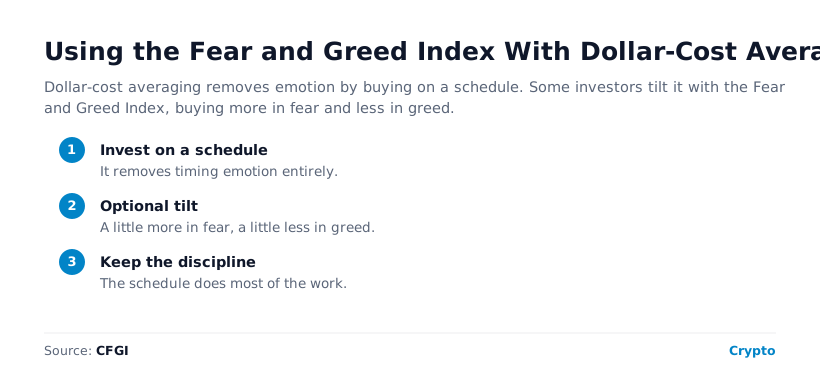
Dollar-cost averaging means investing a fixed amount on a regular schedule, regardless of price, which removes emotion from timing. Some investors tilt that schedule with the Fear and Greed Index: buying a little more on Extreme Fear days and a little less on Extreme Greed days. It is a way to lean contrarian without trying to call exact tops and bottoms, though the tilt should never override the core discipline of the schedule. This is education, not financial advice.
CFGI data
A sentiment tilt works only if extremes are meaningful, and in CFGI crypto data since March 2022 they cluster near turning points without marking them exactly. That is why a schedule-based approach, buying steadily and only nudging the amount at extremes, is more robust than trying to time the index precisely.
Source: CFGI dataset, March 2022 to June 2026.
Key takeaways
- Dollar-cost averaging invests a fixed amount on a schedule, removing timing emotion.
- It buys more units when cheap and fewer when expensive, lowering average cost.
- A sentiment tilt buys a little more in Extreme Fear, a little less in Extreme Greed.
- The tilt’s edge is modest; the core benefit is removing emotion.
- It still carries risk: fear can persist, and no method guarantees a profit.
Why Dollar-Cost Averaging Suits Sentiment
Dollar-cost averaging is investing a set amount at set intervals, say weekly, no matter the price. It works because it takes emotion out of timing, which is exactly what a Fear and Greed Index measures going wrong. The two pair naturally: a schedule keeps you steady, and sentiment data tells you when the crowd is most emotional. In a way they are two answers to the same problem, the human tendency to buy high in greed and sell low in fear, with dollar-cost averaging solving it by automation and the Fear and Greed Index solving it by awareness.
What Dollar-Cost Averaging Is, and Why It Works
The mechanics of dollar-cost averaging are simple but powerful. By investing the same fixed sum at regular intervals, you automatically buy more units of an asset when its price is low and fewer units when its price is high, which mathematically lowers your average cost per unit over time compared with the average price. More importantly, it removes the single hardest and most emotionally fraught decision in investing, when to buy, by making it automatic and recurring, so you never have to agonise over whether now is a good moment or try to time the perfect entry. This is especially valuable in a market as volatile and emotionally charged as crypto, where attempting to time entries is a fast route to buying tops in greed and freezing in fear. Dollar-cost averaging sidesteps all of that: you simply keep buying through the ups and downs, accumulating steadily, and let the discipline of the schedule do the work that willpower so often fails to. It is a strategy built explicitly to defeat the emotional mistakes a Fear and Greed Index exists to measure.
The Sentiment Tilt
A common idea is to keep the schedule but adjust the amount with the index: invest a bit more than usual on days the score is in Extreme Fear, and a bit less, or skip, on days it is in Extreme Greed. The aim is to accumulate more cheaply on average without abandoning the discipline of a schedule, essentially layering a gentle contrarian lean on top of the automated routine.
| Reading | Zone | Tilt |
|---|---|---|
| Under 20 | Extreme Fear | Invest a little more |
| 20 to 79 | Fear to Greed | Invest the usual amount |
| 80 to 100 | Extreme Greed | Invest less, or pause |
A simple sentiment-tilted schedule. An example, not advice.
Does the Tilt Actually Help?
It is worth being honest about how much a sentiment tilt adds, because it is easy to overstate. In principle, buying more when sentiment is fearful (and prices are often lower) and less when it is greedy can modestly improve your average cost, and over some periods it does. But the edge is genuinely modest and far from guaranteed, because, as the data shows, sentiment extremes cluster near turning points without marking them precisely: fear can stay extreme for weeks while prices keep falling, so "buying more in fear" sometimes just means buying more of a continuing decline. The crucial point is one of priority: the overwhelming majority of dollar-cost averaging’s benefit comes from the core discipline, the steady, automatic, emotion-free schedule, and a tilt should enhance that, never undermine it. The danger is letting the tilt become an excuse to deviate wildly, skipping contributions for months in greed or making outsized, fearful all-in bets, which reintroduces exactly the emotional, market-timing behaviour that dollar-cost averaging was designed to remove. A gentle nudge to the amount is reasonable; abandoning the schedule to chase the index is not.
Keep the Schedule, Nudge the Amount
The tilt’s edge is modest, because fear can persist. The real value of dollar-cost averaging is the disciplined schedule, so only nudge the amount at extremes; never let the tilt become an excuse to abandon the routine.
The Risks to Keep In Mind
A few honest caveats apply. A tilt is still exposure: buying more in fear can mean buying into a falling market, and fear can stay extreme for a long time, so a fearful day is no guarantee of a good entry. Dollar-cost averaging reduces timing risk but does not remove market risk, if an asset falls and never recovers, averaging in simply means you bought the whole way down, which is why what you choose to dollar-cost average into matters at least as much as the method. And no approach, tilted or plain, guarantees a profit in a volatile market. The sensible framing is to treat dollar-cost averaging as a disciplined, emotion-reducing way to build a position in something you have conviction in over the long term, optionally with a gentle sentiment lean, while sizing every contribution to what you can comfortably afford to lose and setting your rules in advance. Used that way, it is one of the more robust and beginner-friendly approaches to a hard market, precisely because it works with the discipline a Fear and Greed Index promotes rather than against it. This is education, not financial advice.
Frequently asked questions
What is dollar-cost averaging?
Investing a fixed amount at regular intervals, regardless of price. It automatically buys more units when prices are low and fewer when high, lowering your average cost over time, and it removes the hard, emotional decision of when to buy by making it automatic.
Can you combine dollar-cost averaging with the Fear and Greed Index?
Yes. The common approach is to keep a regular schedule but adjust the amount with the index: a little more in Extreme Fear, a little less in Extreme Greed. It leans contrarian while keeping the discipline of a schedule.
Does a sentiment tilt beat plain dollar-cost averaging?
It can in some periods and not in others. Extremes are meaningful but imprecise (fear can persist), so the edge is modest and not guaranteed. The bigger benefit of dollar-cost averaging is removing timing emotion, which a tilt should enhance, not override.
Is this a strategy I should follow?
It is an illustration of how the index is sometimes used, not advice. Any approach to a volatile market carries risk of loss, dollar-cost averaging reduces timing risk but not market risk. Decide your own rules, size sensibly, and treat sentiment as one input. This is education, not financial advice.
CFGI.io, Market sentiment research
The CFGI research team builds and maintains the CFGI Fear and Greed Index: a 0 to 100 sentiment score from 10 sub-indicators across hundreds of crypto assets and the equity market, refreshed every 15 minutes. We have tracked market emotion through multiple full crypto and equity cycles.
Think we missed something?
Spotted a gap, disagree with a take, or think we should cover a new topic? Message us and we'll act on your input.
Message us on TelegramKeep reading
This article is educational and is not financial advice. Crypto and equities are volatile and you can lose money. See our disclaimer.