Markets
What Is a Drawdown?
Quick answer
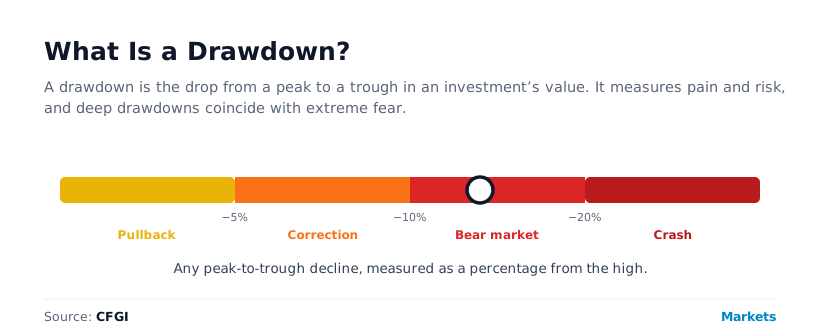
A drawdown is the decline from a peak to a subsequent low in the value of an investment or portfolio, usually measured as a percentage. It is the standard way to express how much has been lost from the top, and therefore how much pain a strategy can inflict. Maximum drawdown, the largest such fall, is one of the most important risk metrics there is, partly because deep drawdowns are punishingly hard to recover from. They are also when fear peaks, which is why they line up with the lowest readings on a Fear and Greed Index. This is education, not financial advice.
CFGI data
Drawdowns and fear move together. The deeper the fall from a peak, the more fearful the crowd, which is why a Fear and Greed Index bottoms during big drawdowns. CFGI’s equity 3 on 8 April 2025, near the bottom of its 0 to 100 range, came amid exactly such a decline.
Source: CFGI dataset, 2021 to June 2026.
Key takeaways
- A drawdown is the drop from a peak to a trough, in percent.
- Maximum drawdown is a key worst-case risk metric.
- Recovery is asymmetric: a 50% fall needs a 100% gain to recover.
- Deep drawdowns test nerves and trigger capitulation.
- They coincide with extreme fear at the bottom.
Measuring the Fall From the Top
If an investment rises to 100 and then falls to 70, it is in a 30% drawdown. The figure matters because it captures the worst-case pain along the way, not just the final return. A strategy that returns well but suffers a 60% drawdown is far harder to hold than one with a 20% drawdown, because deep losses test nerves. A drawdown is, in effect, the answer to the question every investor eventually asks in a downturn: "how far down am I from the best it ever was?"
Maximum Drawdown: The Key Risk Metric
"Maximum drawdown" is the single largest peak-to-trough decline an investment or strategy has ever suffered over a given period, and it is one of the most important numbers in risk management. Where average returns tell you how well something did, maximum drawdown tells you the worst it put you through to get there, the deepest hole you would have had to sit in before recovering. Two strategies with identical returns can have wildly different maximum drawdowns, and the one with the smaller drawdown is usually far easier, and safer, to actually live with. Professionals scrutinise maximum drawdown precisely because it captures the worst-case loss a strategy has genuinely produced, not a theoretical one.
The Brutal Recovery Math
Drawdowns are dangerous because recovering from them is asymmetric: the deeper the fall, the disproportionately larger the gain needed just to break even.
| Drawdown | Gain to break even |
|---|---|
| -20% | +25% |
| -50% | +100% |
| -80% | +400% |
| -90% | +900% |
The gain needed to recover a drawdown.
A 50% loss does not need a 50% gain to recover; it needs a 100% gain, because you are now working from a smaller base. This is why limiting drawdowns matters so much: avoiding a deep hole is often more valuable than chasing the last few percent of return, since the math of digging out only gets harder the further you fall.
Drawdown and the Psychology of Holding
Beyond the math, a drawdown is an emotional test, and that is where it does its real damage. It is one thing to know in theory that a strategy can fall 50%; it is another to watch half your money disappear and still hold on. Most people overestimate their tolerance until they are living through a deep drawdown, at which point fear takes over and they sell, locking in the loss at the worst possible moment. This is why matching a strategy’s likely maximum drawdown to your true risk tolerance is so important: the best plan in the world is worthless if its drawdowns are deep enough to scare you out at the bottom. Surviving a drawdown is as much about temperament as about returns.
How to Limit Drawdowns
Because deep drawdowns are so costly and so hard to endure, much of risk management is really about controlling them. Spreading money across uncorrelated assets through diversification softens the blow, since they are unlikely all to fall at once outside a true crisis. Sensible position sizing and avoiding excessive leverage keep any single loss from going catastrophic, leverage in particular turns ordinary drawdowns into account-ending ones. Holding some safe assets or cash provides ballast and dry powder. The unifying goal is not to eliminate drawdowns, which is impossible, but to keep them shallow enough that you can both recover from them mathematically and endure them emotionally.
Protect the Downside First
Limiting drawdowns is usually more valuable than maximising returns, because the recovery math and your own nerves both punish deep losses far more than shallow ones.
Drawdowns and Fear
The depth of a drawdown maps closely to the depth of fear. As losses from the peak grow, the crowd turns more fearful, which a Fear and Greed Index reads as falling toward Extreme Fear. The biggest drawdowns are where sentiment hits its lows, and where panic selling peaks, the exact moment, paradoxically, that has often marked the best opportunities for those able to hold their nerve. So a deep drawdown accompanied by an Extreme Fear reading is the classic capitulation signature: maximum pain, maximum fear, and frequently the point at which the selling is closest to exhausted.
Frequently asked questions
What is a drawdown?
The decline from a peak to a subsequent low in an investment’s value, usually measured as a percentage. It captures how much has been lost from the top, and so how much pain a strategy can inflict.
What is maximum drawdown?
The single largest peak-to-trough decline an investment or strategy has suffered over a period. It is a key risk metric because it shows the worst-case loss you would actually have had to endure, not a theoretical one.
Why are deep drawdowns so hard to recover from?
Because recovery is asymmetric. A 50% loss needs a 100% gain to break even, not 50%, since you are working from a smaller base. An 80% loss needs a 400% gain. The deeper the fall, the disproportionately harder the climb back.
How do drawdowns relate to fear and greed?
Deep drawdowns coincide with peak fear, so a Fear and Greed Index bottoms during big declines. The deeper the fall, the more fearful the crowd, and the closer the selling may be to exhaustion. This is education, not financial advice.
CFGI.io, Market sentiment research
The CFGI research team builds and maintains the CFGI Fear and Greed Index: a 0 to 100 sentiment score from 10 sub-indicators across hundreds of crypto assets and the equity market, refreshed every 15 minutes. We have tracked market emotion through multiple full crypto and equity cycles.
Think we missed something?
Spotted a gap, disagree with a take, or think we should cover a new topic? Message us and we'll act on your input.
Message us on TelegramKeep reading
This article is educational and is not financial advice. Crypto and equities are volatile and you can lose money. See our disclaimer.