Crypto
What Is a Stablecoin?
Quick answer
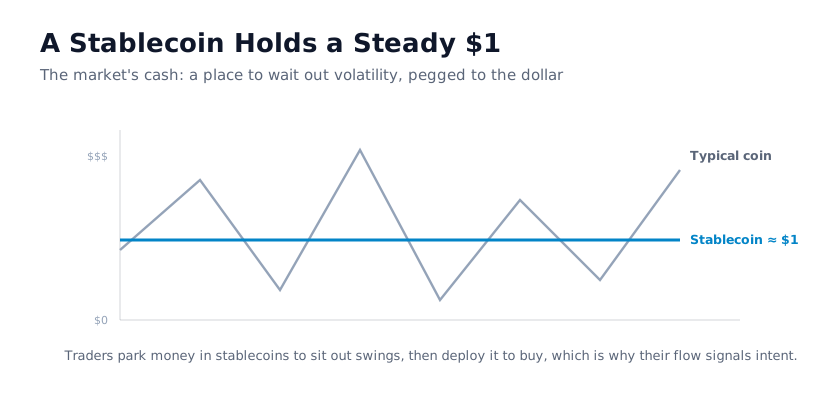
A stablecoin is a cryptocurrency designed to hold a steady value, usually pegged to a currency like the US dollar. It is the market’s cash: traders park money in stablecoins to sit out volatility, then deploy them to buy. They are the backbone of crypto trading, but their stability is a goal, not a guarantee, a peg can break. Because of all this, where stablecoins move is one of the clearest read-outs of buying intent in crypto. This is education, not financial advice.
CFGI data
Stablecoins are the market’s dry powder, and their movement is a sentiment tell. CFGI reads stablecoins flowing onto exchanges as buy intent, which leans greedy, and stablecoins sitting idle as caution. It is one of the 10 inputs behind every 0 to 100 CFGI score, tracked every 15 minutes since March 2022.
Source: CFGI methodology and dataset, March 2022 to June 2026.
Key takeaways
- A stablecoin holds a steady price, usually pegged to the US dollar.
- It works as the market’s cash: a place to wait out volatility.
- Most are backed by reserves; the backing is what holds the peg.
- A peg can break, which is a sharp fear event.
- CFGI reads stablecoins moving onto exchanges as buy intent, a greed signal.
What Is a Stablecoin?
A stablecoin is a cryptocurrency built to avoid the volatility of Bitcoin or Ethereum. Instead of swinging in price, it aims to stay worth roughly one unit of something stable, most often one US dollar. The best known are USDT (Tether) and USDC. That stability makes it the cash of the crypto market: somewhere to hold value between trades without leaving the system or converting back to a bank, a digital dollar that lives on the blockchain and moves with crypto’s speed and openness.
How Does a Stablecoin Hold Its Price?
- Fiat-backed: each coin is backed by reserves (cash and short-term assets) held by the issuer. The reserves are what defend the peg, and most major stablecoins work this way.
- Crypto-backed: the coin is over-collateralised with other crypto locked in a smart contract, so the backing exceeds the value issued.
- Algorithmic: the peg is maintained by code and incentives rather than reserves, the riskiest design, and the one behind the most spectacular failures.
- The peg can break: if confidence in the backing fails, a stablecoin can lose its peg, which is itself a sharp fear event.
The key idea is that a stablecoin is only as stable as whatever stands behind it. A well-reserved, transparent fiat-backed coin is a very different proposition from a thinly-backed algorithmic one.
Why Stablecoins Matter
Stablecoins are, quietly, the plumbing of the entire crypto market. The overwhelming majority of crypto trading is priced in them: rather than quoting Bitcoin in dollars through a bank, exchanges quote it in USDT or USDC, so stablecoins are the unit of account and the settlement layer for most trades. They are the on-ramp and off-ramp that let traders move between volatile assets and a dollar-like store of value instantly, without the delay and friction of the traditional banking system. They are the lifeblood of DeFi, where they are lent, borrowed and used as collateral, and they are increasingly used for real-world payments and cross-border remittances, offering dollar access to anyone with a phone. In short, stablecoins bridge the old financial world and the new, providing the stability of the dollar with the speed and openness of crypto, which is why they have grown into one of the most important and widely-used parts of the whole ecosystem.
The Plumbing of Crypto
Most crypto trades are priced and settled in stablecoins. They are the market’s dollar-like cash, the on/off-ramp between volatile assets and stable value, and the lifeblood of DeFi.
The Risk: When a Peg Breaks
For all their usefulness, stablecoins are not risk-free, and the gravest danger is a "depeg", when a coin meant to be worth a dollar suddenly is not. The catastrophic example is the collapse of the algorithmic stablecoin TerraUSD (UST) in May 2022: when confidence cracked, its peg unravelled and it spiralled toward zero in a matter of days, vaporising tens of billions of dollars and dragging CFGI’s crypto reading down to a low of 17 as fear engulfed the whole market. Even reserve-backed coins can wobble: USDC briefly lost its peg in 2023 during a banking scare over where its reserves were held. The lesson is that "stable" describes a goal, not a guarantee, and a stablecoin’s safety rests entirely on the quality and transparency of whatever backs it. A depeg is one of the sharpest fear events crypto can produce, precisely because stablecoins are the trusted "safe" corner of the market, and when the safe asset turns out not to be safe, the panic is profound.
Why Do Stablecoin Flows Signal Sentiment?
Stablecoins are dry powder: money ready to buy. So watching where they move is close to watching intent. When stablecoins flow onto exchanges, it usually means traders are getting ready to buy, which leans greedy. When they sit idle in wallets, it signals caution and a wait-and-see crowd. CFGI reads that flow as one of the 10 indicators behind its Fear and Greed Index. It is the mirror image of coins flowing in to be sold: stablecoins in means buy intent, tokens in means sell intent. Watching the two flows together, the sell-side of coins moving to exchanges and the buy-side of stablecoins doing the same, gives an unusually direct, on-chain read of which way the crowd is leaning.
Frequently asked questions
What is a stablecoin?
A cryptocurrency designed to hold a steady value, usually pegged to one US dollar (the best known are USDT and USDC). It is the cash of the crypto market: a place to hold value between trades without leaving crypto or converting back to a bank.
How does a stablecoin hold its price?
Most are fiat-backed by reserves of cash and short-term assets; some are crypto-backed (over-collateralised in a smart contract); a few are algorithmic (maintained by code, the riskiest). The reserves or mechanism defend the peg, so a stablecoin is only as stable as what backs it.
Are stablecoins safe?
They are designed to be stable, not risk-free. Their safety rests on the quality of the backing. A stablecoin can "depeg" if confidence fails, as TerraUSD did catastrophically in 2022. Stability is a goal, not a guarantee.
What do stablecoin movements tell you about the market?
Stablecoins are dry powder ready to buy, so stablecoins flowing onto exchanges signal buy intent, which leans greedy; sitting idle signals caution. CFGI uses these flows as one of the 10 indicators behind its 0 to 100 score. This is education, not financial advice.
CFGI.io, Market sentiment research
The CFGI research team builds and maintains the CFGI Fear and Greed Index: a 0 to 100 sentiment score from 10 sub-indicators across hundreds of crypto assets and the equity market, refreshed every 15 minutes. We have tracked market emotion through multiple full crypto and equity cycles.
Think we missed something?
Spotted a gap, disagree with a take, or think we should cover a new topic? Message us and we'll act on your input.
Message us on TelegramKeep reading
This article is educational and is not financial advice. Crypto and equities are volatile and you can lose money. See our disclaimer.