Crypto
What Is DeFi?
Quick answer
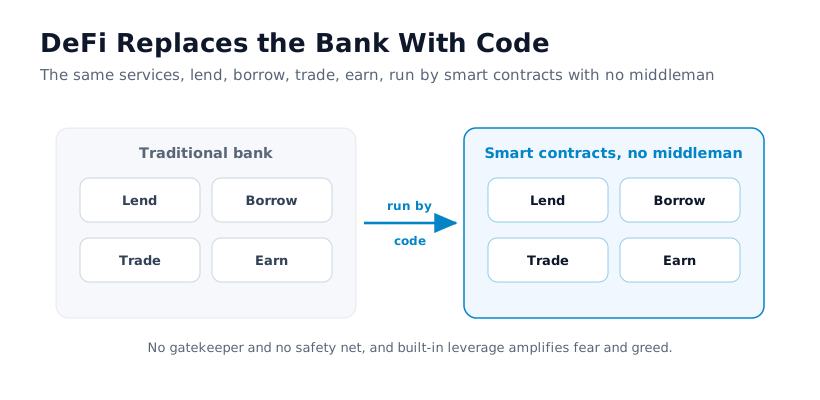
DeFi, short for decentralised finance, is financial services run by code instead of banks. Lending, borrowing, trading and earning yield all happen through smart contracts on a blockchain, with no company in the middle. It puts powerful tools, including heavy leverage, in anyone’s hands, but with no gatekeeper and no safety net, the risks are real. That built-in leverage is part of why crypto sentiment swings so hard. This is education, not financial advice.
CFGI data
DeFi runs on leverage, which amplifies emotion in both directions. CFGI’s sharpest single-day drop on record was 28 points on 25 August 2025, the kind of abrupt repricing leverage produces. The 0 to 100 score is built from 10 indicators including volatility and on-chain flows, refreshed every 15 minutes since March 2022.
Source: CFGI dataset, March 2022 to June 2026.
Key takeaways
- DeFi is financial services run by smart contracts, not banks.
- It covers lending, borrowing, trading and earning yield.
- You keep custody of your assets, and all the responsibility.
- There is no gatekeeper and no safety net if things go wrong.
- Built-in leverage amplifies fear and greed, so swings are sharper.
What Is DeFi?
DeFi rebuilds the things banks do, lending, borrowing, trading, earning interest, as open programs anyone can use. Instead of a bank approving a loan, a smart contract does it automatically against collateral you lock up. It runs mostly on Ethereum and other smart-contract platforms. The appeal is openness: no account approval, no opening hours, no intermediary, anyone with a crypto wallet and an internet connection can use it. The catch is that the same openness means no safety net if something goes wrong.
How DeFi Works
The engine of DeFi is the smart contract, self-executing code that replaces the bank or broker in the middle. A few principles define how it works. It is "non-custodial": rather than depositing money with an institution that holds it for you, you keep your assets in your own wallet and interact with the code directly, so you retain control (and full responsibility). Loans are typically "over-collateralised", since the code cannot check your credit, you must lock up more value than you borrow as security. Much of DeFi runs on "liquidity pools", communal pots of assets that users supply and that power decentralised exchanges and lending markets, earning suppliers a share of the fees. And because these protocols are open and "composable", they can be plugged into one another like building blocks, the famous "money legos", letting developers stack services in ways traditional finance cannot. The whole system runs transparently and automatically, governed by code rather than corporate policy.
What Can You Do With DeFi?
- Trade on decentralised exchanges without an account.
- Lend your coins to earn yield, or borrow against collateral.
- Provide liquidity to earn fees from traders.
- Stake or yield-farm to earn rewards on your assets.
- Use leverage, borrowing to amplify a position, with all the extra risk that brings.
In short, almost anything a bank or brokerage offers has a DeFi equivalent, often available globally, instantly, and to anyone, which is both its great promise and the root of its risks.
The Risks of DeFi
DeFi’s defining feature, removing the middleman, also removes the middleman’s protections, and the risks are substantial. Because everything runs on code, a bug or vulnerability in a smart contract can be exploited to drain funds, and the history of DeFi is littered with hacks that have cost users billions, with usually no one to refund the loss. Leverage and over-collateralised loans bring liquidation risk: if your collateral falls in value, it can be automatically sold off, sometimes at the worst moment. The open, permissionless nature that lets anyone build also lets anyone build a scam, and "rug pulls", where creators abandon a project and run off with the funds, are common. Liquidity providers face "impermanent loss", a subtle way of losing value relative to simply holding. And there is no deposit insurance, no customer service and no recourse: "be your own bank" means you also carry all the risk a bank would normally absorb. DeFi is powerful, but it is unforgiving, and it demands real caution.
No Middleman, No Safety Net
Removing the bank removes its protections too: no insurance, no refunds, no recourse. Smart-contract bugs, liquidations and scams are real, and "be your own bank" means carrying all the risk yourself.
Why Does DeFi Make Sentiment Swing Harder?
Leverage is the reason. When traders borrow to buy, greed pushes prices up faster. When prices fall, those leveraged positions get force-sold (liquidated), turning a dip into a cascade. So DeFi tends to amplify both the greed on the way up and the fear on the way down, compressing the emotional cycle into faster, sharper swings than an unleveraged market would produce. That is exactly the kind of stretched, one-sided crowd a sentiment reading is built to catch. CFGI rolls volatility and on-chain activity into the Crypto Fear and Greed Index, so a leverage-driven swing, like its sharpest single-day drop of 28 points, shows up clearly in the score rather than passing as just another price move.
Frequently asked questions
What is DeFi?
Decentralised finance: financial services, lending, borrowing, trading and earning yield, run by smart contracts on a blockchain instead of by banks. There is no company in the middle, so you keep custody of your assets and all the responsibility.
How does DeFi work?
Smart contracts replace the bank or broker. It is non-custodial (you hold your own assets), loans are usually over-collateralised, much of it runs on communal liquidity pools, and protocols are composable, plugging into one another like "money legos", all governed by transparent code.
Is DeFi safe?
It removes the middleman and with it the safety net. Smart-contract bugs and hacks, liquidations, rug-pull scams and impermanent loss are real risks, and there is usually no insurance and no one to refund you. It is high-risk. This is education, not financial advice.
Why is DeFi linked to bigger market swings?
Because of leverage. Borrowed positions magnify gains and losses, and forced liquidations can turn a fall into a cascade, amplifying greed on the way up and fear on the way down. That amplified emotion is part of what CFGI measures.
CFGI.io, Market sentiment research
The CFGI research team builds and maintains the CFGI Fear and Greed Index: a 0 to 100 sentiment score from 10 sub-indicators across hundreds of crypto assets and the equity market, refreshed every 15 minutes. We have tracked market emotion through multiple full crypto and equity cycles.
Think we missed something?
Spotted a gap, disagree with a take, or think we should cover a new topic? Message us and we'll act on your input.
Message us on TelegramKeep reading
This article is educational and is not financial advice. Crypto and equities are volatile and you can lose money. See our disclaimer.