Crypto
What Is Ethereum?
Quick answer
Ethereum is the second-largest cryptocurrency and the largest smart-contract platform. Where Bitcoin is mainly digital money, Ethereum is a programmable network, a kind of "world computer", that runs applications, tokens and decentralised finance on top of it. As the biggest altcoin, it usually moves with Bitcoin, and how tightly it tracks the leader is itself a sentiment signal. This is education, not financial advice.
CFGI data
Ethereum is the tightest sentiment shadow of Bitcoin. CFGI data shows it tracks Bitcoin 78% in step, the closest of any major coin, and on its own 0 to 100 scale Ethereum has reached a high of 90 on 6 March 2024, scored every 15 minutes since March 2022.
Source: CFGI dataset, March 2022 to June 2026.
Key takeaways
- Ethereum is the largest smart-contract platform and the second-largest crypto asset.
- It is programmable: tokens, DeFi, NFTs and apps run on top of it.
- It differs from Bitcoin in purpose, supply and consensus.
- It moves with Bitcoin more tightly than any other major coin.
- CFGI scores Ethereum on its own scale, so divergence from Bitcoin is visible.
What Is Ethereum?
Ethereum is a blockchain built to run programs, not just record payments. Its native coin is Ether (ETH). The difference from Bitcoin is purpose: Bitcoin is digital money, while Ethereum is a programmable platform that other tokens, apps and decentralised finance are built on. It is the second-largest crypto asset and the largest altcoin, which is why traders treat it as the bellwether for the rest of the market beyond Bitcoin. If Bitcoin proved you could have decentralised money, Ethereum’s ambition was bigger: to be a decentralised platform on which almost anything could be built.
How Is Ethereum Different From Bitcoin?
- Purpose: Bitcoin stores value; Ethereum runs smart contracts.
- Supply: Bitcoin is capped at 21 million; Ether has no fixed cap, though issuance is low and can fall.
- Consensus: Ethereum uses proof of stake (validators), not Bitcoin-style mining.
- Role: Ethereum is the base layer for much of crypto, so its health affects far more than its own price.
The simplest way to hold the distinction: Bitcoin is best understood as an asset, a scarce, digital store of value, while Ethereum is best understood as a platform, an engine that other assets and applications run on. They are not really competitors so much as two different kinds of thing. One notable consequence of the supply difference is that Ether’s monetary policy is more flexible than Bitcoin’s fixed cap: under proof of stake, and with a mechanism that "burns" some Ether on every transaction, the net supply can even shrink during busy periods, a very different design philosophy from Bitcoin’s hard, unchangeable 21-million limit.
What Ethereum Makes Possible
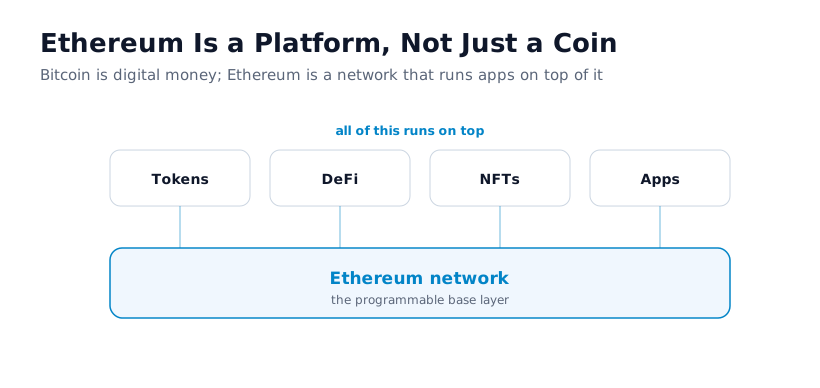
Ethereum’s great innovation was making the blockchain programmable through smart contracts, self-executing code that runs on the network, and that single idea opened the door to almost everything in modern crypto. The vast majority of tokens are smart contracts on Ethereum; decentralised finance (DeFi), letting people lend, borrow and trade without banks, was largely born there; NFTs, stablecoins and member-run DAOs all run on it. This is why Ethereum is sometimes called a "world computer": it is a shared, global platform on which developers can build decentralised applications, with Ether (ETH) serving as the "gas" that pays for the computation. Crucially, this central role means Ethereum’s health matters far beyond its own price, because so much of the crypto economy is built on top of it, the fortunes of countless tokens and applications are tied to the platform beneath them, which is part of why ETH is watched so closely as a barometer of the broader ecosystem.
The "World Computer"
Ethereum made the blockchain programmable, and most of crypto, tokens, DeFi, NFTs, stablecoins, DAOs, was built on it. ETH is the "gas" that powers it, so its health affects far more than its own price.
Why Does Ethereum Shadow Bitcoin So Closely?
Because Bitcoin sets the mood for crypto, the majors tend to follow it, and Ethereum follows most tightly of all. CFGI data shows Ethereum matching Bitcoin sentiment 78% of the time, the tightest of any major coin. That is market structure, not coincidence: the largest, most liquid assets reprice the same fear and greed together, as money flows into and out of crypto as a whole. The useful moments, then, are when they diverge. When Ethereum sentiment pulls away from Bitcoin, it signals that something specific to Ethereum, a major network upgrade, a surge in DeFi activity, a shift in the ETH-versus-BTC narrative, is driving its crowd independently of the market leader. Watching that gap, rather than just Ethereum’s level, can be revealing, since a widening divergence is often the first sign that the market has begun to price Ethereum on its own merits rather than simply as a leveraged echo of Bitcoin. You can compare them on the Ethereum Fear and Greed Index and the wider crypto market.
Frequently asked questions
What is Ethereum?
A blockchain built to run programs, not just record payments, and the largest smart-contract platform. Its native coin is Ether (ETH). It is a programmable "world computer" on which tokens, DeFi, NFTs and apps are built, and the second-largest crypto asset.
How is Ethereum different from Bitcoin?
Purpose (Bitcoin stores value, Ethereum runs smart contracts), supply (Bitcoin capped at 21 million, Ether uncapped but low-issuance), and consensus (Ethereum uses proof of stake, not mining). Bitcoin is best seen as an asset; Ethereum as a platform.
What can you do with Ethereum?
Build and use decentralised applications. Most tokens are smart contracts on Ethereum, and DeFi, NFTs, stablecoins and DAOs largely run on it, with Ether paying the "gas" for computation. Its health affects much of the crypto economy built on top of it.
Does Ethereum always follow Bitcoin?
Usually, but not always. CFGI data shows Ethereum tracks Bitcoin 78% of the time, the tightest of the majors, which means it diverges the rest of the time. Those divergences are where Ethereum-specific sentiment shows up. This is education, not financial advice.
CFGI.io, Market sentiment research
The CFGI research team builds and maintains the CFGI Fear and Greed Index: a 0 to 100 sentiment score from 10 sub-indicators across hundreds of crypto assets and the equity market, refreshed every 15 minutes. We have tracked market emotion through multiple full crypto and equity cycles.
Think we missed something?
Spotted a gap, disagree with a take, or think we should cover a new topic? Message us and we'll act on your input.
Message us on TelegramKeep reading
This article is educational and is not financial advice. Crypto and equities are volatile and you can lose money. See our disclaimer.