Crypto
What Is a Token?
Quick answer
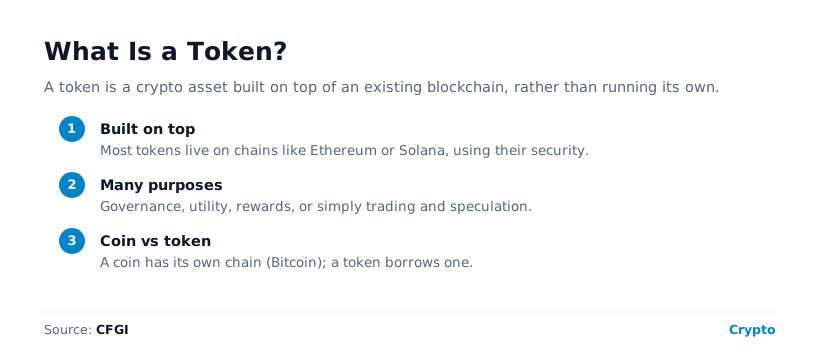
A token is a crypto asset built on top of an existing blockchain instead of running its own. A coin is the native asset of its own chain, like Bitcoin on the Bitcoin network or Ether on Ethereum. A token piggybacks on a chain like Ethereum, using its smart contracts to exist and move. That difference matters because tokens are cheap and quick to create, which is why more than a million of them exist and why most are worth almost nothing.
CFGI data
New tokens appear in waves, and the waves track the mood. CFGI has measured crypto sentiment on a 0 to 100 scale since March 2022, swinging from a fearful 12 to a greedy 87, and token launches, meme manias and trading volume cluster at the greedy end, then dry up when fear returns.
Source: CFGI dataset, March 2022 to June 2026.
Key takeaways
- A token is built on an existing blockchain; a coin runs its own chain.
- Token standards like ERC-20 let any wallet or exchange handle them.
- The four main types are utility, governance, security and stablecoins.
- More than 1.4 million ERC-20 tokens exist, and most have no real value.
- Anyone can mint a token in minutes, so the label alone proves nothing.
Token Versus Coin
The cleanest test is the blockchain. A coin is the native asset of its own blockchain: Bitcoin on the Bitcoin network, Ether on Ethereum. A coin pays the network’s fees and rewards the people who secure it. A token has no chain of its own. It lives on someone else’s, using that chain’s smart contracts to exist and move. Most altcoins you see listed are tokens built on a handful of major chains.
The Standards That Make Tokens Work
Tokens follow shared blueprints called standards, and this is the quiet reason the system works at all. On Ethereum, ERC-20 (introduced in 2015) is the standard for fungible tokens, the interchangeable kind where one unit equals another. ERC-721 defines NFTs, where each token is unique, and ERC-1155 can do both. Other chains have their own: BEP-20 on BNB Chain, TRC-20 on Tron, SPL on Solana.
Because a token sticks to a standard, every wallet and exchange already knows how to read it. Build a token to the ERC-20 spec and it works in MetaMask, on exchanges and inside other apps on day one, without anyone writing special code for it. Standards are what turned tokens from a novelty into an ecosystem.
The Four Kinds of Token
- Stablecoins are pegged to a currency, usually the US dollar, and used as steady money for trading and payments.
- Governance tokens grant a vote over a protocol’s decisions, the fuel behind a DAO.
- Utility tokens buy access or services inside an app, more like a prepaid credit than an investment.
- Security tokens represent ownership in a real company or asset, and sit closest to traditional regulation.
A single token can blur these lines, which is exactly why regulators and courts spend so much time arguing over whether a given token is really a security in disguise.
Why There Are Over a Million of Them
Here is the part that reframes everything: more than 1.4 million ERC-20 tokens have been created, and that is one standard on one chain. The reason is simple. Minting a token to a standard takes minutes and a few dollars in fees, no company, no permission and no product required.
That openness is the point of crypto and also its biggest trap. The vast majority of tokens are abandoned experiments, copy-paste clones or outright scams with no users and no value. The label "token" tells you the technical format and nothing about whether it is worth a cent. Real questions, who uses it, what it does, who controls the supply, matter far more than the fact that it exists.
The Reframe
A token is a container, not a guarantee. Easy to create means most are worthless, so judge the project, never the wrapper.
Tokens, Hype and Sentiment
Because tokens are so cheap to launch, they are the market’s purest expression of mood. In a greedy market, new tokens and memecoins pour out and trade frantically; in a fearful one, the flow stops and most quietly die. That rhythm is exactly what the Crypto Fear and Greed Index captures on a 0 to 100 scale. When token mania is everywhere, the index is usually flashing greed, which is the moment to be most careful, not least. A flood of new tokens and frantic trading is, in effect, greed made visible on-chain, and it tends to dry up the moment fear returns and the speculative appetite vanishes.
Frequently asked questions
What is a token in crypto?
A crypto asset built on top of an existing blockchain rather than running its own. It uses the host chain’s smart contracts and can represent a currency, a vote, a service credit, an ownership share or a collectible.
What is the difference between a token and a coin?
A coin is the native asset of its own blockchain, like Bitcoin or Ether, and pays that network’s fees. A token has no chain of its own; it is built on top of one.
How many tokens are there?
More than 1.4 million ERC-20 tokens exist on Ethereum alone, plus millions more across other chains. The vast majority have no users and no value, because anyone can create one in minutes.
How can I tell if a token is legit?
Look past the wrapper at the project itself. Check how many holders it has and whether ownership is concentrated in a few wallets, whether there is real liquidity and trading volume, whether the contract has been audited, and whether anyone actually uses what the token does. Because tokens are so easy to create, most fail these basic tests.
Are most cryptocurrencies tokens or coins?
Most assets you see listed are tokens, built on a few major blockchains. Only a minority are coins with their own independent chains. This is education, not financial advice.
CFGI.io, Market sentiment research
The CFGI research team builds and maintains the CFGI Fear and Greed Index: a 0 to 100 sentiment score from 10 sub-indicators across hundreds of crypto assets and the equity market, refreshed every 15 minutes. We have tracked market emotion through multiple full crypto and equity cycles.
Think we missed something?
Spotted a gap, disagree with a take, or think we should cover a new topic? Message us and we'll act on your input.
Message us on TelegramKeep reading
This article is educational and is not financial advice. Crypto and equities are volatile and you can lose money. See our disclaimer.