Crypto
What Is a Crypto Exchange?
Quick answer
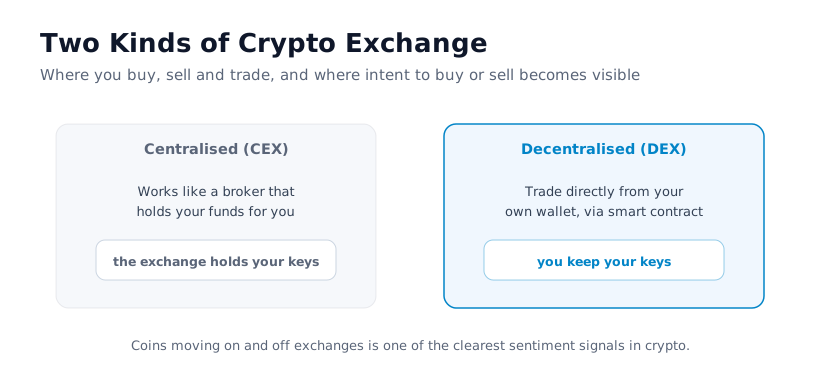
A crypto exchange is a marketplace where people buy, sell and trade cryptocurrencies. Centralised exchanges work like a broker that holds your funds; decentralised exchanges let you trade directly from your own wallet. Centralised exchanges are convenient but hold your keys, which carries real counterparty risk. Exchanges are also where intent becomes visible: the flow of coins on and off them is one of the clearest sentiment signals in crypto. This is education, not financial advice.
CFGI data
Exchanges are where sentiment shows its hand. CFGI reads coins flowing onto exchanges as intent to sell, which leans fearful, and stablecoins flowing in as intent to buy, which leans greedy. Those flows are part of every 0 to 100 CFGI Fear and Greed score, tracked every 15 minutes since March 2022.
Source: CFGI methodology and dataset, March 2022 to June 2026.
Key takeaways
- An exchange is a marketplace for buying, selling and trading crypto.
- Centralised exchanges hold your funds; decentralised ones let you trade from your wallet.
- On a centralised exchange, the exchange holds your keys, a counterparty risk.
- Exchange failures and hacks are a real danger to funds held there.
- Coins moving on and off exchanges is one of the clearest sentiment signals.
What Is a Crypto Exchange?
A crypto exchange is where buyers and sellers meet to trade. It matches orders and sets a live price, much like a stock exchange does for shares. It is usually the first place a newcomer buys crypto and the main venue where prices are discovered, the bustling marketplace at the centre of the crypto economy, where the constant tug of buy and sell orders settles on the price you see quoted everywhere.
Centralised vs Decentralised Exchanges
| Centralised (CEX) | Decentralised (DEX) | |
|---|---|---|
| Who holds funds | The exchange | You, in your own wallet |
| Ease of use | Beginner-friendly | More technical |
| Custody | The exchange holds your keys | You keep your keys |
Centralised versus decentralised exchanges.
The Custody Trade-Off
On a centralised exchange your coins sit in a custodial wallet: convenient, but not your keys. A decentralised exchange lets you trade without giving up custody.
How an Exchange Works
The two types work quite differently under the hood. A centralised exchange (CEX) runs a traditional "order book", matching buyers and sellers, much like a stock exchange, and takes custody of users’ funds to make trading fast and simple. You deposit money, place market or limit orders, and the exchange settles the trade internally. A decentralised exchange (DEX), by contrast, has no central operator: it runs on smart contracts, and most use "liquidity pools" rather than an order book, communal pots of tokens supplied by users, against which you trade directly from your own wallet at a price set by a formula (an "automated market maker"). The CEX trades custody for convenience and a familiar experience; the DEX trades convenience for self-custody and permissionless access. Both are simply mechanisms for discovering a price and swapping one asset for another, but they embody crypto’s two competing instincts: ease of use versus true decentralisation.
The Custody Risk: Not Your Keys
The convenience of a centralised exchange comes with a serious and often underappreciated risk: when the exchange holds your keys, you do not truly control your coins, you hold an IOU from the exchange. This exposes you to "counterparty risk", the danger that the exchange itself fails, is hacked, freezes withdrawals, or turns out to have mishandled customer funds. Crypto history is scarred with examples, most infamously the sudden collapse of the FTX exchange in late 2022, which trapped billions of dollars of customer money and helped drag CFGI’s crypto reading to a low of 16 as fear swept the market. This is the hard lesson behind the crypto mantra "not your keys, not your coins": funds left on an exchange are, in a meaningful sense, not fully yours. The common-sense response is to treat a centralised exchange as a place to trade rather than a place to store wealth, moving long-term holdings into self-custody, while accepting the exchange’s convenience for active trading. Convenience and security pull in opposite directions, and where you land is a personal choice, but the risk is real and worth respecting.
Not Your Keys, Not Your Coins
Funds on a centralised exchange are an IOU; you carry counterparty risk if it fails or is hacked, as FTX’s 2022 collapse showed. Many treat a CEX as a place to trade, not to store long-term wealth.
Why Are Exchange Flows a Sentiment Signal?
Exchanges are the doorway between holding and selling. To sell a coin you usually have to move it onto an exchange first, so a surge of coins flowing in signals that holders are preparing to sell, which reads as fear. The reverse, stablecoins flowing in, signals buyers loading up, which reads as greed. Because these flows happen on the public blockchain, CFGI can read them and fold them into the Crypto Fear and Greed Index as one of its 10 indicators. The exchange is, quite literally, where the crowd shows its hand: the act of moving coins to a venue where they can be sold, or moving stablecoins there to buy, is a statement of intent that, on a transparent blockchain, the whole market can read.
Frequently asked questions
What is a crypto exchange?
A marketplace where people buy, sell and trade cryptocurrencies. It matches buyers and sellers and sets a live price, much like a stock exchange. It is usually where newcomers first buy crypto and the main venue where prices are discovered.
What is the difference between a CEX and a DEX?
A centralised exchange (CEX) holds your funds and runs an order book; it is easy to use but takes custody of your keys. A decentralised exchange (DEX) runs on smart contracts and liquidity pools, letting you trade from your own wallet, keeping custody but adding complexity.
Is it safe to keep crypto on an exchange?
A centralised exchange holds your keys, so you carry counterparty risk if it fails, is hacked or freezes withdrawals, as the FTX collapse showed. Many users treat a CEX as a place to trade and move long-term holdings to self-custody. "Not your keys, not your coins."
Why do exchange inflows signal fear?
Because coins usually move onto an exchange in order to be sold, so a surge of inflows suggests selling pressure, which leans fearful; stablecoins flowing in signal buy intent, which leans greedy. CFGI reads these flows as one of the 10 indicators in its score. This is education, not financial advice.
CFGI.io, Market sentiment research
The CFGI research team builds and maintains the CFGI Fear and Greed Index: a 0 to 100 sentiment score from 10 sub-indicators across hundreds of crypto assets and the equity market, refreshed every 15 minutes. We have tracked market emotion through multiple full crypto and equity cycles.
Think we missed something?
Spotted a gap, disagree with a take, or think we should cover a new topic? Message us and we'll act on your input.
Message us on TelegramKeep reading
This article is educational and is not financial advice. Crypto and equities are volatile and you can lose money. See our disclaimer.