Crypto
What Is a Bitcoin ETF?
Quick answer
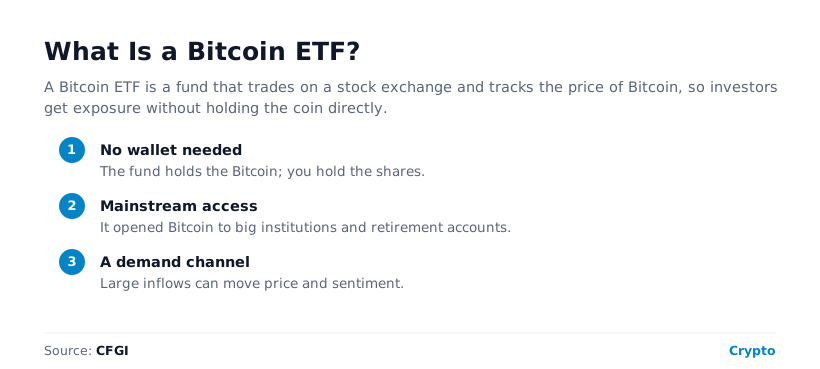
A Bitcoin ETF is an exchange-traded fund that tracks the price of Bitcoin and trades on a regular stock exchange. It lets investors get exposure to Bitcoin through a normal brokerage account, without buying, storing or securing the coin themselves. The first US spot Bitcoin ETFs, which hold real Bitcoin, launched in January 2024 after a decade of rejections, and they bridged traditional finance and crypto, which is why their arrival drew so much money and so much sentiment.
CFGI data
Bitcoin ETF launches and flows are sentiment events. Big inflows often coincide with greed and rising prices; outflows with fear. CFGI tracks that Bitcoin mood on a 0 to 100 scale, refreshed every 15 minutes since March 2022, so the crowd reaction around ETF news shows up in the score in close to real time.
Source: CFGI dataset, March 2022 to June 2026.
Key takeaways
- A Bitcoin ETF tracks Bitcoin’s price and trades like a stock.
- Spot ETFs hold real Bitcoin; futures ETFs hold contracts instead.
- US spot Bitcoin ETFs launched in January 2024 after a decade of rejections.
- They gave exposure without custody, and pulled in tens of billions fast.
- ETF flows are now a closely watched Bitcoin sentiment signal.
Bitcoin In a Brokerage Account
Buying Bitcoin directly means using an exchange and securing it in a wallet with private keys. A Bitcoin ETF removes that step: you buy shares of a fund that holds Bitcoin, and the share price tracks the coin. You get the price exposure through the same account you already use for stocks, with no wallets, seed phrases or exchanges to manage. For many traditional investors, that convenience was the whole point.
Spot Versus Futures Bitcoin ETFs
Not all Bitcoin ETFs are the same, and the difference matters. A "futures" Bitcoin ETF does not hold any actual Bitcoin; instead it holds futures contracts that bet on Bitcoin’s price. The first US Bitcoin ETF, launched in 2021, was this kind, and because futures must be rolled over as they expire, such funds can drift away from Bitcoin’s real price over time. A "spot" Bitcoin ETF, by contrast, holds real Bitcoin in custody, so its shares track the coin far more closely. When people talk about the landmark Bitcoin ETFs, they mean the spot kind, which is the genuine article wrapped in a fund.
The Long Road to Approval
Spot Bitcoin ETFs did not arrive easily. For roughly a decade, the US Securities and Exchange Commission rejected application after application, worried about price manipulation and investor protection in crypto markets. The logjam broke only after a 2023 court defeat, when a judge found the regulator’s reasoning inconsistent and effectively forced its hand. In January 2024, the SEC finally approved the first batch of US spot Bitcoin ETFs. It was a watershed moment, a US regulator granting mainstream, regulated access to an asset it had resisted for years, and it instantly legitimised Bitcoin in the eyes of much of traditional finance.
The 2024 Launch and the Flood of Money
The launch in January 2024 was one of the most successful in the history of exchange-traded funds. Major asset managers including BlackRock and Fidelity rolled out spot Bitcoin ETFs that collectively gathered tens of billions of dollars, reaching around 75 billion in assets, at a pace few products had ever matched. The significance was less about the technology and more about the door it opened: pension funds, financial advisers and ordinary brokerage customers could now allocate to Bitcoin with a few clicks, channelling a wave of mainstream and institutional money into an asset that had spent its early life on the fringes.
What You Gain and Give Up
The ETF is convenient, regulated and removes the custody burden entirely, no exchange to trust with your coins, no keys to lose. But there is a real trade-off, and it is the heart of crypto’s own philosophy. With an ETF you do not hold the actual Bitcoin; you hold shares of a fund that does. You cannot move it on-chain, spend it, or self-custody it, and you pay an annual management fee. It is exposure to the price, not ownership of the asset, the opposite of the self-custody ideal captured by "not your keys, not your coins".
The Choice In One Line
A Bitcoin ETF trades the freedom and responsibility of holding your own coins for the convenience and safety of a regulated wrapper. Which is right depends on why you want Bitcoin in the first place.
Why ETF Flows Became a Key Signal
The spot ETFs created something new: a clear, daily, public measure of how much traditional money is flowing into or out of Bitcoin. Because these funds report their inflows and outflows, traders now watch ETF flows the way they watch any sentiment indicator. Heavy inflows tend to coincide with greed and rising demand, as fresh money pours in; sustained outflows signal fear and retreat. Those flows have become large enough to move Bitcoin’s price in their own right, adding a powerful new, TradFi-driven force to a market that used to be almost entirely native crypto.
Bitcoin ETFs and Sentiment
Whichever route you take, the Bitcoin sentiment that drives the price is the same. ETF launches, approvals and flow data are themselves sentiment events, and the crowd reaction shows up directly in a Bitcoin Fear and Greed Index on the 0 to 100 scale. A wave of ETF inflows arriving alongside Extreme Greed tells a very different story from inflows during fear. Reading ETF flows and the sentiment gauge together gives a fuller picture of who is buying, the traditional world or the crypto-native one, and how the mood is shifting between them.
Frequently asked questions
What is a Bitcoin ETF?
An exchange-traded fund that tracks Bitcoin’s price and trades on a stock exchange, giving investors exposure through a normal brokerage account without holding the coin directly.
What is the difference between a spot and a futures Bitcoin ETF?
A spot ETF holds real Bitcoin, so it tracks the price closely. A futures ETF holds contracts betting on the price, which must be rolled over and can drift from Bitcoin’s actual price over time.
When were Bitcoin ETFs approved?
The first US spot Bitcoin ETFs were approved in January 2024, after roughly a decade of SEC rejections and a 2023 court ruling that forced the regulator’s hand. They became one of the fastest-growing ETF launches ever.
How is a Bitcoin ETF different from buying Bitcoin?
With the ETF you own shares of a fund that tracks the price, not the coin itself, so you cannot move it on-chain or self-custody it. You gain convenience and regulation but pay a fee and give up direct ownership. This is education, not financial advice.
CFGI.io, Market sentiment research
The CFGI research team builds and maintains the CFGI Fear and Greed Index: a 0 to 100 sentiment score from 10 sub-indicators across hundreds of crypto assets and the equity market, refreshed every 15 minutes. We have tracked market emotion through multiple full crypto and equity cycles.
Think we missed something?
Spotted a gap, disagree with a take, or think we should cover a new topic? Message us and we'll act on your input.
Message us on TelegramKeep reading
This article is educational and is not financial advice. Crypto and equities are volatile and you can lose money. See our disclaimer.