Crypto
What Is the Bitcoin Fear and Greed Index?
Quick answer
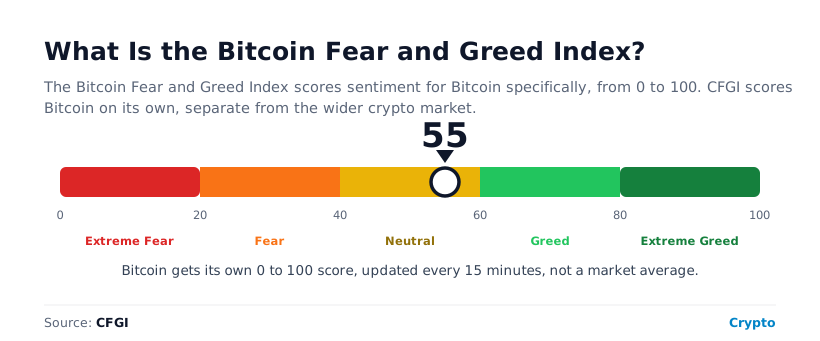
The Bitcoin Fear and Greed Index is a 0 to 100 sentiment score for Bitcoin specifically, rather than the whole crypto market. A low reading means the crowd is fearful, a high reading means it is greedy. Many indexes are heavily Bitcoin-weighted, so their "market" number is really a Bitcoin number in disguise. CFGI goes further and scores Bitcoin on its own, alongside hundreds of other assets individually, so you can see Bitcoin’s mood distinct from the altcoins around it. This is education, not financial advice.
CFGI data
On its own CFGI history, Bitcoin has run almost the full scale: from an Extreme Fear low around 9 to a greed high of 89, scored every 15 minutes from Bitcoin’s own data rather than a blended market average. That range is the emotional bandwidth the gauge is built to measure.
Source: CFGI per-asset history, BTC series.
Key takeaways
- It scores sentiment for Bitcoin specifically, from 0 to 100.
- Low is fear, high is greed; the extremes are where it is most useful.
- It blends signals like volatility, momentum, volume, social media and trends.
- Many market indexes are Bitcoin-weighted, so they approximate it anyway.
- CFGI scores Bitcoin individually and updates every 15 minutes.
Bitcoin Specifically, Not the Market
Most crypto Fear and Greed indexes weight Bitcoin heavily, because it is the largest asset, so their headline "market" number is largely a Bitcoin reading already. A true Bitcoin Fear and Greed Index goes one step better and scores Bitcoin on its own, which is exactly what CFGI does, alongside individual scores for hundreds of other assets.
The point of the score is simple: turn the messy, emotional behaviour of the Bitcoin market into one number between 0 and 100, where low means the crowd is fearful and high means it is greedy. It is a thermometer for mood, not a price prediction.
How a Bitcoin Fear and Greed Index Is Built
A sentiment index does not ask people how they feel; it infers it from how the market behaves. A Bitcoin index typically blends several signals, each capturing a different facet of mood, into one weighted score.
- Volatility. Sharp, unusual price swings, especially to the downside, read as fear.
- Momentum and volume. Strong buying volume and upward momentum read as greed.
- Social media. Spikes in posting and engagement can signal a greedy, excited crowd.
- Dominance. A flight into Bitcoin and away from riskier altcoins can signal caution.
- Search trends. What people are Googling, "buy bitcoin" versus "bitcoin crash", reveals the mood.
CFGI combines a set of 10 such inputs and refreshes the result every 15 minutes, so the Bitcoin score keeps pace with a market that never closes.
Reading the Scale
| Reading | Mood | What it often suggests |
|---|---|---|
| 0 to 24 | Extreme Fear | Capitulation risk, but potential value |
| 25 to 44 | Fear | Caution, weak confidence |
| 45 to 55 | Neutral | No strong emotional lean |
| 56 to 74 | Greed | Optimism, rising risk appetite |
| 75 to 100 | Extreme Greed | Euphoria, elevated risk of a pullback |
What the 0 to 100 bands broadly mean.
The exact band labels vary between providers, but the shape is always the same: the middle is unremarkable, and the two ends are where the signal lives. Extreme readings are the ones worth paying attention to.
Why Score Bitcoin Separately From Altcoins
A single market number cannot tell you when Bitcoin and the rest of the market disagree, and they often do. Bitcoin can read greedy while altcoins are fearful, or the reverse, during a rotation of money between them. Only per-asset scoring reveals that split. On CFGI’s own data, the gap between the most fearful and most greedy major coins reached 61 points on 23 May 2024, a divergence a blended index would have hidden completely. Reading Bitcoin’s mood against the field is often more useful than either number alone.
Using It: The Contrarian Read
The index is most often used as a contrarian gut-check, in the spirit of being "fearful when others are greedy, and greedy when others are fearful". Deep Extreme Fear has historically clustered near painful bottoms, when forced selling has pushed Bitcoin to levels that later looked like value; runaway Extreme Greed has clustered near frothy tops. That said, it is a context tool, not a timing machine: an extreme reading can persist for a while, and sentiment is one input among many. Used to check your own emotions against the crowd’s, rather than to call the exact turn, it earns its place.
Sentiment Is Not the Same As Price
A common mistake is to treat the index as a price chart. It is not. The gauge measures how the crowd feels, not what Bitcoin is worth, and the two can pull apart in revealing ways. A price grinding higher while sentiment stays fearful is the classic "climbing a wall of worry", often a healthier, more durable advance than one driven by euphoria. Sentiment running hot while the price stalls, on the other hand, can be a warning that greed has outrun reality. The most useful readings come from watching the two together: agreement confirms a move, while a divergence between mood and price is a prompt to look closer before acting.
Read Bitcoin Against the Market
Frequently asked questions
What is the Bitcoin Fear and Greed Index?
A 0 to 100 sentiment score for Bitcoin specifically, where low means fear and high means greed. CFGI scores Bitcoin on its own, separate from the wider market and from altcoins, so you can read its mood distinctly.
How is the Bitcoin Fear and Greed Index calculated?
By blending several behavioural signals, such as volatility, momentum, volume, social media activity, Bitcoin dominance and search trends, into one weighted score. CFGI uses a set of 10 inputs and updates every 15 minutes.
Is the crypto index the same as the Bitcoin index?
Often nearly, because many crypto indexes are Bitcoin-weighted. But a market number blends everything, while a per-Bitcoin score isolates Bitcoin. CFGI provides both.
Why score Bitcoin separately?
Because Bitcoin and altcoins can be in very different moods. A 61-point gap between the most fearful and most greedy major coins occurred on 23 May 2024, which only per-asset scoring reveals. This is education, not financial advice.
CFGI.io, Market sentiment research
The CFGI research team builds and maintains the CFGI Fear and Greed Index: a 0 to 100 sentiment score from 10 sub-indicators across hundreds of crypto assets and the equity market, refreshed every 15 minutes. We have tracked market emotion through multiple full crypto and equity cycles.
Think we missed something?
Spotted a gap, disagree with a take, or think we should cover a new topic? Message us and we'll act on your input.
Message us on TelegramKeep reading
This article is educational and is not financial advice. Crypto and equities are volatile and you can lose money. See our disclaimer.