Crypto
What Is a Crypto Wallet?
Quick answer
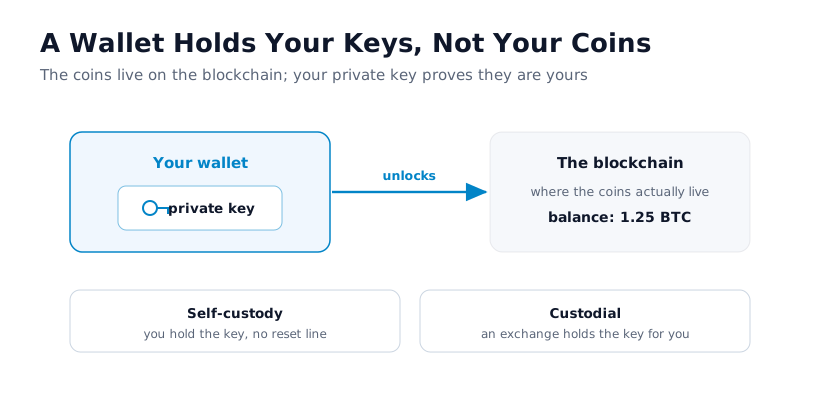
A crypto wallet stores the private keys that prove you own your coins and let you spend them. It does not hold the coins themselves; those live on the blockchain. Wallets come in two flavours: self-custody, where you hold the keys, and custodial, where an exchange holds them for you. Self-custody means being your own bank, with full control and full responsibility, and where coins move between wallets and exchanges is a sentiment signal in itself. This is education, not financial advice.
CFGI data
Wallet flows are a sentiment signal. CFGI reads coins moving from wallets onto exchanges as intent to sell, which leans fearful, and coins leaving exchanges for self-custody as conviction to hold. That flow is one of the 10 inputs behind every 0 to 100 CFGI score, tracked every 15 minutes since March 2022.
Source: CFGI methodology and dataset, March 2022 to June 2026.
Key takeaways
- A wallet holds your keys, not your coins; the coins live on the blockchain.
- Your private key (and seed phrase) controls the funds.
- Self-custody means you hold the keys; custodial means an exchange does.
- Lose a self-custody key and there is no support line to reset it.
- CFGI reads wallet-to-exchange flows as a fear or greed signal.
What Is a Crypto Wallet?
A crypto wallet is a tool that stores your "private keys", the secret codes that prove ownership of your coins and authorise transactions. The coins themselves never leave the blockchain; the wallet just holds the keys that control them. A matching "public key" is your address, which others use to send you funds. This is the single most important and most counterintuitive thing to understand about a crypto wallet: it does not actually "contain" your money the way a physical wallet holds cash. It holds the keys that prove the money on the blockchain is yours to move.
How Keys Actually Work
A wallet is built on a pair of cryptographic keys. The "public key", from which your wallet address is derived, is like an account number you can share freely so people can send you funds. The "private key" is the secret that authorises spending, it is the password that digitally "signs" a transaction to prove you own the coins, and anyone who has it controls the funds completely. Because a raw private key is an unwieldy string of characters, most wallets give you a "seed phrase" (or recovery phrase) instead: a list of 12 to 24 ordinary words that is the human-readable master backup of your keys. Whoever holds that seed phrase controls everything in the wallet. This is why the cardinal rule of crypto is to guard your seed phrase above all else, never type it into a website, never share it, and keep it backed up offline, because it is, quite literally, the keys to the kingdom.
What Are the Main Types of Wallet?
| Type | Who holds the keys | Trade-off |
|---|---|---|
| Self-custody (hot) | You, in a phone or browser app | Full control, but you are responsible |
| Self-custody (cold) | You, on offline hardware | Most secure, less convenient |
| Custodial | An exchange, on your behalf | Convenient, but not your keys |
The main kinds of crypto wallet.
Not Your Keys, Not Your Coins
With a custodial wallet you trust the exchange to hold your coins. With self-custody the responsibility is entirely yours: lose the key and the funds are gone, because there is no central authority to reset it.
Security: Being Your Own Bank
Self-custody embodies one of crypto’s core promises, "be your own bank", and that phrase cuts both ways. The empowerment is real: with a self-custody wallet, you have complete, sovereign control of your money, no bank can freeze your account, block a payment or close your access, and no third party stands between you and your funds. But the responsibility is total and unforgiving. There is no customer-service line, no password reset, and no fraud department to reverse a mistaken or malicious transaction. If you lose your seed phrase, your funds are permanently inaccessible; if a scammer tricks you into revealing it, or malware steals it, your coins are simply gone, with no recourse. The crypto world is full of phishing sites, fake apps and social-engineering tricks designed to capture keys. This is why serious holders keep large amounts in "cold" (offline hardware) wallets, treat their seed phrase like the crown jewels, and stay relentlessly skeptical of anything asking for it. With great control comes great responsibility, and in self-custody, you are the only line of defence.
Be Your Own Bank, Carry the Risk
Self-custody gives you total, censorship-proof control of your money, and total responsibility. No reset, no refund, no fraud department. Guard your seed phrase like the keys to a vault, because it is.
Why Are Wallet Flows a Sentiment Signal?
Because the blockchain is public, the movement of coins between self-custody wallets and exchanges is visible, and it reveals intent. Coins flowing onto exchanges usually mean holders are getting ready to sell, which reads as fear. Coins leaving exchanges into self-custody usually mean holders intend to keep them for the long term, which reads as conviction, the very act of taking coins into cold storage is a statement of intent to hold rather than trade. CFGI folds those exchange flows into its Fear and Greed Index as one of 10 indicators, so the behaviour of millions of wallets becomes a single number. It is a neat example of how crypto’s radical transparency turns even the private act of moving your own coins into a readable, market-wide sentiment signal.
Frequently asked questions
What is a crypto wallet?
A tool that stores your private keys, the secret codes that prove ownership of your coins and authorise transactions. The coins themselves live on the blockchain; the wallet just holds the keys that control them.
How do crypto keys work?
A wallet uses a key pair: a public key (your shareable address, like an account number) and a private key (the secret that signs transactions and controls the funds). Most wallets back this up as a 12 to 24-word "seed phrase", whoever holds it controls the wallet.
What is the difference between a hot, cold and custodial wallet?
A hot wallet is self-custody software connected to the internet (convenient, slightly riskier). A cold wallet is self-custody offline hardware (most secure). A custodial wallet means an exchange holds the keys for you (convenient, but "not your keys").
Why do exchange inflows matter for sentiment?
Coins moving onto exchanges signal intent to sell, which reads as fear; coins moving off into self-custody signal conviction to hold. CFGI uses these flows as one of the 10 indicators behind its 0 to 100 Fear and Greed score. This is education, not financial advice.
CFGI.io, Market sentiment research
The CFGI research team builds and maintains the CFGI Fear and Greed Index: a 0 to 100 sentiment score from 10 sub-indicators across hundreds of crypto assets and the equity market, refreshed every 15 minutes. We have tracked market emotion through multiple full crypto and equity cycles.
Think we missed something?
Spotted a gap, disagree with a take, or think we should cover a new topic? Message us and we'll act on your input.
Message us on TelegramKeep reading
This article is educational and is not financial advice. Crypto and equities are volatile and you can lose money. See our disclaimer.