Stocks
What Is an ETF?
Quick answer
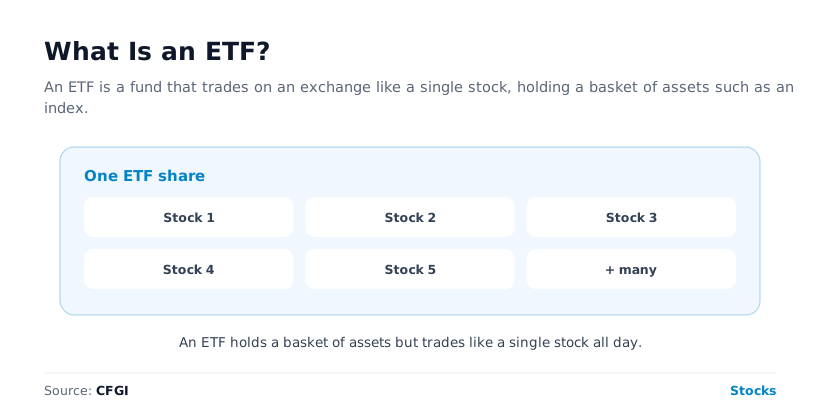
An ETF, or exchange-traded fund, is a fund that trades on a stock exchange like a single share. Instead of owning one company, you own a slice of a basket, often an index like the S&P 500, a sector, a bond portfolio or a commodity. ETFs give instant diversification, trade throughout the day at a live price, and usually charge very low fees, which is why they have become a default building block for modern portfolios.
CFGI data
ETF flows are sentiment voted with real money: into risk-on funds when the crowd is greedy, into safe-haven funds when it is fearful. CFGI scores that same mood directly on a 0 to 100 scale, daily for stocks and every 15 minutes for crypto, and the 2024 spot Bitcoin ETFs tied the two worlds together by routing mainstream money straight into crypto.
Source: CFGI methodology, 0 to 100 sentiment model.
Key takeaways
- An ETF trades like a stock but holds a basket of assets.
- Most are passive, tracking an index at a very low fee.
- Unlike most mutual funds, ETFs trade intraday at a live price.
- A creation-redemption mechanism keeps the price close to fair value.
- Spot Bitcoin ETFs, approved in 2024, opened crypto to mainstream money.
How an ETF Works
An ETF pools money from many investors and buys a basket of assets. Shares of the ETF then trade on an exchange, so you can buy or sell them through the day at a live price, just like a stock. Most ETFs are passive: they track an index, holding the same assets in the same proportions, rather than trying to pick winners.
Owning a single share of a broad ETF means owning a tiny piece of hundreds of companies at once, which is the simplest way to get diversification without buying every stock yourself. That combination of simplicity, breadth and low cost is why ETFs have pulled in trillions of dollars.
ETF Versus Single Stock
| ETF | Single stock | |
|---|---|---|
| Holdings | A basket of assets | One company |
| Diversification | Built in | None on its own |
| Trades intraday | Yes | Yes |
| Single-company risk | Spread across the basket | Concentrated |
ETFs versus individual stocks.
The key difference is risk concentration. If one company in a broad ETF collapses, it is a small fraction of your holding; if it is the only stock you own, it is everything. That is the quiet power of the basket.
ETF Versus Mutual Fund
ETFs and mutual funds are close cousins, both baskets of assets, but they differ in three ways that matter. First, trading: an ETF trades all day at a live market price, while a mutual fund is priced just once, after the close, at its net asset value. Second, cost: passive ETFs and index funds have run at asset-weighted fees well under 0.15% a year, against around 0.64% for the average actively managed equity mutual fund, a gap that compounds enormously over decades. Third, tax: ETFs are usually more tax-efficient, because of a clever behind-the-scenes mechanism that rarely forces them to hand shareholders a taxable capital gain.
The Magic Trick: Creation and Redemption
That mechanism is the most ingenious, and least understood, part of an ETF. Large institutions called "authorised participants" can create or destroy ETF shares directly with the fund, in big blocks, by swapping them in-kind for the underlying basket of assets rather than for cash. If an ETF’s market price drifts above the value of what it holds, they create new shares and sell them, pushing the price back down; if it drifts below, they redeem shares, pushing it back up. This constant arbitrage keeps an ETF’s price tightly anchored to the real value of its holdings, and the in-kind swap is also what makes ETFs so tax-efficient.
Why It Matters to You
Thanks to creation and redemption, the price you pay for an ETF almost always reflects the true value of its basket. You rarely overpay or get shortchanged versus the assets inside.
The Rise of Passive Investing
ETFs are the vehicle that carried the passive-investing revolution into the mainstream. The core idea, pioneered by index-fund champion John Bogle, is that since most active managers fail to beat the market after fees, the smarter move for most people is to own the whole market cheaply and hold on. Decades of evidence backing that view have funnelled vast sums into low-cost index ETFs. The trend is so large it now has its own critics, who worry that as more money is invested passively, fewer participants are doing the work of pricing individual companies, a genuine debate about how markets stay efficient.
ETFs for Everything: The Spot Bitcoin ETF
The ETF wrapper now holds almost anything: sectors, bonds, gold, foreign markets and, since 2024, Bitcoin. In January 2024, US regulators approved the first spot Bitcoin ETFs, funds that hold real Bitcoin and let investors get exposure through an ordinary brokerage account, with no wallets or private keys to manage. They were among the fastest-growing ETF launches in history, gathering tens of billions of dollars, and they pulled a wave of mainstream and institutional money into crypto. For better or worse, the ETF had become the bridge between traditional finance and digital assets.
ETFs and Market Sentiment
Because they are so easy to trade, ETFs are a clear window into where the crowd is putting its money, and money is sentiment made concrete. Big inflows into risk-on equity and crypto ETFs tend to mark greedy, confident phases, while flows into safe-haven funds like short-term bonds or gold mark fear. That is the same mood a Stock Fear and Greed Index reads on a 0 to 100 scale. Watching where ETF money flows, alongside the sentiment gauge, gives you both the action and the emotion behind it.
Frequently asked questions
What is an ETF?
An exchange-traded fund: a fund that trades on an exchange like a single stock but holds a basket of assets, often tracking an index such as the S&P 500. It gives diversification in one low-cost holding.
How is an ETF different from a mutual fund?
An ETF trades on an exchange all day at a live price, while most mutual funds are priced once a day after the close. ETFs also tend to have much lower fees and to be more tax-efficient.
What is the ETF creation-redemption mechanism?
A process where large institutions swap ETF shares for the underlying basket of assets, and back, in big blocks. The resulting arbitrage keeps the ETF’s market price closely anchored to the true value of its holdings.
What is a spot Bitcoin ETF?
An ETF that holds real Bitcoin, letting investors get exposure through a normal brokerage account without managing wallets or keys. The first US spot Bitcoin ETFs were approved in January 2024. This is education, not financial advice.
CFGI.io, Market sentiment research
The CFGI research team builds and maintains the CFGI Fear and Greed Index: a 0 to 100 sentiment score from 10 sub-indicators across hundreds of crypto assets and the equity market, refreshed every 15 minutes. We have tracked market emotion through multiple full crypto and equity cycles.
Think we missed something?
Spotted a gap, disagree with a take, or think we should cover a new topic? Message us and we'll act on your input.
Message us on TelegramKeep reading
This article is educational and is not financial advice. Crypto and equities are volatile and you can lose money. See our disclaimer.