Crypto
What Is a Cold Wallet?
Quick answer
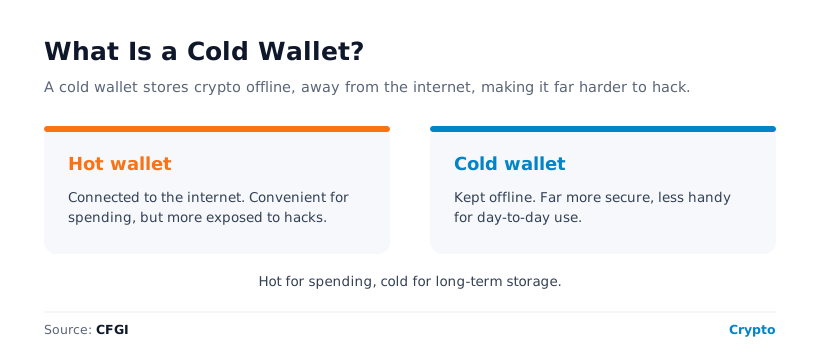
A cold wallet keeps your private key completely offline, on a device that never connects to the internet, so a remote hacker has nothing to reach. It is the opposite of a hot wallet, which stays online for convenience. Cold storage, usually a hardware device or a seed phrase written on paper or metal, is the standard way to hold larger amounts for the long term. The trade-off is that it does not remove risk so much as move it onto you.
CFGI data
Self-custody is a vote of no confidence in custodians, and that confidence is exactly what CFGI measures. Tracking crypto sentiment on a 0 to 100 scale since March 2022, CFGI has swung from a fearful 12 to a greedy 87, and the fearful end is where cold storage and "not your keys" thinking tend to take hold.
Source: CFGI dataset, March 2022 to June 2026.
Key takeaways
- A cold wallet keeps your private key offline, beyond a remote attacker’s reach.
- It is usually a hardware device, or a seed phrase backed up on paper or metal.
- Transactions are signed inside the device, then it goes back offline.
- Cold storage suits long-term savings, not everyday spending.
- The risk shifts to you: lose the seed phrase and the coins are gone for good.
What a Cold Wallet Is
What you really own in crypto is a private key that controls coins recorded on the blockchain. A cold wallet generates and stores that key on a device that never touches the internet. When you want to send funds, the transaction is built on a connected phone or computer, but the signature, the part that needs the key, happens inside the offline device and requires a physical button press. The signed transaction is then broadcast. The key itself never leaves.
That single design choice removes the entire category of remote attack. Malware, phishing pages and exchange breaches all need to reach a key that is online. A key that lives in a drawer cannot be reached by any of them.
Cold Versus Hot
| Cold wallet | Hot wallet | |
|---|---|---|
| Connection | Offline | Online |
| Main risk | Losing the device or seed | Hacks, phishing, breaches |
| Convenience | Lower, deliberate | Higher, instant |
| Best for | Long-term savings | Spending and trading |
Two ways to hold crypto.
Most experienced holders use both: a hot wallet for small, active amounts, like cash in a pocket, and a cold wallet for the bulk, like a vault. The hot wallet is where convenience lives. The cold wallet is where conviction lives.
The Risk Moves, It Does Not Vanish
Cold storage is often sold as "unhackable", which is half the story. Taking the key offline removes the attacker, but it hands you a job that an exchange used to do: never lose the key, and never lose the backup. With self-custody there is no support line, no password reset and no one to refund a mistake.
The scale of that responsibility is easy to underestimate. Studies estimate that close to 20% of all bitcoin that will ever exist, roughly 3.8 million coins, is already lost forever, most of it to forgotten passwords and misplaced or destroyed seed phrases. The most famous case is James Howells, the Welshman who threw away a hard drive holding the keys to 8,000 BTC in 2013. By 2025 that was worth around 750 million US dollars, sitting under a Newport landfill the local council will not let him dig up. No hacker took it. A lost backup did.
The Cold-Storage Bargain
You trade "someone could hack it" for "only I can lose it". That is usually the better trade for savings, but only if your seed-phrase backup is as serious as the balance it protects.
Types of Cold Storage
- Hardware wallets (such as Ledger or Trezor): a small dedicated device that holds the key and signs on-device. The practical standard for most people.
- Seed-phrase backups on paper or, better, stamped into metal that survives fire and water. The seed is the real master key, so it is the thing to protect.
- Air-gapped setups: an old phone or computer kept permanently offline, used only to sign. More effort, favoured by people securing very large amounts.
Whatever the form, the rule is the same: the device can be replaced, the seed phrase cannot. Anyone who reads your seed phrase controls the funds, and anyone who loses it loses the funds, which is why it should never be photographed, emailed or typed into a website.
Cold Storage, Self-Custody and Sentiment
Cold storage is the physical expression of "not your keys, not your coins". Interest in it spikes at predictable moments: after a big exchange fails or a custodian freezes withdrawals, holders rush to move funds into their own hands. That rush is a confidence signal, and confidence is what the Crypto Fear and Greed Index tracks on a 0 to 100 scale. When the market is deep in fear, the case for self-custody is loudest. When greed is running, convenience usually wins and balances drift back online. Knowing which way the mood is leaning is a useful prompt to ask where, exactly, your own coins are sitting.
Frequently asked questions
What is a cold wallet?
A wallet that stores your private key completely offline, usually on a hardware device or as a seed phrase on paper or metal, so it cannot be reached by remote hackers.
Why use a cold wallet?
Because keeping the key offline removes the main attack surface: malware, phishing and exchange breaches all need an online key. It is the standard way to hold larger, long-term amounts.
Can you lose crypto in a cold wallet?
Yes, not to hackers but to yourself. Lose the device and the seed-phrase backup and the funds are gone permanently. Close to 20% of all bitcoin is estimated to be lost this way already.
How do I set up a cold wallet safely?
Buy the device directly from the manufacturer, never second-hand, and generate the seed phrase on the device itself while offline. Write the seed on paper or metal and store it somewhere safe, then send a small test amount before moving real savings. Never type the seed into any website or app.
What is the difference between cold and hot wallets?
A cold wallet is offline and far harder to hack but less convenient; a hot wallet is online and instant but more exposed. Many people use both, savings cold and spending hot. This is education, not financial advice.
CFGI.io, Market sentiment research
The CFGI research team builds and maintains the CFGI Fear and Greed Index: a 0 to 100 sentiment score from 10 sub-indicators across hundreds of crypto assets and the equity market, refreshed every 15 minutes. We have tracked market emotion through multiple full crypto and equity cycles.
Think we missed something?
Spotted a gap, disagree with a take, or think we should cover a new topic? Message us and we'll act on your input.
Message us on TelegramKeep reading
This article is educational and is not financial advice. Crypto and equities are volatile and you can lose money. See our disclaimer.