Crypto
Does the Fear and Greed Index Work for Bitcoin?
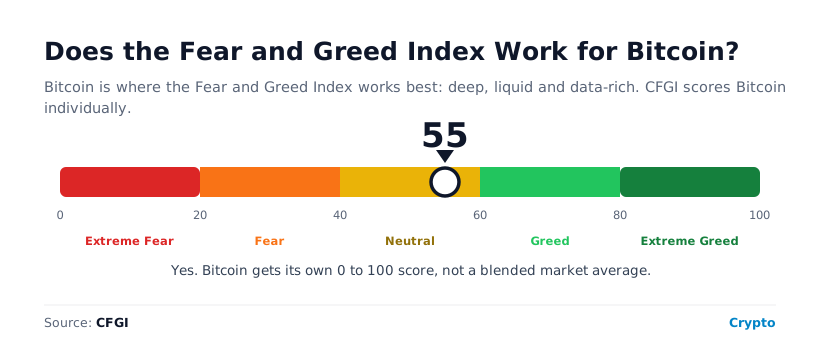
Quick answer
Yes, the Fear and Greed Index works well for Bitcoin, arguably better than for any other crypto asset. Bitcoin is the deepest, most liquid and most data-rich cryptocurrency, so the inputs that feed a sentiment score, volatility, momentum, volume, on-chain activity, are abundant and reliable. CFGI scores Bitcoin individually rather than lumping it into a market average, capturing its own distinct mood. As always, it reads the present mood accurately but does not predict the next move. This is education, not financial advice.
CFGI data
Bitcoin is the index’s strongest case. As the most liquid, most measured crypto asset, its sentiment inputs are the richest, and CFGI scores it on its own 0 to 100 scale every 15 minutes since March 2022. The same caveat holds: it reads now, it does not forecast.
Source: CFGI dataset, March 2022 to June 2026.
Key takeaways
- The index works very well for Bitcoin, its strongest case.
- Bitcoin is the deepest, most liquid and most data-rich crypto asset.
- CFGI scores Bitcoin individually, not as a market average.
- Bitcoin has its own sentiment drivers, macro, flows and the halving.
- It reads the present mood accurately, not the future.
Why Bitcoin Is the Best Case
A sentiment score is only as good as the data behind it, and Bitcoin offers the richest data in crypto. Its huge liquidity, long history and constant measurement mean the inputs, volatility, momentum, volume and more, are reliable and plentiful. That makes the Bitcoin Fear and Greed Index reading especially robust. Scoring Bitcoin individually matters too: because CFGI does not bury it in a market-wide average, the reading reflects Bitcoin’s own mood, which can differ from altcoins.
What Makes Bitcoin’s Data So Good
Three things make Bitcoin the ideal subject for a sentiment gauge. First, depth: it is by far the most liquid cryptocurrency, so its price, momentum and volume signals are clean and meaningful rather than jumpy on thin trading. Second, history: with years of continuous data, each input can be normalised reliably against its own long track record, which is what turns a raw number into a trustworthy fear-to-greed reading. Third, coverage: Bitcoin is the most-watched and most-measured asset in crypto, with deep futures and options markets, rich on-chain data, and constant social and search attention, so there are simply more high-quality signals to blend. More and better data means a steadier, more dependable score.
Garbage In, Garbage Out, Reversed
A sentiment score is only as reliable as its inputs. Bitcoin supplies the deepest, longest and richest inputs in crypto, which is precisely why the index works best on it.
Why Per-Asset Scoring Matters for Bitcoin
Scoring Bitcoin on its own is not a detail; it is central to getting an accurate read. Bitcoin frequently moves to a different rhythm than the rest of crypto, it often leads early in a cycle, tends to hold up better in fear, and its dominance rises and falls against altcoins. A single market-wide number would blur all of that, mixing Bitcoin’s relative calm with the wild swings of smaller coins. By computing Bitcoin’s score independently, across its own history, CFGI captures Bitcoin’s genuine mood rather than a crypto-wide average that may not describe it at all. That separation is what lets you see when Bitcoin is greedy while the altcoins are fearful, or the reverse.
Bitcoin’s Own Sentiment Drivers
Part of why Bitcoin deserves its own reading is that distinctive forces move its mood. More than any other crypto asset, Bitcoin responds to macro conditions, interest-rate expectations, the dollar, and institutional and spot-ETF flows, reflecting its growing role as a "digital gold" store of value. Its four-yearly halving cycle shapes long-run sentiment in a way no other asset shares. And as the market’s anchor, it is usually where big money arrives first when risk appetite returns. These drivers are different enough from those of a typical altcoin that folding Bitcoin into a blended crypto score would actively mislead, another reason the per-asset approach fits Bitcoin so well.
The Same Honest Limit
Working well for Bitcoin does not mean predicting Bitcoin. As with any market, the index is an accurate read of current sentiment, not a forecast, in CFGI data, next-day direction is essentially a coin flip. Bitcoin can stay in Extreme Greed through a long rally or Extreme Fear through a deep drawdown, so a correct reading can still be early. For Bitcoin, then, the index is best used as context: where does the mood sit now, and is it stretched? That is the question it answers superbly, even though it cannot tell you what tomorrow holds.
That caveat is not a weakness specific to Bitcoin, it is the nature of all sentiment. If anything, Bitcoin’s richer data makes the present-tense reading more trustworthy than for almost any other asset, even as the future stays unknowable. So the honest verdict is a strong yes with one asterisk: the Fear and Greed Index works exceptionally well for Bitcoin as a measure of where the crowd stands, and like everywhere else, it should be read as context and combined with the trend, the macro backdrop and your own plan rather than treated as a prediction.
Frequently asked questions
Does the Fear and Greed Index work for Bitcoin?
Yes, arguably better than for any other crypto asset. Bitcoin is the deepest, most liquid and most data-rich, so the inputs that feed a sentiment score, volatility, momentum, volume and on-chain activity, are abundant and reliable.
Why is Bitcoin’s sentiment data so good?
Because of its depth, history and coverage: huge liquidity gives clean signals, years of data allow reliable normalisation, and deep futures, options, on-chain and social data provide many high-quality inputs to blend.
Does CFGI score Bitcoin separately?
Yes. CFGI scores Bitcoin individually on its own 0 to 100 scale, so the reading reflects Bitcoin’s own mood, which often differs from altcoins, rather than a market-wide average.
Can it predict Bitcoin’s price?
No. It reads the present mood accurately but does not forecast. Next-day direction is essentially a coin flip, so use it as context to gauge whether the mood is stretched, not as a signal. This is education, not financial advice.
CFGI.io, Market sentiment research
The CFGI research team builds and maintains the CFGI Fear and Greed Index: a 0 to 100 sentiment score from 10 sub-indicators across hundreds of crypto assets and the equity market, refreshed every 15 minutes. We have tracked market emotion through multiple full crypto and equity cycles.
Think we missed something?
Spotted a gap, disagree with a take, or think we should cover a new topic? Message us and we'll act on your input.
Message us on TelegramKeep reading
This article is educational and is not financial advice. Crypto and equities are volatile and you can lose money. See our disclaimer.