Crypto
What Is a Private Key?
Quick answer
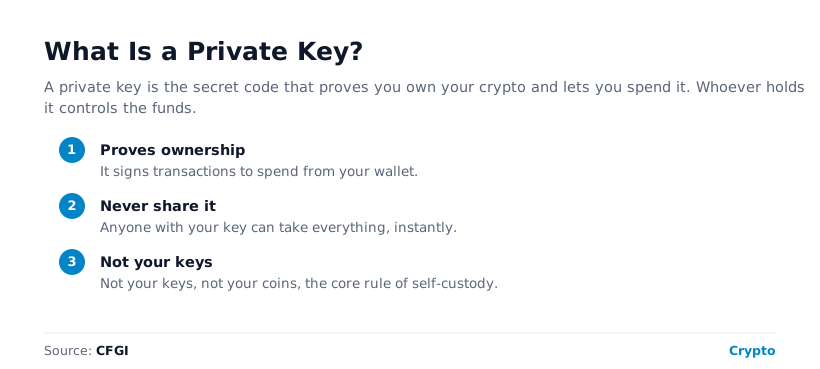
A private key is a secret string of data that proves ownership of your crypto and authorises spending it. Every wallet address has a matching private key, and signing a transaction with that key is how the network confirms the funds are really yours to move. The rule that follows is the heart of crypto: whoever controls the private key controls the coins, which is why protecting it is the whole game in self-custody.
CFGI data
Holding your own keys is an act of confidence, and confidence is what CFGI measures. Tracking crypto sentiment on a 0 to 100 scale since March 2022, CFGI has swung from a fearful 12 to a greedy 87, and the move toward self-custody, taking the key off an exchange and into your own hands, tends to accelerate at the fearful end of that range.
Source: CFGI dataset, March 2022 to June 2026.
Key takeaways
- A private key is the secret that controls your crypto and signs transactions.
- It is a 256-bit number, so large it cannot be guessed by brute force.
- The public address comes from the key one way; the key never comes back.
- Whoever holds the key controls the funds, full stop.
- You usually protect it through a seed phrase, never by handling the raw key.
The Secret That Proves Ownership
Every crypto address has a matching private key. The address is public, like an account number you can hand out to receive funds; the private key is the secret that unlocks it. When you send crypto, your wallet uses the private key to sign the transaction, and the blockchain verifies that signature without the key itself ever being revealed. That is the quiet magic of the system: you can prove you own something without showing the secret that proves it.
How Big Is a Private Key, Really?
A Bitcoin private key is a 256-bit number, which means there are 2 to the power of 256 possible keys. That figure is so large it breaks intuition: it is roughly the number of atoms in a sizeable chunk of the observable universe. Even a machine guessing a billion keys every second would still be running long after the Sun burned out, with no realistic chance of landing on yours.
This is why "someone might guess my key" is not a real worry, and why crypto leans on randomness rather than secrecy of the algorithm. The danger is never that the maths is weak. It is that a key gets copied, phished or carelessly exposed by a human. The cryptography is close to perfect; the handling is where things go wrong.
Public Key, Private Key, Address
These three travel together, in a strict one-way chain. The private key generates a public key, and the public key is hashed into the address you share. You can always go forwards, key to address, but never backwards, address to key. That one-way street is what lets you publish your address all over the internet while keeping the funds safe.
- Private key: the secret. It signs transactions and must never leave your control.
- Public key: derived from the private key, used to verify your signatures.
- Address: a shortened, shareable form of the public key, where people send you funds.
Not Your Keys, Not Your Coins
The phrase "not your keys, not your coins" sums up the stakes. If someone else holds your private key, they control your crypto, even if your balance shows up nicely in an app. When you leave funds on an exchange, the exchange holds the key and you hold an IOU. That is convenient, but it means your access depends on the company staying solvent and secure, the hard lesson of every exchange that has frozen withdrawals or collapsed.
How Private Keys Get Lost Or Stolen
In practice you almost never see the raw private key. It sits behind a seed phrase, the human-friendly backup your wallet generates, and behind a cold wallet if you store funds offline. The threats are therefore aimed at humans, not the cryptography.
The Two Ways It Ends Badly
Lose the key and its backup, and the funds are frozen forever, with no recovery and no support line. Expose the key or seed to a scammer, and the funds are gone the moment they sign a transaction. Both are irreversible.
The defences are unglamorous but absolute: never type a key or seed into a website, never store it in a photo, email or cloud note, and remember that no legitimate service will ever ask you to reveal it. Anyone who does is trying to take your coins.
Private Keys, Custody and Sentiment
Who holds the keys is ultimately a confidence question, and confidence is what the Crypto Fear and Greed Index tracks on a 0 to 100 scale. After a big exchange failure, trust in custodians drops and people rush to take their keys into their own hands, a spike in self-custody that maps neatly onto a spike in fear. Understanding what a private key is turns an abstract slogan into a concrete decision: how much of your crypto do you want to control directly, and how much are you content to leave in someone else’s hands?
Frequently asked questions
What is a private key?
A secret string of data that proves ownership of your crypto and authorises spending it. Signing a transaction with it tells the network the funds are yours to move, so whoever holds it controls the coins.
Can a private key be guessed or hacked?
Not by brute force. A private key is a 256-bit number with so many possibilities that guessing one is computationally impossible. The real risk is a key being phished, copied or carelessly exposed by a person, not cracked by a computer.
What is the difference between a private key and a public address?
The address is public, like an account number you share to receive funds, and is derived from the key one way. The private key is the secret that unlocks it and authorises spending. Never share the private key.
What happens if I lose my private key?
Without the key or its seed-phrase backup, the funds are permanently inaccessible and no one can recover them. If someone else gets it, they control the funds. This is education, not financial advice.
CFGI.io, Market sentiment research
The CFGI research team builds and maintains the CFGI Fear and Greed Index: a 0 to 100 sentiment score from 10 sub-indicators across hundreds of crypto assets and the equity market, refreshed every 15 minutes. We have tracked market emotion through multiple full crypto and equity cycles.
Think we missed something?
Spotted a gap, disagree with a take, or think we should cover a new topic? Message us and we'll act on your input.
Message us on TelegramKeep reading
This article is educational and is not financial advice. Crypto and equities are volatile and you can lose money. See our disclaimer.