Markets
What Is a Sell-Off?
Quick answer
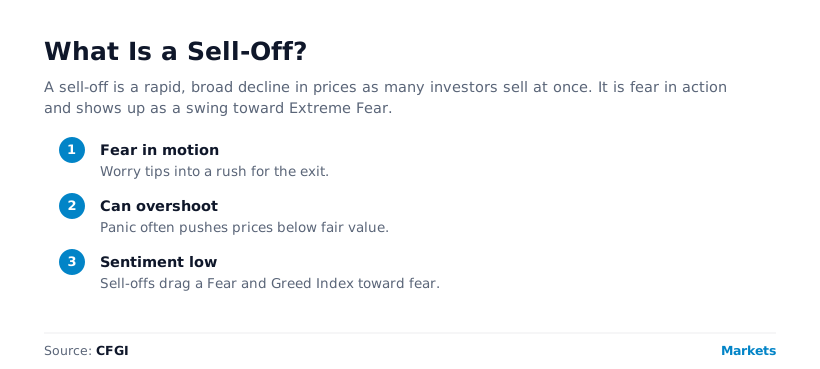
A sell-off is a rapid, widespread drop in prices caused by many investors selling at the same time. It can be triggered by bad news, disappointing data, a shock, or simply by fear feeding on itself. Sell-offs vary in severity, from a sharp single-day drop to the start of a correction or crash, but all share the same engine: a sudden shift from confidence to fear, often amplified by forced selling. A Fear and Greed Index swings down hard during one. This is education, not financial advice.
CFGI data
A sell-off is fear in motion. As investors rush to sell, CFGI swings down hard toward Extreme Fear, the equity 3 on 8 April 2025 came amid exactly such broad selling. The speed and depth of the sentiment drop reflect how broad the sell-off is.
Source: CFGI dataset, 2021 to June 2026.
Key takeaways
- A sell-off is a rapid, broad decline as many sell at once.
- It can be triggered by news, data, a shock, or fear itself.
- It ranges from a single-day drop to the start of a crash.
- Forced selling can make it feed on itself.
- It is fear in action, swinging sentiment down hard.
When Everyone Heads for the Exit
A sell-off is the market acting on fear at speed. A trigger, a bad earnings season, a shock data point, a geopolitical event, prompts selling, and as prices fall, more investors sell to avoid further losses. The selling feeds on itself, which is what makes a sell-off fast and, sometimes, indiscriminate. Not every sell-off becomes a crash or even a correction. Many are brief, a single stormy session that passes. What they share is the emotional driver: a swing from confidence to fear.
What Triggers a Sell-Off
Sell-offs usually start with a catalyst that shifts the mood. The classic triggers are a disappointing earnings report, a weak economic data point like a bad inflation or jobs number, a hawkish surprise from a central bank, or a geopolitical shock. Sometimes a single large company’s bad news spreads fear across its whole sector or the market. But not every sell-off has a clear cause: markets that have run up on greed can simply roll over under their own weight, with profit-taking and technical selling snowballing into a broad decline. Whatever the spark, the common thread is that it tips the balance of buyers and sellers decisively toward sellers, and the rush for the exit begins.
Sell-Off, Correction Or Crash?
A sell-off is really a description of behaviour, broad, rapid selling, rather than a specific size, so it overlaps with related terms.
| Term | What it describes |
|---|---|
| Sell-off | The act of broad, rapid selling, any size |
| Correction | A decline of 10% to 20% |
| Crash | A sudden, extreme drop over days |
How a sell-off relates to bigger declines.
A sell-off can be a single contained session that passes, or it can be the opening act of a correction or crash. In real time you cannot know which, which is exactly why watching how far and fast it spreads matters. The word also gets applied to a single asset, "the stock sold off after earnings", as readily as to the whole market, so context tells you whether you are looking at one company’s bad day or a broad, market-wide flight from risk.
How Sell-Offs Feed On Themselves
What turns ordinary selling into a violent sell-off is a set of self-reinforcing mechanics. As prices fall, pre-set "stop-loss" orders trigger automatic selling, and leveraged traders face margin calls that force them to sell whether they want to or not. Both add fresh supply just as fear is rising, pushing prices lower and triggering yet more stops and calls in a cascade. Modern markets add another layer, as algorithmic and program trading can accelerate the move. This is the same engine behind panic selling: the selling manufactures the conditions for more selling, which is why a sell-off can snowball far faster and deeper than the original trigger alone would justify.
Selling Begets Selling
Stop-losses and margin calls turn falling prices into forced selling, which drives prices lower still. That feedback loop is what separates a violent sell-off from an orderly dip.
Sell-Offs and Fear
Because a sell-off is fear in action, a Fear and Greed Index swings down hard during one. How far and fast the score falls is a useful read on how broad the selling is, and whether it is a passing squall or the start of something larger. A shallow dip in sentiment that quickly recovers suggests the sell-off was contained, while a plunge into deep, sustained Extreme Fear, like the equity score’s fall to 3 in April 2025, signals a broad, serious move. The gauge will not tell you when the selling stops, but watching the depth and persistence of the fear it registers helps distinguish an ordinary down day from the early stage of a genuine decline.
Frequently asked questions
What is a sell-off?
A rapid, widespread drop in prices caused by many investors selling at once, triggered by bad news, weak data, a shock, or fear feeding on itself, often amplified by forced selling.
What triggers a sell-off?
Commonly a disappointing earnings report, weak economic data, a hawkish central-bank surprise, or a geopolitical shock. Sometimes there is no clear cause, and a greedy, overextended market simply rolls over under profit-taking and technical selling.
Is a sell-off the same as a crash?
Not necessarily. A sell-off describes broad, rapid selling of any size; it can be a brief single-day drop or the opening act of a 10% to 20% correction or a sudden crash. They share the same engine but differ in severity.
How does a sell-off show on the Fear and Greed Index?
It swings the score down hard toward Extreme Fear. How far and fast it falls, and how long the fear persists, hints at how broad the selling is and whether it is a squall or something larger. This is education, not financial advice.
CFGI.io, Market sentiment research
The CFGI research team builds and maintains the CFGI Fear and Greed Index: a 0 to 100 sentiment score from 10 sub-indicators across hundreds of crypto assets and the equity market, refreshed every 15 minutes. We have tracked market emotion through multiple full crypto and equity cycles.
Think we missed something?
Spotted a gap, disagree with a take, or think we should cover a new topic? Message us and we'll act on your input.
Message us on TelegramKeep reading
This article is educational and is not financial advice. Crypto and equities are volatile and you can lose money. See our disclaimer.