Stocks
What Is a Stock Exchange?
Quick answer
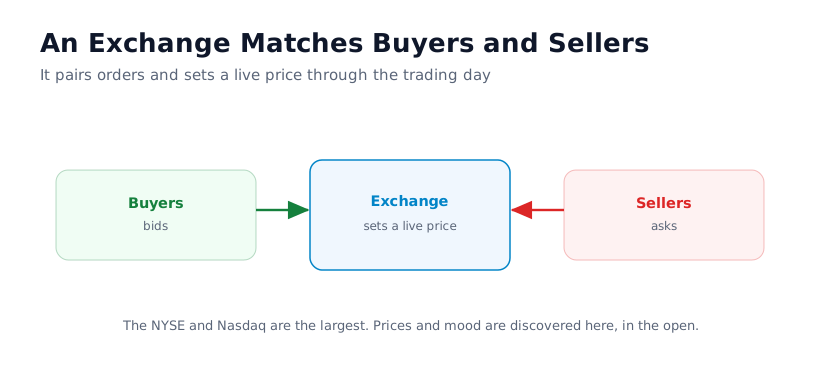
A stock exchange is a marketplace where shares of public companies are bought and sold. Exchanges like the New York Stock Exchange and Nasdaq match buyers with sellers and set a live price through the trading day. They provide liquidity, so you can buy or sell easily, and price discovery, finding a fair price through millions of trades. The exchange is where prices, and the crowd’s mood, are discovered in the open. This is education, not financial advice.
CFGI data
The exchange is where the market’s mood is discovered, and CFGI scores it daily. The Stock Fear and Greed Index reads behaviour from major indices and leading stocks into a 0 to 100 reading, updated daily since 2021, so the day’s mood becomes a single number.
Source: CFGI dataset, 2021 to June 2026.
Key takeaways
- A stock exchange is a marketplace for buying and selling shares.
- It matches buyers with sellers and sets a live price.
- It provides liquidity and discovers a fair price.
- Listed companies must meet standards and report openly.
- It is where prices and mood are discovered in the open.
What Is a Stock Exchange?
A stock exchange is the venue where shares change hands. It brings buyers and sellers together and continuously updates a price wherever the two agree. Most trading today is electronic, matched in milliseconds. Unlike crypto, exchanges keep set hours and close overnight and at weekends, a pause that is part of why equity moods tend to swing less violently than the 24-hour crypto market.
How an Exchange Works: Matching Orders
At its core, an exchange is a giant matching engine. Buyers submit "bids", the price they will pay, and sellers submit "asks", the price they will accept, and the exchange pairs them up, with a trade happening wherever a bid and an ask meet. The running list of all these orders is the "order book", and the price you see quoted is simply the level of the most recent match, updating continuously as new orders arrive. This constant matching is how an exchange performs "price discovery": out of millions of individual decisions to buy and sell, a single, live, agreed price emerges for each stock, second by second.
The Major Stock Exchanges
- New York Stock Exchange (NYSE): the world’s largest by listed value, dating to 1792, traditionally an "auction" market where participants trade with each other.
- Nasdaq: fully electronic and tech-heavy, a "dealer" market where trades go through market makers. See the Nasdaq.
- Others: the London Stock Exchange, Tokyo Stock Exchange and many more serve their regions.
The auction-versus-dealer distinction is mostly under the hood today, since both are now overwhelmingly electronic, but it reflects two different traditions for how buyers and sellers are brought together.
Why Exchanges Matter: Liquidity and Price Discovery
An exchange does two indispensable jobs. The first is providing liquidity: by gathering huge numbers of buyers and sellers in one place, it makes it easy to convert shares into cash quickly, with market makers standing ready to trade so you rarely have to wait for a counterparty. The second is price discovery: the constant tug-of-war of orders produces a continuously updated, broadly fair price that reflects all the information and emotion in the market at that moment. Without a central exchange, buying and selling shares would be slow, opaque and expensive; with one, a global market can reprice thousands of companies in real time.
Two Jobs In One
An exchange both lets you trade easily (liquidity) and tells you what things are worth (price discovery). Those two functions are what make a modern stock market possible.
Listing and Regulation
Not just any company can trade on a major exchange. To be "listed", a company must meet the exchange’s minimum financial and governance requirements, its listing standards, and register as a reporting company, after which it must keep meeting ongoing standards and file regular disclosures with regulators like the SEC. This gatekeeping matters: it means a stock trading on the NYSE or Nasdaq has cleared a bar of size, transparency and accountability that an obscure over-the-counter penny stock has not. The exchange, in effect, lends some of its credibility to the companies it lists, which is part of why a listing is prized and why being thrown off an exchange is a serious blow.
Why the Exchange Shows the Market’s Mood
Because every trade on it is a vote. The collective buying and selling sets not just prices but the tone of the whole market, calm or frantic, greedy or fearful. The closing bell each day also matters: that overnight pause is part of why equity moods swing less violently than 24/7 crypto. CFGI reads that exchange behaviour into the Stock Fear and Greed Index, turning a trading day’s worth of bids, asks and price moves into a single mood score from 0 to 100, the emotional temperature of the marketplace distilled into one number.
Frequently asked questions
What is a stock exchange?
A marketplace where shares of public companies are bought and sold. It matches buyers and sellers, sets a continuously updating live price, and provides liquidity and price discovery for the market.
How does an exchange set a price?
By matching buy orders (bids) with sell orders (asks) in an order book. A trade happens wherever a bid and ask meet, and the quoted price is the level of the most recent match, updating continuously through the day.
What is the difference between the NYSE and Nasdaq?
Both are major US exchanges. The NYSE is the largest by listed value and historically an auction market; the Nasdaq is fully electronic, a dealer market run through market makers, and weighted toward technology companies.
Why does an exchange show the market’s mood?
Because every trade is a vote, so collective buying and selling sets the tone, calm or frantic, greedy or fearful. CFGI reads that behaviour into the Stock Fear and Greed Index, turning a trading day into a single 0 to 100 score. This is education, not financial advice.
CFGI.io, Market sentiment research
The CFGI research team builds and maintains the CFGI Fear and Greed Index: a 0 to 100 sentiment score from 10 sub-indicators across hundreds of crypto assets and the equity market, refreshed every 15 minutes. We have tracked market emotion through multiple full crypto and equity cycles.
Think we missed something?
Spotted a gap, disagree with a take, or think we should cover a new topic? Message us and we'll act on your input.
Message us on TelegramKeep reading
This article is educational and is not financial advice. Crypto and equities are volatile and you can lose money. See our disclaimer.