Stocks
What Is a Penny Stock?
Quick answer
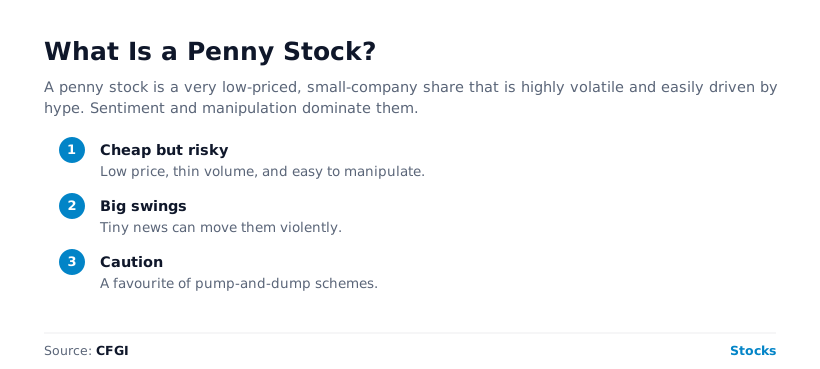
A penny stock is a share that trades at a very low price, under 5 dollars by the SEC definition, usually issued by a small, little-known company and traded over the counter rather than on a major exchange. They are appealing because a tiny price move can be a big percentage gain, but they are extremely risky: thinly traded, poorly disclosed, easy to manipulate, and dominated by hype and emotion rather than fundamentals. Sentiment, and outright manipulation, drive them far more than value does. This is education, not financial advice.
CFGI data
Penny stocks are sentiment and hype distilled, with little fundamental anchor. That makes a disciplined, fundamentals-and-sentiment approach, like reading CFGI from 0 to 100 across established names, the opposite of the rumour-driven trading that defines penny stocks. The contrast is the lesson.
Source: CFGI dataset and standard market definitions, June 2026.
Key takeaways
- A penny stock trades at a very low price, under 5 dollars by SEC definition.
- They trade over the counter, not on major exchanges.
- A low share price does not mean a cheap or undervalued company.
- They are thinly traded, volatile and easy to manipulate.
- Pump-and-dump schemes target them; hype drives them, not fundamentals.
Cheap, But Rarely a Bargain
The low price of a penny stock is seductive: it feels like you can own a lot of shares for a little money, and a move from 0.10 to 0.20 doubles your stake. But a low price is not the same as cheap value. Most penny stocks are small, unproven companies with thin trading, wide spreads and little reliable information. That combination makes them a playground for manipulation, where hype inflates a price before insiders sell, leaving later buyers with losses.
What Counts As a Penny Stock
The US Securities and Exchange Commission formally defines a penny stock as one trading below 5 dollars a share, though many people picture stocks trading for pennies or fractions of a cent. The defining feature is not just the price but where they trade. Penny stocks usually do not meet the listing requirements of major exchanges like the New York Stock Exchange or Nasdaq, so they change hands "over the counter", often on the OTC markets historically known as the "pink sheets" after the colour of the paper their quotes were once printed on. Crucially, these venues impose far lighter disclosure and reporting requirements, which is the root of much of the risk.
Why the Low Price Is Misleading
The most common penny-stock mistake is confusing a low share price with cheapness. The price of a single share tells you almost nothing about value; what matters is the market capitalisation, the price multiplied by the total number of shares. A company at 0.10 dollars with billions of shares can be worth more, and wildly more overvalued, than a solid company trading at 100 dollars. Owning "10,000 shares" feels impressive, but it is the slice of the business those shares represent that counts, and for most penny stocks that slice is tiny, fragile, and frequently worth far less than the hype implies.
Shares Are Not Value
A 0.05 dollar stock is not "cheaper" than a 500 dollar one. Value is price times shares outstanding. The number of shares you can buy with your money is irrelevant to whether the company is worth it.
The Risks: Liquidity, Manipulation and Fraud
Penny stocks concentrate several dangers at once, best seen against a listed stock.
| Penny stock | Listed stock | |
|---|---|---|
| Price | Under 5 dollars | Any |
| Trades on | OTC / pink sheets | NYSE / Nasdaq |
| Disclosure | Light or none | Strict and audited |
| Liquidity | Thin, wide spreads | Usually deep |
| Fraud risk | High | Lower |
Penny stock versus a listed stock.
Thin liquidity means you can struggle to sell at all without crashing the price. Poor disclosure means you may be trading on rumour rather than facts. And many of these companies are financially distressed, sometimes near insolvency. Most brokers will not even accept market orders on them, forcing you to use limit orders, a small sign of how hazardous the trading conditions are.
The Pump and Dump
The signature penny-stock scam is the "pump and dump". Promoters quietly buy a large position in an obscure, cheap stock, then aggressively hype it, through cold calls, spam emails, social media and slick newsletters, with promises of a guaranteed moonshot. As naive buyers pile in, the thinly traded price rockets (the "pump"). The promoters then sell their entire holding into that buying frenzy (the "dump"), collapsing the price and leaving everyone who arrived late holding near-worthless shares. It is a concentrated, deliberately engineered greed cycle, and the very features that define penny stocks, low price, thin trading, little oversight, are exactly what make the scheme work.
Penny Stocks and Sentiment
Because penny stocks have little fundamental anchor, they are driven almost entirely by emotion and promotion, a concentrated, often manipulated form of greed and fear. That is the opposite of the disciplined approach a Fear and Greed Index supports across established, well-traded companies. CFGI deliberately scores liquid, real businesses where sentiment reflects genuine collective behaviour, not a single promoter’s spam campaign. The contrast is itself instructive: reading the mood of a real market is a discipline, while chasing a hyped penny stock is the gambling it can help you avoid.
Frequently asked questions
What is a penny stock?
A very low-priced share, under 5 dollars by the SEC definition, usually from a small, little-known company traded over the counter rather than on a major exchange. They are thinly traded, highly volatile and easy to manipulate.
Does a low share price mean a stock is cheap?
No. Value is the market capitalisation, price multiplied by total shares, not the price of one share. A 0.10 dollar stock with billions of shares can be far more overvalued than a 100 dollar one. The number of shares you can buy is irrelevant.
What is a pump and dump?
A scheme where promoters buy a cheap stock, hype it aggressively to drive the price up, then sell their entire holding into the buying frenzy, collapsing the price and leaving later buyers with losses. Penny stocks are the classic target.
Are penny stocks a good investment?
They are very risky. A low price is not good value, disclosure is poor, liquidity is thin and manipulation is common, so most investors avoid them entirely. This is education, not financial advice.
CFGI.io, Market sentiment research
The CFGI research team builds and maintains the CFGI Fear and Greed Index: a 0 to 100 sentiment score from 10 sub-indicators across hundreds of crypto assets and the equity market, refreshed every 15 minutes. We have tracked market emotion through multiple full crypto and equity cycles.
Think we missed something?
Spotted a gap, disagree with a take, or think we should cover a new topic? Message us and we'll act on your input.
Message us on TelegramKeep reading
This article is educational and is not financial advice. Crypto and equities are volatile and you can lose money. See our disclaimer.