Stocks
What Is a Market Maker?
Quick answer
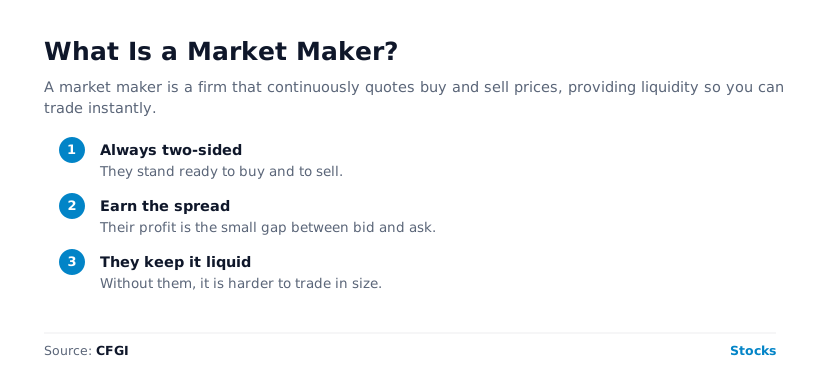
A market maker is a firm that stands ready to both buy and sell an asset at all times, quoting a bid price and an ask price continuously. By always being on the other side of a trade, market makers provide liquidity, so you can buy or sell instantly instead of waiting for a matching counterparty to appear. They earn the small spread between their buy and sell prices, multiplied across enormous volumes of trades.
CFGI data
Market makers widen their spreads when they are scared, which is the stress a Fear and Greed Index reads. The conditions that push CFGI’s Stock score toward Extreme Fear, below 20 on its 0 to 100 scale, are exactly when quoting turns defensive, liquidity thins and trading suddenly gets more expensive for everyone.
Source: CFGI methodology, 10-input 0 to 100 model.
Key takeaways
- A market maker quotes both a buy and a sell price continuously.
- It earns the spread between bid and ask, across millions of trades.
- It also earns exchange rebates and payment for order flow.
- A few firms, led by Citadel Securities and Virtu, dominate US volume.
- When markets are stressed, spreads widen and trading gets costlier.
Always Ready to Trade
When you sell a stock, someone has to buy it at that very moment. A market maker is the firm that almost always will. It posts a price at which it will buy (the bid) and a price at which it will sell (the ask) at the same time, standing ready to take the other side of your trade. In doing so it takes on real risk, holding inventory that might move against it, and it is paid for that service by the small gap between its two prices.
The Bid-Ask Spread
The spread is the engine. A market maker buys at the lower bid and sells at the higher ask, pocketing the difference on each round trip. On a single trade that gap is tiny, often a cent or less, but multiplied across millions of trades a day it adds up to enormous, steady revenue. The riskier or less liquid the asset, the wider the spread the market maker demands, which is why thinly traded stocks and obscure tokens cost more to trade than blue-chips. The spread, in effect, is the price you pay for the convenience of trading right now.
How Market Makers Really Make Money
The spread is the headline, but modern market makers have three income streams stacked together.
- The spread. Buy at the bid, sell at the ask, repeated at vast scale.
- Exchange rebates. Exchanges pay a small rebate, often a fraction of a cent per share, to firms that provide liquidity.
- Payment for order flow. Brokers are paid to route their customers’ orders to a market maker to execute.
Payment for Order Flow
That third stream explains how "commission-free" trading apps make money. In payment for order flow, a market maker pays a broker, such as a popular retail app, for the right to handle its customers’ trades. The sums are large: one dominant firm paid hundreds of millions of dollars in a single quarter to acquire retail order flow. The trade is controversial. Supporters say retail traders still get good prices and zero commissions; critics worry about the conflict of interest, since the broker is paid by the firm executing the trade rather than working purely for the customer. Either way, it is a reminder that when a service is free, you are often part of how it gets paid for.
The Quiet Truth
"Free" trades are not free to the system. The market maker pays for your order flow because handling it, at scale, is profitable. The cost is buried in the spread, not shown on a statement.
Who the Big Market Makers Are
Market making has consolidated into a handful of giant, highly automated firms. Citadel Securities and Virtu Financial together account for roughly a fifth of all US equities trading volume, and Citadel alone handles a large share of all retail equity trades. Alongside them sit firms like Jane Street and Two Sigma. Almost all of it is now electronic: algorithms quote and hedge across many exchanges at once, adjusting prices thousands of times a second on microsecond timeframes. A separate, older role survives on the NYSE in the "designated market maker", a firm assigned to specific stocks with an obligation to keep an orderly market, including providing liquidity in volatile moments when others might step back.
Why They Matter for Liquidity
Market makers are a huge part of what gives a market its liquidity. Their constant two-sided quotes are what let your trade fill in an instant at a tight spread, rather than waiting and hoping for a matching buyer or seller. Without them, markets would be slower, choppier and far more expensive to trade. You rarely see them, but you rely on them every time you click buy or sell and the order simply, instantly, fills.
Market Makers and Market Sentiment
Market makers are also a hidden channel through which fear shows up in your trading costs. When markets turn stressed and volatile, they widen their spreads, and sometimes pull back their quotes, to protect themselves from being run over, which makes trading more expensive exactly when volatility spikes. Those are the same conditions that drive a Stock Fear and Greed Index toward its extremes. So a sudden widening of spreads is itself a quiet sentiment signal: the professionals who price liquidity have grown cautious.
Frequently asked questions
What is a market maker?
A firm that continuously quotes both a buy and a sell price for an asset and stands ready to trade, providing liquidity so others can transact instantly. It earns the spread between its bid and ask.
How do market makers make money?
Mainly from the bid-ask spread, repeated across huge volumes, plus exchange rebates for providing liquidity and payment for order flow from brokers who route trades to them.
What is payment for order flow?
When a market maker pays a broker for the right to execute its customers’ trades. It is how many "commission-free" trading apps earn revenue, and it raises debate about conflicts of interest and best execution.
Why do market makers matter?
They provide the liquidity that lets you trade instantly with tight spreads. In stressed markets they widen spreads to manage risk, making trading costlier when volatility spikes. This is education, not financial advice.
CFGI.io, Market sentiment research
The CFGI research team builds and maintains the CFGI Fear and Greed Index: a 0 to 100 sentiment score from 10 sub-indicators across hundreds of crypto assets and the equity market, refreshed every 15 minutes. We have tracked market emotion through multiple full crypto and equity cycles.
Think we missed something?
Spotted a gap, disagree with a take, or think we should cover a new topic? Message us and we'll act on your input.
Message us on TelegramKeep reading
This article is educational and is not financial advice. Crypto and equities are volatile and you can lose money. See our disclaimer.