Stocks
What Is a Public Company?
Quick answer
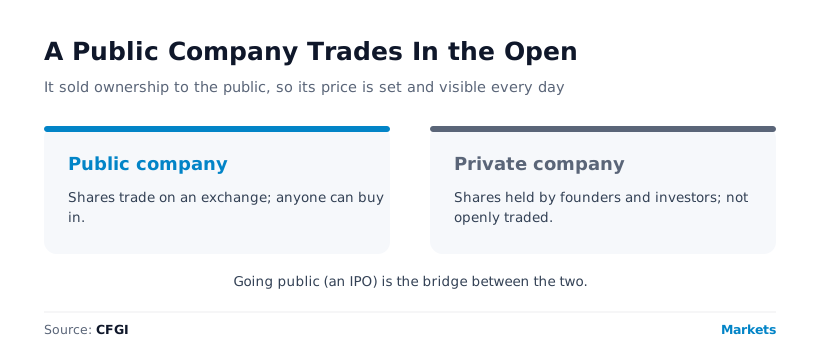
A public company is one whose shares are listed on a stock exchange, so anyone can buy them. It has sold ownership to the public, usually through an IPO, and in return must report its finances openly and answer to shareholders and regulators. Going public lets a company raise large amounts of capital, but it trades away control and privacy for that access. Being public means its price, and the crowd’s mood toward it, is set and visible every trading day. This is education, not financial advice.
CFGI data
Going public makes a company’s mood measurable. CFGI scores stock sentiment from 0 to 100, updated daily since 2021, across major indices and leading stocks, turning the public market’s fear and greed into a single readable number.
Source: CFGI dataset, 2021 to June 2026.
Key takeaways
- A public company’s shares are listed on a stock exchange.
- Anyone can buy them, and the price is set in the open.
- Companies usually go public through an IPO to raise capital.
- Being public means heavy reporting and answering to shareholders.
- A live public price makes its daily mood measurable.
What Is a Public Company?
A public company has sold shares to the general public, which now trade on a stock exchange. Apple, Microsoft and Tesla are public: anyone can own a piece of them. In exchange for raising money from the public, the company accepts strict rules, including regular, open financial reporting. That openness is the defining bargain of being public, you gain access to a vast pool of investors, but you give up much of your privacy and a good deal of your control.
Public Versus Private
The opposite of a public company is a private company, owned by a small group of founders, staff or investors, whose shares are not freely traded. The differences run deep.
| Public | Private | |
|---|---|---|
| Who can buy in | Anyone, on an exchange | A select few |
| Daily price | Yes, live and visible | No public price |
| Disclosure | Heavy, mandatory | Minimal |
| Raising capital | Easy, at scale | Harder, limited |
| Control | Diluted, answerable | Concentrated, nimble |
Two ways to own a company.
Neither is "better": a private company trades easy access to capital for control and privacy, while a public one does the reverse. The journey from one to the other is usually an IPO.
Going Public: The IPO
A company crosses from private to public through an "initial public offering", or IPO, the first time it sells shares to the general public. It is a major, heavily regulated event: in the US, IPOs fall under the Securities and Exchange Commission and the Securities Act of 1933, and the company must produce extensive disclosures so investors know what they are buying. The IPO is the moment ownership opens to the world, the founders and early backers see their stakes become tradable, the company receives a large injection of capital, and from that day forward its value is set in public, minute by minute, by the market rather than by a private valuation.
Why Companies Go Public (and Why Some Don’t)
The main draw of going public is capital: an exchange listing opens access to a vast pool of investors, funding expansion, paying down debt and rewarding early shareholders on a scale private fundraising rarely matches. It also brings prestige and visibility that can attract customers and talent. But the costs are real, which is why many successful companies stay private for years or forever. Public companies surrender control to a broad shareholder base, face heavy and expensive reporting and compliance, and feel relentless pressure to hit short-term quarterly targets. Private firms, by contrast, keep their decision-making concentrated and nimble and their finances confidential. The choice is a genuine trade-off between the firepower of public capital and the freedom of private ownership.
Capital for Control
Going public buys access to enormous capital and visibility, paid for with control, privacy and short-term scrutiny. Plenty of strong companies decide the price is not worth it.
The Duties of Being Public
Being public is an ongoing obligation, not a one-off event. A listed company must publish detailed financial results every quarter and year, file regular reports with regulators, submit to independent audits, and disclose material news that could move its share price, all so that the investing public can make informed decisions. It answers to its shareholders, who can vote on major matters, and to the listing standards of its exchange. This transparency is the price of public capital: in return for the right to raise money from anyone, a public company agrees to operate in the open. That same flow of mandatory, public information is also what makes a public company so much easier to analyse, and to measure, than a private one.
Why Going Public Makes Mood Measurable
Because a public price is a live, continuous vote. Every trading day, the crowd reprices the company, and that price carries emotion as well as fact. A private company has no such signal, its worth is only re-estimated occasionally, behind closed doors, while a public one broadcasts its mood constantly through its ticker. That is what lets CFGI score public stocks on the Stock Fear and Greed Index, reading their fear and greed from real, observable market behaviour. The act of going public is, in effect, what turns a company’s mood into something a sentiment gauge can read.
Frequently asked questions
What is a public company?
A company whose shares are listed on a stock exchange so anyone can buy them. It has sold ownership to the public, usually through an IPO, and must report its finances openly and answer to shareholders and regulators.
What is the difference between a public and private company?
A public company’s shares trade freely on an exchange with a live price and heavy disclosure; a private company is owned by a select few, has no public price and minimal disclosure. Public firms raise capital easily but trade away control and privacy.
Why do companies go public?
Mainly to raise large amounts of capital for growth, to let early owners and investors sell their stakes, and to gain visibility. In return they accept loss of control, costly reporting and short-term scrutiny, which is why some stay private.
Can you measure a private company’s sentiment?
Not in the same way. Without a daily public price, there is no live signal of the crowd’s mood. CFGI scores public stocks, which broadcast their mood continuously through real market behaviour. This is education, not financial advice.
CFGI.io, Market sentiment research
The CFGI research team builds and maintains the CFGI Fear and Greed Index: a 0 to 100 sentiment score from 10 sub-indicators across hundreds of crypto assets and the equity market, refreshed every 15 minutes. We have tracked market emotion through multiple full crypto and equity cycles.
Think we missed something?
Spotted a gap, disagree with a take, or think we should cover a new topic? Message us and we'll act on your input.
Message us on TelegramKeep reading
This article is educational and is not financial advice. Crypto and equities are volatile and you can lose money. See our disclaimer.