Crypto
What Is a Crypto Bubble?
Quick answer
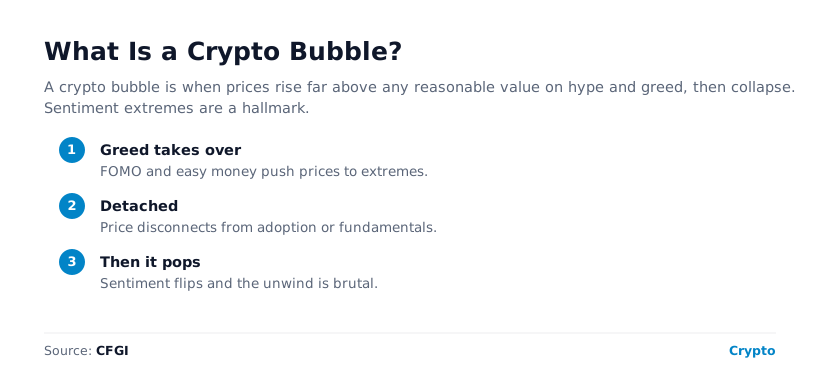
A crypto bubble is when prices rise far above any reasonable value, driven by hype, greed and the fear of missing out, then collapse when the buying runs out. Crypto’s volatility, thin anchor to fundamentals and fast-moving narratives make bubbles common, and its boom-bust cycles in 2013, 2017 and 2021 each ended in roughly 80% drawdowns. Bubbles form in greed and burst into fear, so sentiment extremes, especially sustained Extreme Greed, are a hallmark of a market detaching from value. This is education, not financial advice.
CFGI data
Bubbles live at the greed end of the scale. CFGI has tracked sentiment across hundreds of assets on its 0 to 100 scale since March 2022, and per-asset scoring is what reveals a single coin pinned in Extreme Greed while the broader market is calmer, the local bubble a market-wide number would miss.
Source: CFGI dataset, March 2022 to June 2026.
Key takeaways
- A bubble is prices rising far above reasonable value on hype.
- It forms in greed and bursts into fear.
- Crypto’s cycles in 2013, 2017 and 2021 each ended in ~80% drawdowns.
- Crypto is bubble-prone because value is hard to anchor.
- Sustained Extreme Greed is a hallmark of one.
How a Bubble Forms and Bursts
A bubble follows a familiar arc: a story takes hold, prices rise, the rise attracts more buyers chasing gains, and the chase pushes prices far past what fundamentals justify. Eventually the supply of new buyers runs out, the move stalls, and the same crowd that bought in greed sells in fear, collapsing the price. Crypto is especially prone to bubbles because narratives move fast, the supply of attention is global, and volatility is high. A single coin or sector can inflate and deflate in weeks.
Crypto’s Bubble History
Crypto has lived through several full boom-and-bust cycles, each larger than the last, and each ending in a brutal drawdown.
| Cycle | Driver | What followed |
|---|---|---|
| 2013 | Early Bitcoin mania | Sharp crash |
| 2017 to 2018 | ICO boom (~$830B peak) | Roughly 80% drawdown |
| 2021 to 2022 | DeFi and NFT surge (~$3.3T peak) | Bitcoin fell ~78% |
Crypto’s major cycles.
In the most recent bust, Bitcoin fell from around 69,000 dollars in November 2021 to about 15,500 a year later, a drop of nearly 78%. Drawdowns of 50 to 80% are not outliers in crypto; they are a recurring feature of its cycles.
Why Crypto Is So Bubble-Prone
Crypto bubbles are bigger and more frequent than in most markets for structural reasons. Many crypto assets have no earnings, cash flow or traditional way to anchor their value, so price is driven far more by narrative and sentiment than by fundamentals, leaving little to stop it detaching from reality. The market trades 24 hours a day, globally, with heavy leverage that amplifies both the climb and the collapse. It is dominated by emotional retail money and powered by FOMO, and each cycle brings a fresh "this time is different" technology story that makes any price seem justifiable. Together these turn ordinary enthusiasm into full-blown manias with unusual ease.
The Stages of a Crypto Bubble
Crypto bubbles tend to follow the classic five-stage pattern, just faster and more violently than in traditional markets.
- Displacement: a new technology or narrative, ICOs, DeFi, NFTs, AI tokens, captures imaginations.
- Boom: prices climb steadily and the story spreads.
- Euphoria: caution vanishes, valuations are dismissed, and FOMO-driven buying goes parabolic.
- Profit-taking: early and savvy money quietly sells near the top.
- Panic: the trend breaks and the crowd rushes for the exits, often amplified by liquidations.
Recognising which stage the market is in is far more useful than trying to pinpoint the exact top.
Spotting and Surviving a Bubble
The warning signs are consistent: a parabolic, near-vertical price chart, an asset "everyone" is suddenly talking about, valuations waved away with new-paradigm stories, soaring leverage, and a flood of inexperienced new money. The hard truth is that you cannot reliably time the burst, bubbles can inflate far longer and higher than seems possible, so the answer is risk management rather than top-calling. Taking some profits on the way up, keeping position sizes sensible, and never betting more than you can afford to lose matter far more than predicting the exact peak. Surviving a bubble intact is a better goal than catching its final dollar of gains.
You Cannot Time the Top
Bubbles routinely run higher and longer than anyone expects. Managing risk, trimming, sizing, keeping cash, beats trying to sell the exact peak, which almost no one does.
Bubbles and Extreme Greed
A Crypto Fear and Greed Index is one way to gauge how stretched things are. Sustained Extreme Greed, especially on a single asset that is running far ahead of the market, is the signature of a possible bubble. The index will not call the top, no tool can, but it flags when price is running on emotion rather than substance. CFGI’s per-asset scoring is especially useful here: it can show one coin pinned in euphoric Extreme Greed while the broader market is merely warm, exposing a local bubble that a single market-wide number would completely hide.
Frequently asked questions
What is a crypto bubble?
When prices rise far above any reasonable value, driven by hype, greed and fear of missing out, then collapse when the buying runs out. Crypto’s volatility and thin anchor to fundamentals make them common.
How big have crypto crashes been?
Very big. The 2017 to 2018 and 2021 to 2022 busts each saw roughly 80% drawdowns, with Bitcoin falling about 78% from its late-2021 high. Drawdowns of 50 to 80% are a recurring feature of crypto cycles, not outliers.
How do you spot a crypto bubble?
Signs include a parabolic price, an asset everyone is chasing, valuations dismissed with new-paradigm stories, high leverage and a flood of new money, plus sustained Extreme Greed on a sentiment index, especially on an asset running ahead of the market.
Do bubbles always burst?
By definition, a bubble is an unsustainable rise that eventually collapses. Timing the burst is nearly impossible, which is why risk management, trimming, sizing, keeping cash, matters more than calling the top. This is education, not financial advice.
CFGI.io, Market sentiment research
The CFGI research team builds and maintains the CFGI Fear and Greed Index: a 0 to 100 sentiment score from 10 sub-indicators across hundreds of crypto assets and the equity market, refreshed every 15 minutes. We have tracked market emotion through multiple full crypto and equity cycles.
Think we missed something?
Spotted a gap, disagree with a take, or think we should cover a new topic? Message us and we'll act on your input.
Message us on TelegramKeep reading
This article is educational and is not financial advice. Crypto and equities are volatile and you can lose money. See our disclaimer.