Crypto
Common Mistakes Using the Fear and Greed Index
Quick answer
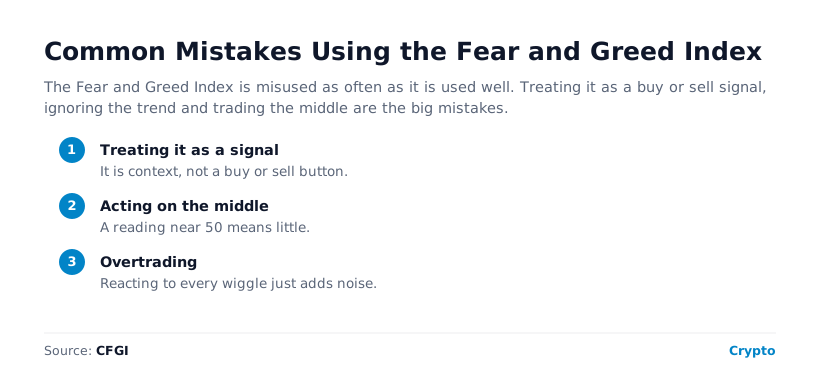
The most common mistakes are treating the index as a buy or sell signal, acting on every extreme regardless of trend, reading the neutral middle as if it meant something, and chasing every 15-minute flicker. The root of nearly all of them is confusing a description of the present with a prediction of the future. The index reads current sentiment well but forecasts poorly, so used as a trigger it disappoints. Used as context, it is far more useful. This is education, not financial advice.
CFGI data
The headline mistake is expecting prediction. CFGI sentiment matches same-day market direction 79% of the time but the next day only 49%, near a coin flip, on data since March 2022. Anyone trading the index as a forecast is acting on that 49%.
Source: CFGI dataset, March 2022 to June 2026.
Key takeaways
- Mistake 1: treating it as a buy or sell signal rather than context.
- Mistake 2: acting on every extreme, ignoring the trend.
- Mistake 3: reading the neutral middle as meaningful.
- Mistake 4: chasing every 15-minute flicker.
- The root error: confusing description with prediction.
The Big Mistakes
- Treating it as a signal. The Fear and Greed Index reads the present, not the future. Buying or selling purely because it hit an extreme ignores that it barely forecasts the next day.
- Fighting the trend. Extreme Fear in a strong downtrend can persist for weeks. Acting against a powerful trend on sentiment alone is how contrarians get run over.
- Trading the middle. Around 40 to 59 the reading is noise. Reacting to small moves in the neutral band is reading signal into randomness.
- Using one market number. When a per-asset score exists, the market average can hide that the coin you hold is the one at an extreme.
Mistake Five: Chasing Every Flicker
A fifth, subtler mistake is over-monitoring, reacting to every twitch of the live gauge. Because the crypto score refreshes every 15 minutes, it is tempting to watch it obsessively and treat each small move as meaningful, but this is a fast route to anxiety and overtrading. Sentiment is useful at the extremes and over the meaningful timeframes of days and weeks, not minute to minute, where the reading is dominated by short-term noise. A score wobbling between 48 and 52 over an afternoon is telling you nothing, yet an over-engaged user can talk themselves into "seeing" trends in that randomness and trading on them. The discipline is to check the index around significant moves and at the extremes, on the daily or longer reading, rather than staring at the live number. Like most market tools, the Fear and Greed Index rewards patience and punishes hyperactivity, and the constant refresh, helpful as it is, can become a trap for those who mistake activity for insight.
The Root Error: Description Versus Prediction
Almost every one of these mistakes flows from a single, deeper misunderstanding: confusing a description of the present with a prediction of the future. The Fear and Greed Index is, fundamentally, a thermometer, it tells you, accurately, how hot or cold the crowd’s emotion is right now. The error is treating it as a crystal ball, reasoning "it says Extreme Fear, therefore the price must bounce". But a low reading does not contain any promise about tomorrow; it simply describes today. This is closely related to the gambler’s fallacy, the belief that an extreme is "due" to reverse on some schedule, when in reality sentiment can stay extreme for a long time. Once you internalise that the index measures the present mood and does not forecast the next move, the right way to use it follows naturally, and most of the common mistakes simply dissolve. The tool is not broken when an extreme fails to reverse immediately; it was never designed to predict the timing in the first place. Respecting what it actually is, an honest, real-time read of crowd emotion, is the key to avoiding nearly all the pitfalls.
A Thermometer, Not a Crystal Ball
The deepest mistake is expecting a present-tense tool to predict the future. The index measures the crowd’s mood now; it does not promise what price does tomorrow. Most other errors flow from this one.
How to Avoid Them
Use the index as context, not a trigger. Pay attention only at the extremes, respect the trend, check the specific asset rather than the market average, read the daily mood rather than every flicker, and decide in advance what an extreme reading will and will not make you do. Above all, hold the right mental model: the index describes the crowd’s present emotion, it does not predict price, and it is one input to weigh alongside the trend, your own analysis and your plan. No way of using a sentiment index removes market risk or guarantees a profit, these are common pitfalls to avoid, not a strategy in themselves. But an investor who understands what the tool is, and uses it for what it does well, reading the temperature of the crowd, especially at the extremes, will get far more from it than one who treats it as a magic buy or sell button. This is education, not financial advice.
Frequently asked questions
What is the biggest mistake with the Fear and Greed Index?
Treating it as a buy or sell signal, which flows from the deeper error of confusing description with prediction. It reads current sentiment well but forecasts the next day poorly (near a coin flip), so used as a trigger it disappoints. It works best as context.
Should I act every time it hits an extreme?
No. Extremes can persist, especially against a strong trend, and assuming an extreme is "due" to reverse is the gambler’s fallacy. An extreme is a reason to pay attention, not to act automatically.
Should I watch it minute to minute?
No. The score refreshes every 15 minutes, but reacting to every flicker leads to anxiety and overtrading. Sentiment matters at the extremes and over days and weeks; a score wobbling in the neutral band over an afternoon is mostly noise.
Does the neutral zone matter?
Not much. Around 40 to 59 the reading is mostly noise. The index is most informative at the extremes, under 20 and over 80. Hold the right mental model, it describes the present, it does not predict. This is education, not financial advice.
CFGI.io, Market sentiment research
The CFGI research team builds and maintains the CFGI Fear and Greed Index: a 0 to 100 sentiment score from 10 sub-indicators across hundreds of crypto assets and the equity market, refreshed every 15 minutes. We have tracked market emotion through multiple full crypto and equity cycles.
Think we missed something?
Spotted a gap, disagree with a take, or think we should cover a new topic? Message us and we'll act on your input.
Message us on TelegramKeep reading
This article is educational and is not financial advice. Crypto and equities are volatile and you can lose money. See our disclaimer.