Markets
What Is the Difference Between Fear and Greed In Markets?
Quick answer
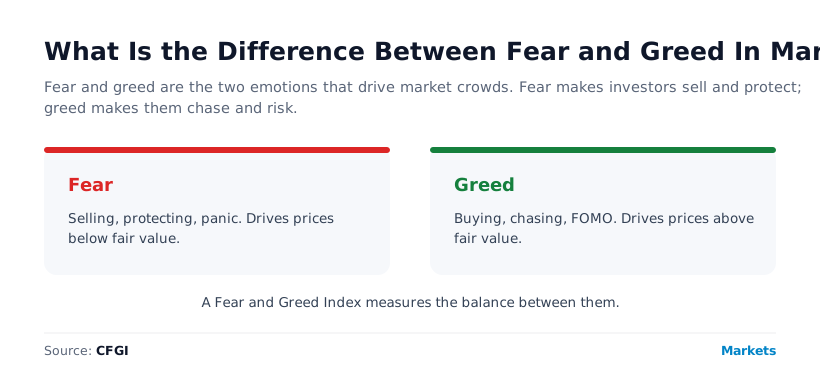
Fear and greed are the two emotions that move market crowds. Fear is the urge to protect capital: it makes investors sell, avoid risk and demand safety, which drags prices down. Greed is the urge to chase returns: it makes investors buy, take risk and ignore warnings, which pushes prices up. The two are not symmetric, fear strikes faster and deeper than greed builds, and a Fear and Greed Index measures where a market sits between them on a single scale. This is education, not financial advice.
CFGI data
In CFGI data since March 2022, the two emotions are not symmetric: fear arrives fast and deep, greed builds slowly and stays scarce. The stock score hit an extreme-fear 3 on 8 April 2025 but topped out at 83 on 19 December 2023, a reminder on the 0 to 100 scale that fear moves markets harder than greed.
Source: CFGI dataset, March 2022 to June 2026.
Key takeaways
- Fear is the urge to protect: sell, avoid risk, seek safety.
- Greed is the urge to chase: buy, take risk, ignore warnings.
- Fear drags prices down; greed pushes them up.
- Fear tends to be faster and deeper than greed, thanks to loss aversion.
- A single index scores a market from 0 (fear) to 100 (greed).
Two Emotions, Two Behaviours
| Fear | Greed | |
|---|---|---|
| Urge | Protect capital | Chase returns |
| Behaviour | Sell, avoid risk | Buy, take risk |
| Effect on price | Pushes down | Pushes up |
| Speed | Fast and deep | Slow and stretched |
How fear and greed differ in markets.
A Fear and Greed Index places a market on the line between the two, from 0 (pure fear) to 100 (pure greed), so you can see which emotion is in charge.
Fear: The Urge to Protect
Fear is the instinct to protect what you have. In a frightened market, investors sell to raise cash, dump risky assets, and crowd into safe havens like bonds, gold or the dollar. Volatility spikes, volume can dry up, and the mood feeds on itself as falling prices trigger more selling. Fear is powered by "loss aversion", the well-documented finding that the pain of a loss is felt about twice as keenly as the pleasure of an equivalent gain. That lopsided wiring is why fear is such a potent market force: people will do almost anything, often at the worst possible moment, to stop the bleeding.
Greed: The Urge to Chase
Greed is the opposite impulse: the urge to chase returns and not be left behind. In a greedy market, investors buy aggressively, pile into whatever is rising, take on leverage, and wave away warning signs with the timeless phrase "this time is different". FOMO, the fear of missing out, blurs the line between the two emotions, but the behaviour is distinctly greedy: risk appetite climbs, caution evaporates, and prices can detach from fundamentals. Where fear hoards, greed reaches, and the further it reaches, the more fragile the rally it builds becomes.
The Asymmetry: Fear Is Faster and Deeper
The most important difference is that the two emotions are not mirror images. Fear spikes hard and fast, while greed builds slowly and rarely reaches the same extremes. Markets are often said to "take the stairs up and the elevator down": months of patient, greedy accumulation can be erased in days of panic. Loss aversion is the engine of this asymmetry, the rush to avoid pain is far more urgent than the pull toward gain. CFGI’s own record shows it plainly: the equity score has plunged to a deep 3 in a panic but topped out at only 83 at its most euphoric. Fear, in short, hits markets harder than greed.
Stairs Up, Elevator Down
Greed accumulates gains slowly; fear gives them back fast. That is why the lowest readings tend to be more extreme, and more sudden, than the highest ones.
Two Ends of One Scale
What makes a Fear and Greed Index so useful is that it puts both emotions on a single ruler. A reading under 20 means fear dominates; over 80 means greed does; around 50 means they are balanced. Rather than guessing which mood prevails from the headlines, you get one number that captures the tug-of-war between protecting and chasing. Because the index reads measurable behaviour, volatility, momentum, demand for safety, it can tell you not just which emotion is in charge but how stretched it has become, which is where the real signal lives.
Why the Difference Matters for You
The asymmetry has a practical edge. Because fear is sharp and self-exhausting, buying into Extreme Fear has historically been the more reliable contrarian move, panic burns out and prices snap back. Because greed is slow and stubborn, selling at the first sign of it is far less reliable, since euphoria can persist for a long time. So the two extremes call for different responses: deep fear is often a moment to be brave (carefully), while deep greed is usually a cue to manage risk and trim rather than to dramatically sell out. Knowing which emotion you are facing, and that they behave differently, is half of using sentiment well.
Frequently asked questions
What is the difference between fear and greed?
Fear is the urge to protect capital, which makes investors sell and seek safety; greed is the urge to chase returns, which makes them buy and take risk. Fear drags prices down, greed pushes them up.
Which is stronger in markets?
Fear tends to be faster and deeper than greed, driven by loss aversion, the pain of a loss is felt about twice as keenly as an equal gain. That is why crashes are sharp while greed builds slowly and reaches extremes less often.
How does the index show both?
It scores a market from 0 to 100: low readings mean fear dominates, high readings mean greed dominates, and the middle is balanced. One number captures the tug-of-war between protecting and chasing.
Does the difference change how I use the index?
Yes. Because fear is sharp and self-exhausting, buying deep fear has been the more reliable contrarian move; because greed is slow and stubborn, deep greed is better used to manage risk than to sell outright. This is education, not financial advice.
CFGI.io, Market sentiment research
The CFGI research team builds and maintains the CFGI Fear and Greed Index: a 0 to 100 sentiment score from 10 sub-indicators across hundreds of crypto assets and the equity market, refreshed every 15 minutes. We have tracked market emotion through multiple full crypto and equity cycles.
Think we missed something?
Spotted a gap, disagree with a take, or think we should cover a new topic? Message us and we'll act on your input.
Message us on TelegramKeep reading
This article is educational and is not financial advice. Crypto and equities are volatile and you can lose money. See our disclaimer.