Markets
What Is the Business Cycle?
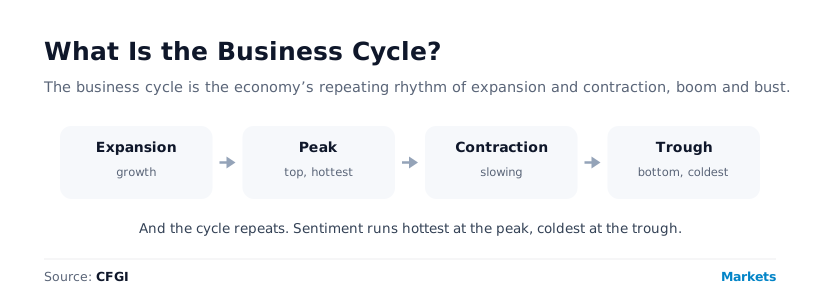
Quick answer
The business cycle is the economy’s recurring pattern of expansion and contraction over time, running through growth, peak, slowdown and recovery in a rough, repeating rhythm. No two cycles are identical, and they vary hugely in length, but the pattern of boom and bust is a constant of every economy. Markets follow it closely because each phase favours different assets and shifts the prevailing mood between greed and fear.
CFGI data
CFGI often turns before the cycle does, because sentiment leads the economy. The score can reach Extreme Greed, 80 or above on its 0 to 100 scale, near a peak, and Extreme Fear, below 20, near a bottom, ahead of the official data that later confirms the turn. CFGI has tracked that scale since March 2022.
Source: CFGI methodology, 0 to 100 sentiment model.
Key takeaways
- The business cycle is the economy’s rhythm of expansion and contraction.
- Its four phases are expansion, peak, contraction and trough.
- Postwar US expansions averaged about 64 months, contractions about 10.
- Sentiment and confidence drive a large share of the cycle, by some estimates around 40%.
- Markets and sentiment gauges tend to turn before the economy does.
The Phases of the Cycle
Economies do not grow in a straight line; they move in waves with four recognisable phases.
- Expansion. Interest rates tend to be low, borrowing is easy, demand grows, and businesses hire and invest. Confidence builds, the good times.
- Peak. Growth tops out. Demand starts to outpace supply, inflation heats up, and the central bank usually begins raising rates to cool things down.
- Contraction. Activity slows as higher rates and falling demand bite. A deep enough contraction is a recession, the stretch from peak to trough.
- Trough. The low point. Activity bottoms, then steadies, and a new expansion begins, often while the gloom still feels total.
How Long Does a Cycle Last?
In the US, the National Bureau of Economic Research is the official referee that dates each phase. Its postwar figures show a striking asymmetry: expansions have averaged around 64 months, while contractions have averaged just over 10.
| Phase | Typical length |
|---|---|
| Expansion | About 64 months |
| Contraction (recession) | About 10 months |
| Full cycle, trough to trough | About 75 months |
US business cycle, postwar averages (NBER).
The lesson hidden in those averages is that the economy spends far more time growing than shrinking; the booms are long and the busts are comparatively short and sharp. But the averages hide enormous variation, with historical contractions ranging from a couple of months to over five years, so the cycle is a rhythm, not a timetable.
What Drives the Cycle
In the short run, the cycle is mostly driven by two things: how much consumers spend and how much businesses invest. When both are rising, the economy expands; when both pull back, it contracts. Credit is the accelerator, cheap money in expansions encourages borrowing and spending, while the rate rises that arrive near a peak gradually choke it off. That is why the central bank’s interest-rate decisions are so closely watched: they are, in effect, attempts to smooth the cycle’s extremes.
The Sentiment Engine
Here is the part that connects the cycle to fear and greed. Spending and investment are not purely mechanical, they depend on how confident people feel. Confident consumers buy; nervous ones save. Optimistic firms invest and hire; worried ones freeze. Because that confidence is partly self-fulfilling, it becomes a force of its own. One influential study estimated that swings in sentiment account for roughly 40% of US business cycle fluctuations, with confidence about investment playing the largest role. The mood is not just a reaction to the cycle; it is one of the engines turning it.
Why This Matters
If a large share of the cycle is driven by collective mood, then measuring that mood is not a sideshow. It is reading one of the main forces behind the economy itself.
Different Phases, Different Assets
Because each phase has its own character, investors talk about "rotating" between types of assets as the cycle turns. The pattern is rough, never mechanical, but it is recognisable.
- Early expansion. Riskier, economically sensitive assets, smaller companies and cyclicals like industrials and consumer discretionary, tend to lead as growth accelerates.
- Late expansion and peak. Inflation-sensitive areas can shine, but rising rates start to weigh on the most speculative names.
- Contraction. Defensive sectors, utilities, healthcare and consumer staples, plus safer assets like government bonds, tend to hold up best when fear takes over.
- Trough and recovery. The cycle resets, and risk appetite slowly returns to the assets that were hit hardest.
You do not need to trade this to benefit from understanding it. Knowing roughly where the cycle sits explains why one part of the market is soaring while another sags, and stops you mistaking a phase of the cycle for a permanent trend.
Why Markets Lead the Cycle
Each phase tends to favour different assets, riskier ones in expansions, defensive ones in contractions, but the more important point for an investor is timing. Markets move ahead of the economy, not with it. Stocks often turn greedy before a recovery is visible in the data, and fearful before a downturn officially arrives, because investors are pricing the next phase, not the current one. That is exactly why a Fear and Greed Index can act as a leading, contrarian signal: peak greed has often clustered near cycle tops, and peak fear near the bottoms that, in hindsight, were the opportunities.
Frequently asked questions
What is the business cycle?
The economy’s recurring pattern of expansion and contraction, running through growth, peak, recession and recovery in a rough rhythm that repeats over time.
What are the four phases of the business cycle?
Expansion (growth), peak (the top, where inflation and rate rises appear), contraction or recession (the slowdown from peak to trough), and the trough (the bottom, before a new expansion). No two cycles are identical.
How long does a business cycle last?
In the postwar US, expansions have averaged about 64 months and contractions about 10, for a full cycle of roughly 75 months. But the variation is huge, so the averages are a guide, not a schedule.
Why do markets care about the business cycle?
Because different phases favour different assets and moods, and markets move ahead of the economy, turning greedy or fearful before the data confirms the turn. This is education, not financial advice.
CFGI.io, Market sentiment research
The CFGI research team builds and maintains the CFGI Fear and Greed Index: a 0 to 100 sentiment score from 10 sub-indicators across hundreds of crypto assets and the equity market, refreshed every 15 minutes. We have tracked market emotion through multiple full crypto and equity cycles.
Think we missed something?
Spotted a gap, disagree with a take, or think we should cover a new topic? Message us and we'll act on your input.
Message us on TelegramKeep reading
This article is educational and is not financial advice. Crypto and equities are volatile and you can lose money. See our disclaimer.