Stocks
What Is a Sector In the Stock Market?
Quick answer
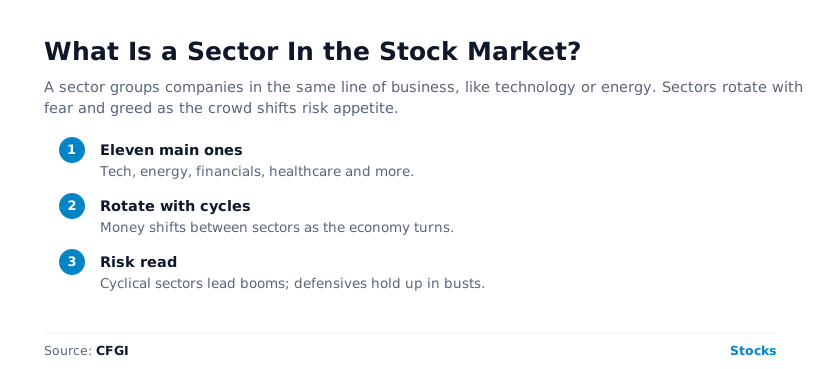
A sector is a group of companies that operate in the same broad area of the economy, such as technology, energy, healthcare or financials. Grouping stocks this way, most commonly into 11 standard sectors, helps investors compare like with like and see where money is flowing. Sectors behave differently and rotate with sentiment: defensive sectors tend to hold up in fear, while cyclical, growth-leaning sectors lead in greed. This is education, not financial advice.
CFGI data
Sector rotation is sentiment made visible. As CFGI swings between fear and greed on its 0 to 100 scale, money tends to rotate from defensive sectors toward cyclical ones and back. Per-asset scoring lets you see which areas are running hot while others stay cautious, the rotation behind the headline mood.
Source: CFGI dataset, 2021 to June 2026.
Key takeaways
- A sector groups companies in the same line of business.
- The standard framework, GICS, splits the market into 11 sectors.
- Cyclical sectors swing with the economy; defensive ones hold up.
- Money rotates between sectors as the economic cycle turns.
- Sector leadership is itself a read on risk appetite.
Sorting the Market by Business
Thousands of listed companies are far easier to navigate when grouped by what they actually do. The standard frameworks split the market into around 11 sectors, technology, financials, healthcare, energy, consumer staples and so on. Each behaves differently, so knowing a stock’s sector tells you a great deal about how it is likely to move: a utility and a software company face completely different forces, even on the same day.
The 11 GICS Sectors
The most widely used scheme is the Global Industry Classification Standard, or GICS, created by MSCI and S&P in 1999 and used across the financial world. It sorts every major public company into one of eleven sectors.
- Information Technology and Communication Services: software, hardware, internet and media.
- Financials: banks, insurers and brokers. Health Care: drugs, devices and care.
- Consumer Discretionary (wants) and Consumer Staples (needs).
- Industrials, Energy and Materials: the backbone of the physical economy.
- Utilities and Real Estate: steady, income-focused and rate-sensitive.
Each sector then breaks down further into industry groups, industries and sub-industries, so a single "Financials" sector contains everything from giant banks to niche insurers, which is why investors often look one level deeper than the headline sector when comparing companies.
Cyclical Versus Defensive Sectors
For reading the market, the most useful split is between cyclical and defensive sectors. Cyclical sectors, technology, consumer discretionary, financials, industrials, materials and energy, thrive when the economy is expanding and consumers and businesses are spending freely, and they fall hard when it contracts. Defensive sectors, utilities, consumer staples and healthcare, sell essentials people buy in any climate, so they hold up far better in downturns and lag in booms. The two groups are almost mirror images, which is exactly what makes the balance between them so informative.
Sector Rotation Through the Cycle
Because sectors respond to the economy at different times, money tends to move between them in a recognisable order as the business cycle turns, a pattern called sector rotation. The rough map is well known to professionals.
| Cycle stage | Sectors that often lead |
|---|---|
| Early expansion | Technology, consumer discretionary |
| Mid cycle | Financials, industrials |
| Late cycle | Energy, materials |
| Contraction | Staples, healthcare, utilities |
Which sectors tend to lead at each stage.
No cycle follows the script exactly, but the framework explains why one part of the market can be booming while another sags, and it is the logic behind "sector rotation" investment strategies.
Why Sectors Matter for an Investor
Sectors are practical tools, not just labels. They let you compare like with like, judging a bank against other banks rather than against a biotech, and they are essential for genuine diversification: owning ten stocks all in technology is far riskier than owning ten spread across sectors, because the tech names will rise and fall together. For exposure to a whole sector at once, investors often use sector ETFs, funds that track a single sector’s index, such as a technology or financials fund, in one holding. Thinking in sectors is one of the simplest upgrades to how you understand a portfolio.
Reading Sector Leadership As a Signal
Beyond owning them, watching which sectors lead is a window into what the market expects. When aggressive, cyclical sectors like technology and discretionary are out front, it usually reflects optimism and positioning for growth. When investors crowd into defensive utilities, staples and healthcare, it often signals rising caution and worry about the road ahead. So a quiet shift in sector leadership can flag a change in the market’s mood before it shows up in the headline index, which is why analysts track the cyclical-versus-defensive balance so closely.
Sector Rotation and Sentiment
Sector rotation is, at bottom, sentiment made visible. When the crowd turns greedy, money rotates into cyclical, growth-leaning sectors; when fear takes over, it rotates into defensives. That movement is the same shift in risk appetite a Stock Fear and Greed Index reads on its 0 to 100 scale. Watching which sectors lead, alongside the gauge, gives a fuller, two-angle picture of where confidence really stands, the mood the index measures and the money flows that confirm it.
Frequently asked questions
What is a sector in the stock market?
A group of companies in the same broad area of the economy, such as technology, energy or healthcare. The standard GICS framework sorts the market into 11 sectors, which helps investors compare like with like.
What are the 11 stock market sectors?
Information Technology, Communication Services, Financials, Health Care, Consumer Discretionary, Consumer Staples, Industrials, Energy, Materials, Utilities and Real Estate, the eleven GICS sectors.
What is sector rotation?
The tendency for money to move between sectors as the economic cycle turns: growth and tech in early expansion, financials and industrials mid-cycle, energy and materials late, and defensives in contraction.
Which sectors do well in fear?
Defensive sectors like utilities, consumer staples and healthcare tend to hold up better when the crowd is fearful, while cyclical sectors lead in greed. A rotation into defensives signals rising caution. This is education, not financial advice.
CFGI.io, Market sentiment research
The CFGI research team builds and maintains the CFGI Fear and Greed Index: a 0 to 100 sentiment score from 10 sub-indicators across hundreds of crypto assets and the equity market, refreshed every 15 minutes. We have tracked market emotion through multiple full crypto and equity cycles.
Think we missed something?
Spotted a gap, disagree with a take, or think we should cover a new topic? Message us and we'll act on your input.
Message us on TelegramKeep reading
This article is educational and is not financial advice. Crypto and equities are volatile and you can lose money. See our disclaimer.