Stocks
What Is a Cyclical Stock?
Quick answer
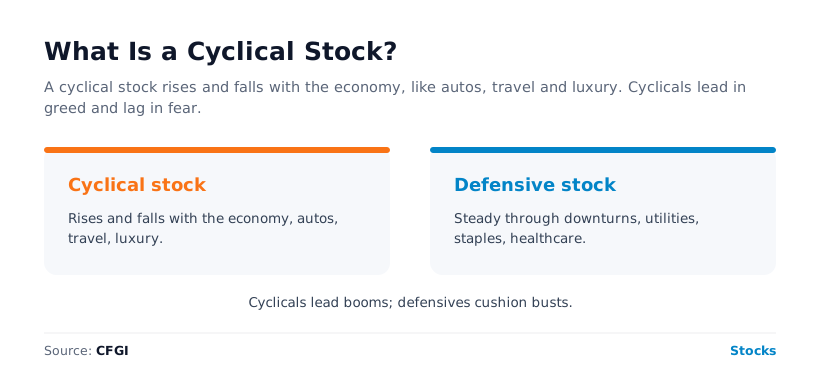
A cyclical stock is one whose fortunes rise and fall with the broader economy. Companies in areas like travel, cars, luxury goods, construction and finance boom when times are good and the crowd is confident, and suffer when the economy slows and fear takes over. Cyclicals are the mirror of defensive stocks: they tend to lead in greed and lag, or fall hardest, in fear, which makes them highly sensitive to shifts in market sentiment. This is education, not financial advice.
CFGI data
Cyclicals are leveraged to the mood. They tend to lead when CFGI reads greed and fall hardest when it plunges toward equity lows like the 3 on 8 April 2025 on its 0 to 100 scale. Watching sentiment helps frame whether the backdrop favours cyclicals or their defensive opposites.
Source: CFGI dataset, 2021 to June 2026.
Key takeaways
- A cyclical stock rises and falls with the economy.
- Examples include travel, autos, luxury, construction and finance.
- They have high beta and swing more than the market.
- They lead in booms and fall hardest in recessions.
- Timing them is hard, and "cheap" cyclicals can be a trap at the top.
Tied to the Economic Cycle
Cyclical companies sell things people buy more of when they feel wealthy and confident, and cut back on the moment money is tight: holidays, new cars, luxury goods, big-ticket building projects. Their revenues swing with the economic cycle, so their share prices tend to be far more volatile than the market. They are the mirror image of defensive stocks, which sell essentials and hold up better in hard times, and knowing which type a stock is tells you a great deal about how it will behave as conditions change.
What Makes a Stock Cyclical
The defining trait is discretionary demand: people and businesses can easily delay or cancel the purchase when confidence dips. A family postpones a new car, a couple skips the cruise, a company shelves a factory expansion. Because that demand surges in good times and evaporates in bad, cyclical earnings swing dramatically, and the share prices swing with them, giving cyclicals a high beta, usually above one. They amplify the market’s moves in both directions, which is the source of both their appeal and their danger.
The Cyclical Sectors
- Consumer discretionary. Cars, travel, restaurants, luxury, the first spending people cut.
- Industrials. Machinery, construction and transport tied to business investment.
- Financials. Banks and lenders, whose fortunes track economic activity and credit.
- Materials and energy. Miners, chemicals and oil, geared to industrial demand and commodity prices.
The Trade-Off: Big Upside, Whippy Ride
Cyclicals are the offence to defensives’ defence. When the economy is expanding and risk appetite is high, they can deliver the explosive gains that leave steady, defensive names behind, which is why they lead bull markets. The flip side is brutal: when growth stalls and fear takes over, cyclicals fall hardest and fastest, because their earnings can collapse just as quickly as they soared. They reward conviction and timing in a strong economy and punish complacency in a weak one. Judge them on their upside in expansions and their drawdowns in contractions, not on a single snapshot.
The Mirror
Defensive stocks lose less in busts; cyclical stocks gain more in booms. A balanced portfolio usually wants some of each, so it neither misses the upside nor takes the full force of the downside.
Early Cyclicals Versus Late Cyclicals
Not all cyclicals move at the same moment. Within the group there is an order. "Early cyclicals" like consumer discretionary and financials tend to lead at the start of a recovery, when confidence and cheap credit return. "Late cyclicals" like energy and materials often peak near the top of the cycle, when the economy is running hot and demand for raw materials is highest. This is the engine behind sector rotation: money flows through the cyclical sectors in sequence as the cycle ages, which is why one cyclical area can be soaring while another has already rolled over.
Why Cyclicals Are Hard to Time
In theory the play is simple, buy cyclicals near the bottom when fear is greatest and sell near the top when greed peaks, but in practice it is treacherous. The cycle is hard to call, and cyclicals set a famous trap for the unwary: near a top, their earnings are at a peak, which makes their valuations look deceptively "cheap" on measures like the price-to-earnings ratio, right before those earnings collapse. A cyclical that looks like a bargain at the height of a boom can be the most dangerous stock to own. The lesson is that with cyclicals, where you are in the cycle matters more than the headline valuation.
Cyclicals and Sentiment
Because they live and die by confidence, cyclicals are leveraged to fear and greed more than almost any other type of stock. In greedy, expansion-minded markets they tend to lead the charge; when fear sets in, they fall hardest. A Stock Fear and Greed Index reads that mood on a 0 to 100 scale, so it helps frame which environment the market is pricing and whether the backdrop favours aggressive cyclicals or their defensive opposites. When sentiment and the economic cycle line up, the case for, or against, cyclicals is at its clearest.
Frequently asked questions
What is a cyclical stock?
A stock whose fortunes rise and fall with the economy, in areas like travel, autos, luxury goods, construction and finance. Cyclicals boom in confident times and suffer when the economy slows.
How are cyclicals different from defensives?
Cyclicals depend on economic strength and swing with the cycle, with high beta; defensive stocks sell essentials and hold up better in downturns. They are mirror images, behaving oppositely as conditions change.
Why can a cheap-looking cyclical be a trap?
Because near a market top, a cyclical’s earnings are at a peak, making its valuation look deceptively cheap right before those earnings collapse in a downturn. With cyclicals, the stage of the cycle matters more than the headline valuation.
Do cyclicals do well in greed?
Generally yes. They tend to lead in greedy, expansion-minded markets and fall hardest in fear. A Fear and Greed Index helps frame the backdrop. This is education, not financial advice.
CFGI.io, Market sentiment research
The CFGI research team builds and maintains the CFGI Fear and Greed Index: a 0 to 100 sentiment score from 10 sub-indicators across hundreds of crypto assets and the equity market, refreshed every 15 minutes. We have tracked market emotion through multiple full crypto and equity cycles.
Think we missed something?
Spotted a gap, disagree with a take, or think we should cover a new topic? Message us and we'll act on your input.
Message us on TelegramKeep reading
This article is educational and is not financial advice. Crypto and equities are volatile and you can lose money. See our disclaimer.