Stocks
What Is Beta?
Quick answer
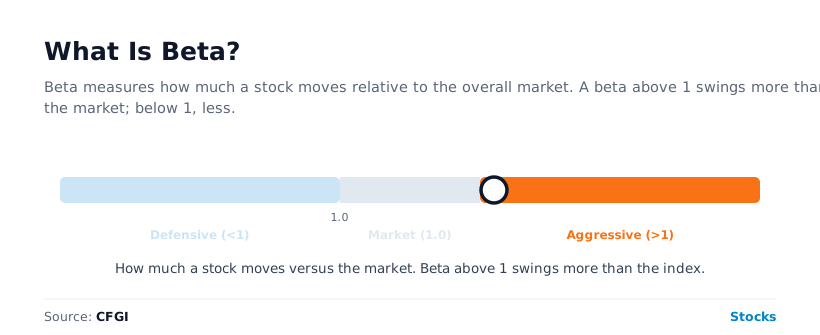
Beta measures how much a stock tends to move relative to the overall market. A beta of 1 means it moves roughly in line with the market; above 1 means it swings more and is more volatile; below 1 means it swings less and is steadier. Beta is a quick gauge of a stock’s risk relative to the market, useful for understanding how a holding is likely to behave when sentiment shifts and the whole market moves at once.
CFGI data
Beta tells you how much a stock amplifies the market; CFGI tells you the mood being amplified. Low-beta defensive names tend to hold up best exactly when the Stock Fear and Greed Index hits Extreme Fear, below 20 on its 0 to 100 scale, while high-beta names fall hardest, which is the relationship beta is built to describe.
Source: CFGI methodology, 10-input 0 to 100 model.
Key takeaways
- Beta measures a stock’s movement relative to the market.
- Beta of 1 moves with the market; above 1 is more volatile, below 1 steadier.
- It is the risk measure at the heart of the CAPM model.
- The "beta anomaly" is that low-beta stocks have historically outperformed risk-adjusted.
- Beta is backward-looking and captures only market-related risk.
Movement Relative to the Market
Beta compares a stock’s swings to a benchmark, usually the S&P 500. A beta of 1.5 suggests the stock tends to move about 1.5 times as much as the market, up and down; if the market rises 10%, a stock like that might rise around 15%, and fall harder when the market drops. A beta of 0.6 suggests it moves only about 60% as much. High-beta stocks, often growth names and small caps, amplify the market; low-beta stocks, often defensive names like utilities, cushion it.
Reading the Beta Number
| Beta | Behaviour | Typical examples |
|---|---|---|
| Below 0 | Moves opposite the market (rare) | Some gold or hedge assets |
| 0 to 1 | Steadier than the market | Utilities, consumer staples |
| About 1 | Moves with the market | Broad index funds |
| Above 1 | More volatile than the market | Tech, growth, small caps |
What a beta value tells you.
A negative beta is unusual and prized, because an asset that tends to rise when the market falls offers real diversification. Most stocks, though, sit somewhere on the positive scale between defensive and aggressive.
Beta and CAPM
Beta is not just a description; it sits at the heart of a famous theory, the Capital Asset Pricing Model, or CAPM. Mathematically, beta is the covariance of a stock with the market divided by the market’s variance, but the idea is simpler than the formula: CAPM says an investor should expect a higher return for taking on more market risk, and beta is how that risk is measured. In theory, a higher-beta stock should reward you with higher expected returns for the bumpier ride. That tidy relationship is the textbook view, and it is exactly where reality gets interesting.
The Beta Anomaly
Here is one of the most surprising findings in all of finance. If CAPM were the full story, high-beta stocks should reliably outperform low-beta ones over time, to compensate for their extra risk. They do not. Over long stretches of market history, low-beta, low-volatility stocks have actually delivered higher risk-adjusted returns than high-beta ones, and with smaller drawdowns. This is the "low-volatility anomaly", and it quietly contradicts the theory that more risk always means more reward.
Why It Might Happen
One popular explanation: many investors crave the lottery-like thrill of high-beta stocks and bid them up too far, while steady low-beta names are overlooked and left cheap. The boring stocks end up better bargains.
High Beta Versus Low Beta In Practice
In a rising, confident market, high-beta stocks tend to lead, which is why they look so attractive at the top of a bull run. In a falling market they are punished hardest. Low-beta defensives do the opposite: they lag in the boom but hold their value far better in the bust. Neither is "better" in the abstract; they suit different goals and different moments. The practical use of beta is to know what you own, so you are not surprised when a portfolio of high-beta names drops twice as fast as the market in a sell-off.
What Beta Does and Does Not Tell You
Beta is useful, but it has real limits. It is backward-looking, calculated from past data, and a stock’s beta can drift over time as its business changes. It measures only market-related risk, not company-specific surprises like a fraud, a recall or a failed product, the very things that can sink a single stock regardless of the market. And it says nothing about whether a stock is cheap or expensive. Treat beta as a rough gauge of how a holding reacts to the market, one input among many, rather than a prediction or a quality score.
Beta and Market Sentiment
Beta and sentiment work together. Beta tells you how violently a stock will react to a market-wide move; a Stock Fear and Greed Index tells you, on a 0 to 100 scale, which way the market is about to lean. When sentiment swings to greed, high-beta stocks tend to surge ahead; when it collapses to Extreme Fear, low-beta defensives are where money hides. Knowing the beta of what you hold, alongside where the mood sits, gives you a much clearer sense of how your portfolio will behave through the swings.
Frequently asked questions
What is beta?
A measure of how much a stock moves relative to the overall market. A beta of 1 moves with the market; above 1 swings more and is more volatile; below 1 swings less and is steadier.
What is a good beta?
There is no universally good beta; it depends on your goals and risk appetite. High beta means bigger swings and more risk; low beta means a steadier ride. It is a relative gauge, not a verdict on quality.
What is the beta anomaly?
The surprising finding that low-beta, low-volatility stocks have historically earned higher risk-adjusted returns than high-beta ones, with smaller drawdowns, which contradicts the theory that more risk always means more reward.
What are the limits of beta?
It is backward-looking, can change over time, and captures only market-related risk, not company-specific surprises or valuation. Use it as a rough risk gauge, not a forecast. This is education, not financial advice.
CFGI.io, Market sentiment research
The CFGI research team builds and maintains the CFGI Fear and Greed Index: a 0 to 100 sentiment score from 10 sub-indicators across hundreds of crypto assets and the equity market, refreshed every 15 minutes. We have tracked market emotion through multiple full crypto and equity cycles.
Think we missed something?
Spotted a gap, disagree with a take, or think we should cover a new topic? Message us and we'll act on your input.
Message us on TelegramKeep reading
This article is educational and is not financial advice. Crypto and equities are volatile and you can lose money. See our disclaimer.