Stocks
What Is Stock Market Volatility?
Quick answer
Stock market volatility is how much and how fast share prices swing. Calm markets drift; volatile ones lurch. It is measured most famously by the VIX, the "fear gauge", and by realised volatility, the actual size of past swings. Volatility tends to spike when fear takes over, because markets fall faster than they rise, and it is neither good nor bad in itself, it measures the size of moves, not their direction. It is one of the clearest signals of a nervous market. This is education, not financial advice.
CFGI data
Volatility spikes with fear, and CFGI reads it as a core signal behind the Stock Fear and Greed Index. The score has swung the full width of the scale, from an extreme-fear 3 on 8 April 2025 to a high of 83, a 0 to 100 reading updated daily since 2021, so when swings turn sharp the reading leans hard toward fear.
Source: CFGI methodology and dataset, 2021 to June 2026.
Key takeaways
- Volatility is how much and how fast prices swing.
- It is measured by the VIX (expected) and realised volatility (actual).
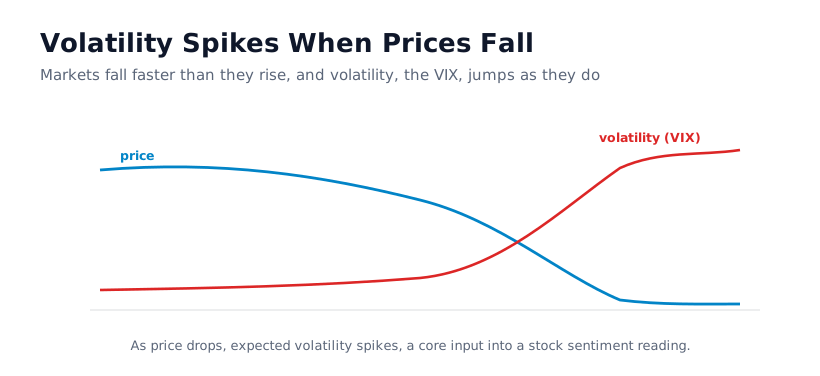
- It spikes in fear, because markets fall faster than they rise.
- It measures the size of moves, not their direction.
- It is a core input into a stock sentiment reading.
What Is Stock Market Volatility?
Volatility measures the size and speed of price moves, not their direction. A market creeping up 0.2% a day is low-volatility; one swinging 3% a day is high-volatility. It is, in effect, a measure of how anxious the market is. The same idea applies to every market, and it is amplified in thin, fast ones like crypto. See the broader concept in what volatility is. Crucially, volatility is about magnitude, not direction: a market can be highly volatile while rising or falling, though in practice the sharpest volatility is overwhelmingly associated with falling, fearful markets.
How Volatility Is Measured
There are two main flavours of volatility, and they answer different questions. "Realised" or historical volatility looks backward, measuring how much prices actually swung over a past period, usually expressed as a standard deviation of returns. "Implied" volatility looks forward: it is the amount of movement the options market is pricing in for the future, and it is captured by the famous VIX index, which tracks expected 30-day volatility in the S&P 500. The VIX is the one most people mean by "the volatility index" or "the fear gauge", because it reads the market’s anticipated nervousness in real time, rising as investors pay up for protective options when they sense trouble ahead.
Why Does Volatility Spike In Fear?
Because of an old market truth: stocks take the stairs up and the lift down. Calm uptrends build slowly over months, while panics can erase weeks of gains in days. This asymmetry, rooted in loss aversion, means that fear produces sharp, sudden moves while greed produces gentle, grinding ones. So sharp, sudden volatility almost always means fear has taken hold, which is why the VIX is called the "fear gauge" and why volatility and fear are so tightly linked. Long stretches of low volatility, by contrast, signal calm, and sometimes complacency: a market that has been placid for too long can be quietly building up fragility beneath the surface, the "calm before the storm".
Is High Volatility Good Or Bad?
Neither, in itself, and conflating volatility with danger is a common mistake. Because volatility measures the size of moves rather than their direction, it cuts both ways: the same volatile conditions that produce frightening down days also produce powerful up days, which is why some of the biggest single-day rallies in history happened amid extreme volatility. For a trader, volatility is opportunity, the bigger the swings, the more there is to capture, while for a long-term investor it is mostly noise to be ridden out, and panicking at high volatility often means selling near a low. High volatility is best read as a signal of fear and uncertainty, not as an automatic instruction to sell. It is context, and the right response is usually to manage risk, not to flee.
Volatility Is Not Direction
High volatility means big moves, not necessarily down ones. The same turbulence that brings the scariest declines also brings the sharpest rallies, so it is a signal of fear, not a sell button.
How Does CFGI Use Volatility?
Volatility, the territory of the VIX, is one of the core signals behind a sentiment reading. When swings turn sharp, that pulls a score toward fear; when the market settles, it eases toward calm. CFGI folds volatility into the Stock Fear and Greed Index alongside breadth, momentum and safe-haven demand, so the index captures what the VIX says about fear and surrounds it with the rest of the picture. This is why a volatility spike and a plunge in the Fear and Greed score so often arrive together: they are two views of the same surge of fear, the VIX measuring it through options prices and the sentiment index blending it with everything else the crowd is doing.
Frequently asked questions
What is stock market volatility?
How much and how fast share prices swing, measuring the size and speed of moves rather than their direction. A market creeping up 0.2% a day is low-volatility; one swinging 3% a day is high-volatility.
How is stock market volatility measured?
Most famously by the VIX, which tracks the volatility options traders expect in the S&P 500 over the next 30 days (implied volatility). Realised or historical volatility, the actual size of past swings, is also measured directly as a standard deviation of returns.
Is high volatility good or bad?
Neither in itself. Volatility measures the size of moves, not direction, so the same turbulence brings both the scariest declines and the sharpest rallies. It signals fear and uncertainty, which is context, not an automatic signal to sell.
Why does volatility matter for sentiment?
Because sharp swings cluster with fear, "stocks take the stairs up and the lift down". Volatility is a core input into a stock sentiment score, so rising volatility pulls the reading toward fear. This is education, not financial advice.
CFGI.io, Market sentiment research
The CFGI research team builds and maintains the CFGI Fear and Greed Index: a 0 to 100 sentiment score from 10 sub-indicators across hundreds of crypto assets and the equity market, refreshed every 15 minutes. We have tracked market emotion through multiple full crypto and equity cycles.
Think we missed something?
Spotted a gap, disagree with a take, or think we should cover a new topic? Message us and we'll act on your input.
Message us on TelegramKeep reading
This article is educational and is not financial advice. Crypto and equities are volatile and you can lose money. See our disclaimer.