Stocks
Stock Fear and Greed Index History
Quick answer
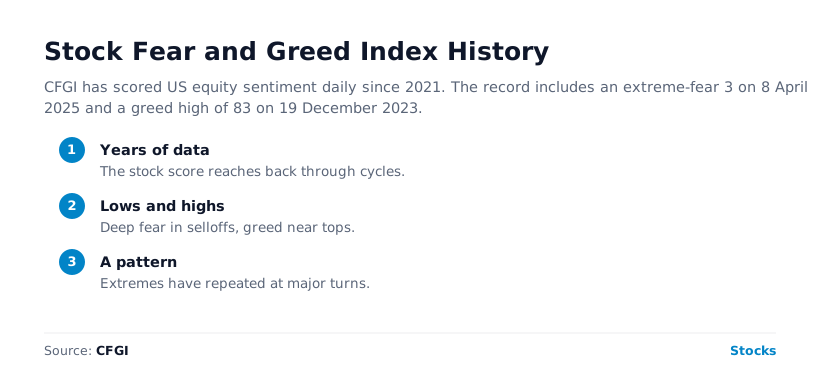
The CFGI Stock Fear and Greed Index has tracked US equity sentiment daily since 2021, distilling 10 indicators into one 0 to 100 score. Its history includes vivid extremes, an extreme-fear reading of 3 on 8 April 2025 and a greed high of 83 on 19 December 2023, and shows that equity sentiment swings in cycles, reverts from its extremes, and reaches fear faster and more often than greed. The record is what gives today’s reading meaning. This is education, not financial advice.
CFGI data
CFGI’s equity history is concrete. Since 2021 it has scored US stock sentiment daily on a 0 to 100 scale, reaching an extreme-fear 3 on 8 April 2025 and a greed high of 83 on 19 December 2023, real anchors that show how far the mood can travel.
Source: CFGI dataset, 2021 to June 2026.
Key takeaways
- CFGI has scored US equity sentiment daily since 2021.
- It reached an extreme-fear 3 on 8 April 2025.
- It reached a greed high of 83 on 19 December 2023.
- Equity sentiment swings in cycles and reverts from extremes.
- Fear arrives faster and more often than greed.
Vivid Extremes In the Record
The value of a sentiment history is the anchors it provides, real moments that show how far the mood can swing. The CFGI equity record has two striking ones: a plunge to an extreme-fear 3 on 8 April 2025, and a climb to a greed high of 83 on 19 December 2023.
| Date | CFGI stock score | Zone |
|---|---|---|
| 8 April 2025 | 3 | Extreme Fear |
| 19 December 2023 | 83 | Extreme Greed |
The extremes of the equity record.
What the History Teaches
Both extremes proved temporary, the hallmark of sentiment. A reading of 3 was not a permanent state but a moment of maximum fear that passed; a reading of 83 was froth that cooled. Seeing those anchors is what lets you judge whether today’s stock reading is mild or stretched. Without the history, a score of, say, 30 is just a number; against the record, you can see it is meaningfully fearful but nowhere near the panic of 3. History is what converts a bare reading into a judgement about how unusual the current mood really is.
This is also why the most useful way to view the index is not as a single dial but as a line over time. The dial tells you the mood right now; the chart tells you where that mood sits in the sweep of the past few years, and which direction it is travelling. A 40 that has been falling fast from 70 carries a very different message than a 40 that has been climbing out of the teens, even though the number is identical. The record turns the gauge from a snapshot into a story.
Reading the Cycles
Viewed over time, the equity score does not wander randomly; it swings in cycles that loosely track the market and economic cycle. Periods of confidence build the score up toward greed as a bull market matures, while shocks and downturns collapse it toward fear, and then, crucially, it reverts. The deep-fear lows have tended to cluster around market bottoms and stress events, while the greed highs have appeared in calmer, rising markets. This cyclical rhythm is exactly what makes the history useful: by seeing where the current reading sits within the repeating swing from fear to greed and back, you get a sense of which part of the emotional cycle the market is in, rather than reading a single day in isolation.
Fear Arrives Faster Than Greed
One pattern jumps out of the equity record: the two emotions are not symmetrical. The plunge to 3 in April 2025 happened fast, in a sharp, violent collapse, while the climb to 83 in December 2023 was reached gradually over a long, patient rise. This mirrors the broader truth that markets "take the stairs up and the elevator down": fear is sudden and sharp, greed is slow and stubborn. The data also shows the equity score spending more time in fear than in euphoria, with deep-greed readings being relatively scarce. That asymmetry is worth carrying into how you read the live gauge, a fast crash into fear is common, while a pinned greed reading is rarer and, when it appears, all the more notable.
Asymmetric by Nature
In the record, fear comes fast and often, greed builds slowly and stays scarce. A deep-fear print is a routine, fast-moving event; a high-greed one is rarer and worth heeding.
Why the History Matters
Ultimately, a single reading only means something in context, and the daily record since 2021 is that context. It is also what allows the index to be tested honestly: the same history that anchors today’s reading is what lets analysts measure how the gauge has behaved around past turning points, the basis for understanding its strengths and its limits as a contrarian tool. The live gauge below shows where equity sentiment sits today, and the value of the chart above it is that it lets you place that number where it belongs, against years of real fear and greed, rather than reacting to it in a vacuum.
Frequently asked questions
How far back does the Stock Fear and Greed Index go?
The CFGI equity record runs to 2021, scoring US stock sentiment daily on a 0 to 100 scale from 10 indicators.
What are the most extreme readings on record?
CFGI’s equity score hit an extreme-fear 3 on 8 April 2025 and a greed high of 83 on 19 December 2023. Both proved temporary and reverted toward the middle.
What does the equity history show?
That sentiment swings in cycles tied to the market cycle and reverts from extremes, and that fear arrives faster and more often than greed, with deep-greed readings relatively scarce.
Why does the history matter?
Because a single reading only means something in context. Real anchors like the 3 and the 83 let you judge whether today’s fear or greed is mild or stretched, and they let the gauge be tested honestly against past turning points. This is education, not financial advice.
CFGI.io, Market sentiment research
The CFGI research team builds and maintains the CFGI Fear and Greed Index: a 0 to 100 sentiment score from 10 sub-indicators across hundreds of crypto assets and the equity market, refreshed every 15 minutes. We have tracked market emotion through multiple full crypto and equity cycles.
Think we missed something?
Spotted a gap, disagree with a take, or think we should cover a new topic? Message us and we'll act on your input.
Message us on TelegramKeep reading
This article is educational and is not financial advice. Crypto and equities are volatile and you can lose money. See our disclaimer.