Stocks
What Is the CNN Fear and Greed Index?
Quick answer
The CNN Fear and Greed Index is a well-known gauge of US stock market sentiment, scored from 0 to 100. It combines seven indicators of stock-market behaviour into one number, from extreme fear to extreme greed. It popularised the format, though it reads the whole US market as a single figure rather than scoring stocks individually, and it covers only equities, not crypto. This is education, not financial advice.
CFGI data
CNN popularised a single market-wide gauge; CFGI scores both stocks and crypto, and scores assets individually. On 5 February 2026 that breadth showed crypto at an all-time low of 12 while the stock market sat at 35, two moods one number cannot capture. The Stock Fear and Greed Index updates daily, 0 to 100, since 2021.
Source: CFGI dataset, 2021 to June 2026.
Key takeaways
- A 0 to 100 gauge of US stock market sentiment.
- It combines seven indicators into one number.
- It popularised the Fear and Greed format.
- It reads the whole market as a single figure, equities only.
- CFGI scores both stocks and crypto, and hundreds of assets individually.
What Is the CNN Fear and Greed Index?
The CNN Fear and Greed Index is a widely followed measure of how fearful or greedy US stock investors are. Like any Fear and Greed Index, it runs from 0 (extreme fear) to 100 (extreme greed). It is the reading most people picture when they hear the phrase, and it deserves real credit for taking the abstract idea of market sentiment and turning it into a single, intuitive number that anyone could understand, which helped make sentiment a mainstream concept rather than a professional’s niche.
The Seven Indicators
The CNN index blends seven measures of stock-market behaviour, each capturing a different facet of fear or greed:
- Market momentum: the S&P 500 versus its 125-day average.
- Stock price strength: the number of stocks at 52-week highs versus lows.
- Stock price breadth: the volume in rising shares versus falling ones.
- Put/call options: the ratio of bearish puts to bullish calls.
- Market volatility: the VIX, the "fear gauge".
- Safe-haven demand: the performance of stocks versus bonds.
- Junk-bond demand: the appetite for risky versus safe corporate debt.
Each is scaled and combined into one figure for the whole US market, updated through the trading day. What these seven have in common is that they all read behaviour rather than opinion, what investors are actually doing with their money, from how they price options to whether they favour stocks or bonds, which is what makes the result a measure of revealed mood rather than survey talk.
How the CNN Index Is Used
In practice, people use the CNN index much as they would any sentiment gauge: as a quick, contrarian read on the crowd’s mood. The signal lives at the extremes. A reading deep in Extreme Fear is often taken as a sign the market is oversold and panic may be overdone, while a reading in Extreme Greed is read as a warning that euphoria has set in and caution may be warranted, the spirit of Warren Buffett’s "be fearful when others are greedy, and greedy when others are fearful". The middle of the range carries little signal and is mostly noise. Its great strength is accessibility: it is free, prominently published, and instantly understandable, which is exactly why it became the reference point most people mean when they say "the Fear and Greed Index". As with any sentiment tool, the important caveat is that it reads the present rather than predicting the future: a high reading does not mean the market will fall tomorrow, only that conditions have become stretched, and the crowd can stay greedy, or fearful, for longer than seems reasonable.
How Does a Per-Asset Approach Differ?
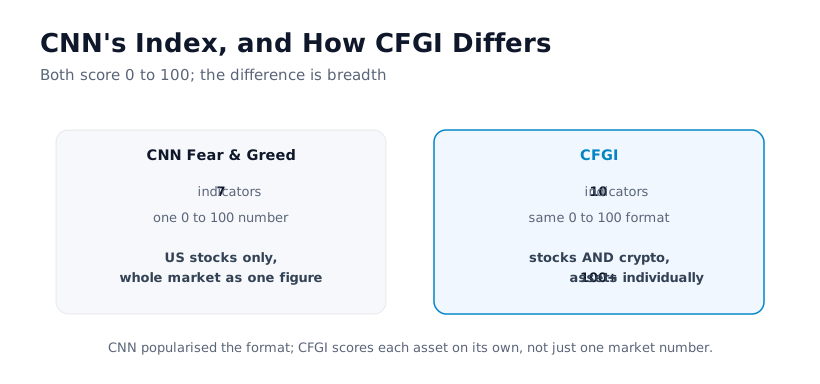
CNN’s index reads the US stock market as one figure. CFGI takes a wider view in two ways: it scores both stocks and crypto on the same scale, and it scores assets individually rather than as a single average. That breadth matters. Reading the whole market as one number, as CNN does, hides the divergences that are often the most useful information, one market can be fearful while another is calm, and within crypto one coin can be euphoric while another panics. On 5 February 2026, for instance, crypto hit an all-time low of 12 while the stock market sat at 35, two very different moods that a single equity gauge cannot show. CFGI also reads 10 indicators rather than 7, but the bigger difference is coverage: stocks and crypto, and hundreds of individual assets, through one comparable lens. Neither approach is "wrong", they answer different questions. CNN’s single number is a clean, headline read on the US stock market’s overall mood, ideal for a quick check. A per-asset, cross-market index is built for those who want to compare crowds, spot rotations between markets, and read the sentiment of a specific coin or stock rather than just the average, which is the level of detail an investor active across both equities and crypto increasingly needs.
Frequently asked questions
What is the CNN Fear and Greed Index?
A widely followed gauge of US stock market sentiment, scored from 0 (extreme fear) to 100 (extreme greed) from seven indicators. It popularised the format and is the reading most people picture when they hear "the Fear and Greed Index".
What indicators does the CNN Fear and Greed Index use?
Seven: market momentum, stock price strength, stock price breadth, the put/call options ratio, market volatility (the VIX), safe-haven demand (stocks versus bonds) and junk-bond demand, combined into one 0 to 100 score.
Is the CNN index only for stocks?
Yes, it tracks US stock market sentiment as a single figure. CFGI publishes separate Fear and Greed readings for both stocks and crypto, and scores hundreds of assets individually.
What is the difference between CNN’s index and CFGI?
CNN scores the whole US stock market as one number from 7 indicators. CFGI scores both stocks and crypto from 10 indicators, and scores assets individually, so it can show different markets, and different assets, in different moods at once. This is education, not financial advice.
CFGI.io, Market sentiment research
The CFGI research team builds and maintains the CFGI Fear and Greed Index: a 0 to 100 sentiment score from 10 sub-indicators across hundreds of crypto assets and the equity market, refreshed every 15 minutes. We have tracked market emotion through multiple full crypto and equity cycles.
Think we missed something?
Spotted a gap, disagree with a take, or think we should cover a new topic? Message us and we'll act on your input.
Message us on TelegramKeep reading
This article is educational and is not financial advice. Crypto and equities are volatile and you can lose money. See our disclaimer.