Stocks
What Is the Russell 2000?
Quick answer
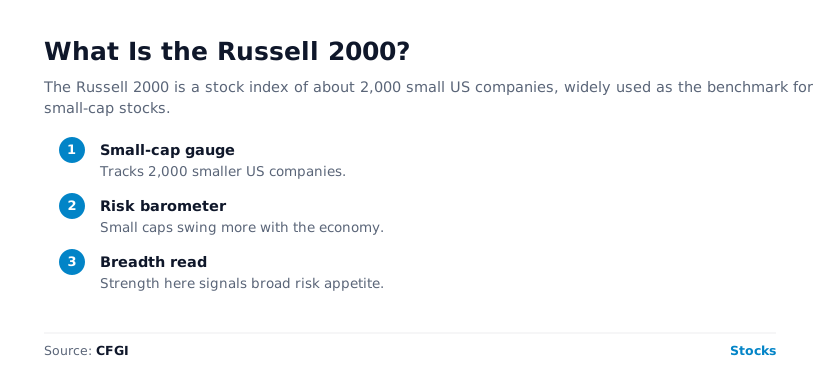
The Russell 2000 is a stock market index that tracks roughly 2,000 small US companies, making it the most-watched benchmark for small-cap stocks. Where the S&P 500 measures the largest companies, the Russell 2000 measures much smaller, more domestically focused ones, which tend to be more sensitive to the economy and to borrowing costs. Because of that, it is often read as a gauge of how much risk investors are willing to take on riskier, home-grown growth.
CFGI data
Small caps are a risk-appetite gauge, and so is CFGI. When the Russell 2000 leads the larger indices, risk-on confidence is building, the mood the Stock Fear and Greed Index reads as greed on its 0 to 100 scale; when small caps lag badly, caution is setting in. The two readings tend to rhyme.
Source: CFGI methodology, 10-input 0 to 100 model.
Key takeaways
- The Russell 2000 tracks about 2,000 small US companies, the smallest of the Russell 3000.
- It is the main benchmark for small-cap stocks, launched in 1984.
- Small caps are more volatile, more domestic and more sensitive to interest rates.
- Index membership is reset at reconstitution, now twice a year from 2026.
- Its relative strength is widely read as a measure of risk appetite.
The Small-Cap Benchmark
A market index measures a defined slice of the market. The S&P 500 covers the giants; the Russell 2000, launched by the Frank Russell Company in 1984, covers the small companies, around 2,000 of them. Because these firms are smaller, younger and more domestically focused, the index behaves very differently from the big-cap benchmarks, and that difference is exactly what makes it useful.
How the Index Is Built and Rebalanced
The Russell 2000 is not a hand-picked list. It is defined mechanically as the smallest 2,000 companies within the Russell 3000, which itself holds the 3,000 largest US stocks. So the Russell 2000 is, in effect, "the US market minus the 1,000 biggest companies", a clean snapshot of the small-cap universe.
Membership is refreshed at an event called reconstitution, when stocks that have grown are promoted out and shrinking ones move in. Historically this happened once a year in June, in one of the highest-volume trading days of the calendar as funds adjust to match the new list. From 2026, reconstitution moves to a semi-annual schedule, in June and December, so the index keeps closer pace with a fast-changing small-cap market.
Why Small Caps Behave Differently
| Russell 2000 | S&P 500 | |
|---|---|---|
| Company size | Small-cap | Large-cap |
| Number of stocks | About 2,000 | 500 |
| Volatility | Higher | Lower |
| Revenue focus | Mostly domestic | Often global |
| Rate sensitivity | High | Moderate |
Russell 2000 versus S&P 500.
Smaller companies have less of a cushion. Their earnings are less predictable, they lean more on borrowing, so they feel rising interest rates faster, and their revenue tends to come from the home economy rather than the world. That makes the Russell 2000 a purer read on US economic conditions, but also a bumpier ride: it swings harder than the S&P 500 in both directions, with more volatility as the price of its higher growth potential.
A Read On Risk Appetite
This sensitivity is why traders watch the Russell 2000 less for what it owns and more for what it signals. When investors are confident, they reach for riskier, higher-growth small caps, and the Russell tends to lead. When they turn cautious, money retreats to the safety of large, global, profitable names and small caps lag. Comparing the Russell 2000 against the S&P 500, the small-cap-versus-large-cap ratio, is a classic shorthand for whether the market is in a "risk-on" or "risk-off" mood, and how much faith it has in the domestic economy.
How to Track Or Invest In It
Most people get exposure through a fund rather than buying 2,000 stocks. The iShares Russell 2000 ETF, ticker IWM, is the largest, with tens of billions of dollars in assets, and there are index funds tracking the same benchmark. Worth knowing: small caps are sometimes argued to carry a long-run "small-cap premium" for their extra risk, but in recent years a handful of giant technology companies have driven large-cap indices, leaving small caps trailing, a reminder that the premium is a long-run tendency, not a promise.
Small caps also carry their own market folklore, like the "January effect", the long-observed tendency for smaller stocks to outperform early in the year as tax-driven selling unwinds. Such patterns are well known, inconsistent and easily over-traded, so they are better treated as colour than as a strategy. The durable case for the Russell 2000 is exposure to home-grown growth and a clean read on risk appetite, not a calendar trick.
The Russell 2000 and Sentiment
Because small caps rise and fall with risk appetite, the Russell 2000 is itself a kind of sentiment indicator, and it pairs naturally with one. The Stock Fear and Greed Index reads the market’s mood directly on a 0 to 100 scale; the Russell 2000’s relative strength reads the same mood through price. When both point the same way, strong small caps and a greedy reading, the risk-on signal is clearer; when they diverge, it is a prompt to look closer at where the investor sentiment really sits.
Frequently asked questions
What is the Russell 2000?
A stock index tracking roughly 2,000 small US companies, the most-watched benchmark for small-cap stocks. It is defined as the smallest 2,000 companies in the Russell 3000.
How is the Russell 2000 different from the S&P 500?
The S&P 500 tracks 500 of the largest, often global companies; the Russell 2000 tracks about 2,000 small, mostly domestic ones. Small caps are more volatile and more sensitive to the economy and interest rates.
What is Russell reconstitution?
The periodic reset of index membership, when companies that have grown are promoted out and smaller ones move in. It happened annually each June, and from 2026 occurs semi-annually in June and December.
Why does the Russell 2000 matter for sentiment?
Because small caps are bought most when investors are confident, the index leads in risk-on markets and lags in risk-off ones, making it a widely used gauge of risk appetite. This is education, not financial advice.
CFGI.io, Market sentiment research
The CFGI research team builds and maintains the CFGI Fear and Greed Index: a 0 to 100 sentiment score from 10 sub-indicators across hundreds of crypto assets and the equity market, refreshed every 15 minutes. We have tracked market emotion through multiple full crypto and equity cycles.
Think we missed something?
Spotted a gap, disagree with a take, or think we should cover a new topic? Message us and we'll act on your input.
Message us on TelegramKeep reading
This article is educational and is not financial advice. Crypto and equities are volatile and you can lose money. See our disclaimer.